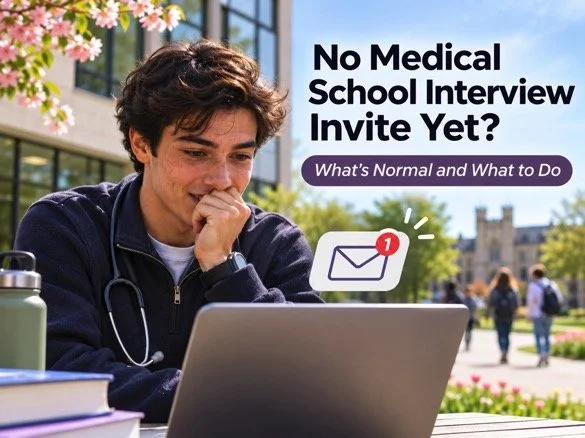
It's mid-November. Someone in your year has posted about an interview invite, your group chat won't stop buzzing, and you've checked your inbox (and your junk folder, twice) more often than you'd like to admit. 😅
Here's the reassuring bit. For most medical schools, having no interview invite yet is completely normal. Interviews for 2027 entry at medical schools across the United Kingdom (UK) run from December to March, and a few carry on into April.
This guide covers what the schools themselves say about timings, how to tell ordinary silence from a real problem, and how to use the wait well. 💙
💙 No interview invite yet? The short answer
You're very probably fine. Three reasons:
- 🔵 Schools only started ranking after the deadline. The Universities and Colleges Admissions Service (UCAS) deadline for medicine was 15 October 2026. Most schools then score every eligible applicant before anyone is invited.
- 🔵 The season is long. The University of Manchester usually interviews from December to early March. University College London (UCL) runs from December to March. Keele University's window stretches from December 2026 to April 2027.
- 🔵 Every school works to its own timetable. UCAS says universities make decisions at different times, so you might hear before your friends or after them.
Why does it take so long?
Schools don't read applications in the order they arrive. Most rank everyone using a mix of the University Clinical Aptitude Test (UCAT), grades and sometimes other factors, then invite the top group. The University of Leeds uses a points system that counts your best General Certificate of Secondary Education (GCSE) results, predicted grades and UCAT score, and it says there's no fixed UCAT cut-off. The University of Liverpool says its threshold changes every year, depending on how many applications it receives and how strong they are.
That's why nobody, including us, can tell you in advance where the line will fall. It also explains why admissions teams need months to finish. Liverpool's own timetable lists application review running from 15 October to 31 March.
📅 When do medical schools send interview invites? Dates for 2027 entry
Here's what a selection of medical schools say on their own admissions pages for 2027 entry. Dates can change, so check your own schools' pages before you plan anything.
- 🟢 University of Sheffield: invitations go out by email in November, all on the same day, and slots are first come, first served. Interviews run from 8 January to 4 February. Applicants who aren't invited hear through UCAS in December.
- 🟢 University of Leeds: face-to-face Multiple Mini Interviews (MMIs) take place on 4, 5 and 6 January 2027.
- 🟢 University of Liverpool: on-campus interviews run from 25 January to 10 February, with online interviews on 11 and 12 February. The school doesn't offer interviews after 5 March.
- 🟢 University of Manchester: details are emailed to the address on your UCAS application, and spaces are first come, first served.
- 🟢 UCL: invitations are sent on a rolling basis by email, normally with at least a week's notice. You must acknowledge within five calendar days, and the school asks you to check your junk folder and the UCL Applicant Portal.
- 🟢 Newcastle University: interviews generally run from December to February. Applicants who meet the points threshold are sent an email invitation.
- 🟢 Lancaster University: interviews usually run in January and February, and the school aims to give at least two weeks' notice. Applicants who meet the minimum entry requirements but aren't called for interview may hear at any point between January and the end of March.
- 🟢 Keele University: shortlisting uses a score built from your UCAT and personal statement, and the school says it can't state the threshold in advance.
Don't see your schools? The Medical Schools Council keeps a free entry requirements tool covering every medical school in the UK, and each school's own admissions page will have the latest dates.
Your Next Step: Medical School Interviews
Your application is in. Are you interview ready?
Getting an interview is an achievement. Turning it into an offer takes preparation. Whether you've received an invitation or are still waiting, now is the time to build your confidence.
Prepare with experienced NHS doctors on our Medical School Interview Course, then test your skills with realistic practice and written feedback at our 40-station Mock MMI Circuits.
🚦 Normal, worth a check, or time to act?
Use this traffic-light test.
🟢 Completely normal
- It's mid-November and you haven't heard from any school.
- A friend has an invite and you don't. They may have applied to different schools, and many schools send invitations in rounds.
- Your schools haven't published exact dates. Several only share a window.
- Your application still shows as waiting for a decision. UCAS says decisions arrive at different times, so don't worry if you hear nothing for a while.
🟡 Worth checking today
- Search your junk and spam folders for each school's name.
- Check the email address on your UCAS application is spelt correctly. Manchester, for example, writes to that address.
- Look at each school's applicant portal if it has one. UCAS says not every school sends invitations through UCAS, so find out how each of yours will contact you.
- Read each school's admissions page for its invitation dates.
🔴 Time to act
- A school said it would contact you by a set date, that date has passed, and there's nothing in your inbox, junk folder or portal. Send one polite email to the admissions team with your full name and UCAS details.
- An invitation has arrived and you haven't booked yet. Reply straight away. Sheffield says booked slots can't be changed, and Liverpool only offers a second chance in exceptional circumstances.
🧭 What to do while you wait
1. Build a calm inbox routine 📬
Check your email and any applicant portals once or twice a day, at set times. Refreshing every ten minutes won't make an invite arrive sooner, and it makes the wait feel twice as long.
2. Keep January and February flexible 🗓️
Interview dates cluster in the new year: Leeds on 4 to 6 January, Sheffield from 8 January, Liverpool from 25 January. Notice can be as short as a week, and good slots go quickly where booking is first come, first served. Warn your family, your sixth form and any employer that you may need to move things around, and avoid booking anything you can't change.
3. Start preparing now 🎯
A week's notice goes fast. Reread your personal statement, because interviewers can ask about anything in it. Then work through these three things:
- The Medical Schools Council's free Interview Prep website takes about 30 minutes and covers the interview types and dealing with nerves.
- The Medical Schools Council's statement on core values and attributes shows what every medical school is looking for. Use it to find real examples from your own life.
- Try a mock MMI station out loud with a friend or teacher, and time yourself.
4. Keep your grades on track 📚
An interview invite isn't an offer, and an offer won't become a place unless you get the results it asks for. UCAS describes conditional offers as based on exam results, so keep your revision steady while you wait.
5. Look after yourself 💚
The National Health Service (NHS) advice for stressed students is refreshingly simple: eat well, sleep enough, stay active and make time to relax. It also suggests you try not to worry about the future or compare yourself with others. If a group chat is winding you up, mute it for a day. If worry is taking over, the NHS Every Mind Matters Mind Plan is free and starts with five quick questions, and talking to someone you trust helps too.
🌱 If the answer is no
Nobody wants to read this section, but you'll feel steadier knowing the options exist.
What "not invited" does and doesn't mean
More people want medicine than there are interview places. UCAS counted 25,840 applicants to medicine by this year's 15 October deadline, and Sheffield, for example, expects to invite around 1,100 home applicants to its standard course. Schools have to draw a line somewhere, and it moves every year. Falling below it says something about this year's ranking. It says nothing about whether you'd make a good doctor.
Your options
Ask for feedback
Lancaster gives feedback to unsuccessful applicants through UCAS at the same time as its decision, and Liverpool posts limited feedback there too. Newcastle gives feedback on request once the admissions cycle has finished. It's thinner if you weren't shortlisted, but it can still show whether your admissions test score or something else made the difference.
Use UCAS Extra
If you used all five UCAS choices and you're not holding any offers, Extra opens on 25 February 2027 and runs until 1 July. It lets you add one more choice at a time. Contact the school first to check it will consider you.
Think about reapplying
Plenty of applicants try again. UCAS reported 4,420 reapplicants to medicine in this year's October figures, up from 3,380 last year. Another year can give you time to retake the UCAT, build your experience and choose your four schools more carefully.
Look at other routes
Medicine isn't the only way into healthcare. Studying Healthcare, run jointly by the Medical, Dental and Pharmacy Schools Councils, explains how to apply for medicine, dentistry and pharmacy. Our own guides on choosing a fifth UCAS choice and studying medicine in Europe are worth a read too.
❓ Quick answers
Do all medical schools email interview invitations?
Not all use UCAS. UCAS says not every course provider sends interview invitations through its system, so check how each of your schools will contact you. Manchester, Sheffield, UCL and Newcastle all use email, and UCL also uses an applicant portal.
Does a later invitation mean I'm less likely to get an offer?
Nothing on the schools' pages suggests it does. Lancaster, for example, doesn't tell anyone the outcome until every interview has finished, so an early or late slot doesn't change when decisions arrive. Where booking is first come, first served, move quickly mainly so you get a date that suits you.
When will I know if I'm not getting an interview?
It varies. Sheffield tells applicants who aren't invited through UCAS in December. Lancaster may tell some applicants at any point from January to the end of March, and Liverpool's application review runs to 31 March. Silence in November tells you very little.
Should I email the admissions team?
Only if a school's published invitation date has passed and you've checked your junk folder and portal. Admissions teams are handling thousands of applications, so send one clear, polite email rather than several.
🚀 Make the wait count
Waiting is easier when you know what you'll do with an invitation. At Blue Peanut Medical, we work with applicants at exactly this stage every year. Our Medical School Interview Course is taught in small groups by Dr Mannan, an NHS general practitioner (GP) and placement supervisor for the University of Manchester and University of Lancashire medical schools. Our mock MMI circuits are supervised by Dr Khan, a Member and Fellow of the Royal College of General Practitioners (MRCGP, FRCGP).
Want more to read while you wait? Try our guide to Medical School Interview Questions 2027 or Wellbeing and Resilience at Your Medical School Interview.
You've done the hard part by getting your application in. Now keep your phone charged and your January diary flexible. 📱
This guide is based on information from medical school and UCAS websites at the time of writing (15 November 2026). Dates and policies can change, so always check directly with each school. If you spot an error, let us know and we will correct it.
🔗 Useful links
Medical Schools Council
- Interviews: types of interview and how to prepare
- Interview Prep website (free, about 30 minutes)
- How to run a mock MMI
- Guidance for candidates on online interviews
- Statement on the core values and attributes needed to study medicine
- Resources for applicants, including the entry requirements tool
- Studying Healthcare
UCAS
- Dates and deadlines for 2027 entry
- Tracking your application
- Types of offers and when you'll hear back
- Extra choices
- Application figures from the 15 October deadline
Medical schools (2027 entry)
- University of Sheffield
- University of Leeds
- University of Liverpool
- University of Manchester
- University College London
- Newcastle University admissions policy
- Lancaster Medical School admissions policy
- Keele University
NHS
Blue Peanut Medical School Interview Preparation
Your application is in. Now prepare to secure your offer.
Interview invitations are arriving. Don't wait until yours arrives to start preparing. Learn from Dr Abdul Mannan and Dr Imran Khan , NHS doctors, former admissions assessors and current placement supervisors at two UK medical schools.
Build confidence with our Medical School Interview Course and gain realistic practice with written feedback at our 40-station Mock MMI Circuits.