Should You Still Apply to Medicine in 2026? The Honest Answer
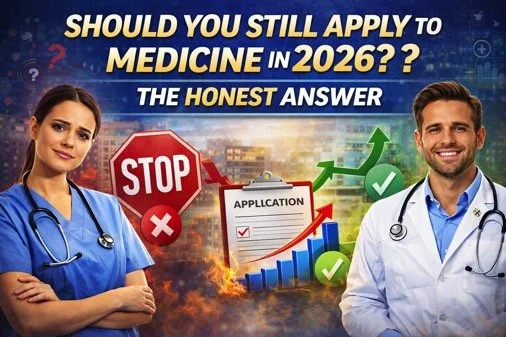
💙 First things first — if you're here, you're already asking the right questions.
Whether you've wanted to be a doctor since you were seven or the idea has only recently started to feel real, it takes courage to take that first proper look at what applying to medicine actually involves. So well done for doing exactly that.
But we get it — it can feel overwhelming. You've probably heard things like "It's impossible to get in," "Doctors are all burnt out," or "The NHS is a mess." And somewhere between your biology textbook and your personal statement draft, the dream can start to feel a bit wobbly.
So here's what this article is going to do: give you a genuinely honest, balanced picture of what applying to UK medical school looks like in 2026 — the good, the tricky, and the things nobody tells you. No sugarcoating, but no doom and gloom either.
By the end, you'll have everything you need to make the right decision for you. Let's get into it. 🩺
🔢 Let's Talk Numbers — How Competitive Is It Really?
We know stats can feel scary, but understanding them is actually one of the most empowering things you can do. So here they are, with some important context alongside them.
A Record Surge in Applications
A total of 25,770 students applied to study Medicine for 2026 entry by the October 2025 UCAS deadline — a rise of over 10% on the previous year. That's a huge number, and it shows that the passion for medicine is very much alive among students your age.
At the same time, the number of available places has grown to around 8,126 funded places in England — roughly a 4% increase on the year before. So yes, competition is real. But here's what those headline numbers don't tell you:
Not all 25,770 applicants are equally prepared. Many haven't done meaningful work experience. Many haven't started UCAT prep early enough. Many will submit a personal statement that doesn't truly reflect their motivations. The students who get in are the ones who show up prepared — and that can absolutely be you.
Competition Is High — But It Is Not Random
Getting an offer from a UK medical school isn't luck. The students who succeed every year are those who plan strategically, reflect deeply on their experiences, and prepare thoroughly for every stage of the process.
Think about it this way: if you're reading an article like this in Year 12 or early Year 13, you're already ahead of a huge number of applicants. That matters more than you might think.
✅ The Case FOR Applying to Medicine in 2026
Here are some genuinely encouraging reasons why right now is a great time to be pursuing medicine — and why your timing could actually work in your favour.
1. The NHS Really Does Need You
This isn't just something careers advisers say to fill prospectus brochures. The UK has just 3.2 doctors per 1,000 people — one of the lowest ratios in Europe, where the average is 4.2. There are currently over 112,000 vacancies across the NHS workforce, and with an ageing population, that demand isn't going anywhere.
The government's NHS Long Term Workforce Plan has committed to doubling the number of medical school places — from around 7,500 to 15,000 per year — by 2031/32. The direction of travel is clear: the UK needs more home-trained doctors, and the system is being built around that.
By the time you qualify — roughly 2031 at the earliest — the NHS will genuinely be waiting for you. That's a pretty powerful thing to hold onto when revision feels relentless. 💚
2. There Are More Routes In Than Ever Before
The doors to medicine are being actively widened. An additional 350 places were created for the 2025/26 academic year alone, and new pathways, such as the Medical Doctor Degree Apprenticeship, are in development — designed to open up medicine to students who might not follow the traditional A-level route.
If you're from a disadvantaged background or a community historically underrepresented in medicine, many schools are now actively seeking students like you. Contextual admissions, widening access schemes, and foundation year programmes exist specifically to help. This is a better time than ever to see yourself in medicine — because medical schools increasingly want to see you there too.
3. The Career Security Is Real
Life is unpredictable. But one thing that isn't? The need for doctors. No matter what shifts happen in technology, AI, or healthcare policy, human clinical judgment and patient relationships will always require a real, trained doctor. Medicine is one of the most secure career paths you can choose.
Yes, the road is long. But at the end of it, you have a career that's intellectually stretching, deeply purposeful, and almost certainly available. For the right person, that trade-off is genuinely worth it.
4. A Medical Degree Opens Far More Doors Than You Think
Here's something that surprises many students: medicine doesn't just lead to becoming a doctor. Graduates go on to work in clinical research, global health, pharmaceutical companies, medical education, healthcare policy, and far beyond. The skills you build — critical thinking, managing uncertainty, communicating clearly under pressure — are valuable in almost any professional field.
So even if your path evolves over time, the foundation that a medical degree provides is extraordinary.
5. The Sense of Purpose Is Like Nothing Else
Yes, it's a big deal to say this — but it's true, and it matters. Doctors consistently describe their work as deeply meaningful, even on the hardest days. Being trusted with someone's health and wellbeing, being present at some of the most important moments of a person's life — very few careers offer that.
If you're drawn to medicine because you genuinely care about people, that pull is your greatest asset. Hold onto it. 🌿
⚠️ The Honest Stuff — Things Worth Knowing Before You Commit
We'd be doing you a disservice if we only told you the good bits. Here are some real challenges to be aware of — not to put you off, but so you can go into this with your eyes open and your expectations in the right place.
1. The Road Doesn't End at Graduation
One thing many applicants don't realise until they're already in medical school: getting your degree is not the finish line. After graduating, you'll complete Foundation Training (two years), and then apply for Speciality Training to become a qualified specialist, which can take anywhere from three to ten more years, depending on the speciality.
And here's the thing — competition doesn't stop at the medical school gate. In 2025, there were over 8,800 applications for just 1,678 Internal Medicine Training posts — a ratio of more than 5:1.
The good news: the Medical Training (Prioritisation) Bill is working its way through Parliament and aims to give UK-trained graduates priority access to NHS training posts. From 2026 onwards, this should make a real difference to domestic graduates — so the picture is improving.
2. The NHS Is Under Pressure — and Doctors Feel It
It wouldn't be honest to pretend the NHS is a stress-free environment right now. Long hours, high patient demand, and stretched resources mean burnout is a genuine issue. A GMC survey found that 21% of doctors were at risk of burnout, with many regularly working beyond their contracted hours.
But here's some perspective: plenty of doctors still love their jobs, find deep meaning in their work, and would make the same choice again. The key is going in with realistic expectations. Don't base your vision of medicine solely on the brochure — talk to actual junior doctors, read their blogs, follow them on social media. The honest, unfiltered version of the job is far more useful to you than the polished one.
3. It's a Long Commitment — and That's Worth Sitting With
A UK undergraduate medical degree is five or six years. Add Foundation Training and speciality training, and you may not be a fully independent consultant until your early to mid-thirties. That's a significant chunk of your life.
This doesn't mean it's the wrong choice — for many people, it's absolutely the right one. But it does mean your motivation needs to be solid enough to carry you through the hard stretches: the brutal exam seasons, the difficult clinical placements, the moments when you wonder what on earth you're doing. Take some time to honestly ask yourself whether your reasons for wanting medicine are strong enough for that.
4. The Application Is Genuinely Demanding
To give yourself a real shot at getting in, you'll need: strong A-levels (typically AAA or AAA* in science subjects), a competitive UCAT score, meaningful healthcare work experience, a compelling personal statement, and strong performance at interview. That's a lot to juggle — especially when you're also trying to survive Year 13.
💡 The good news? Every single one of these elements is something you can prepare for. None of it is out of reach if you plan ahead and start early.
🏗️ What's the Government Actually Doing About This?
It's worth knowing that the challenges we've just described aren't being ignored — quite the opposite.
The NHS Long Term Workforce Plan (updated via the government's 10 Year Health Plan for England) sets out a clear commitment to expand medical education and reduce reliance on international recruitment. The aim is to bring international recruitment down to below 10% of new doctors by 2035, meaning UK-trained graduates like you will be increasingly prioritised for posts.
The Medical Training (Prioritisation) Bill — currently progressing through Parliament — is designed to tackle the specialty training bottleneck directly, giving home-grown graduates first access to NHS training places.
🏛️ None of this flips a switch overnight, and there will still be challenges along the way. But if you're applying in 2026 and qualifying around 2031, the system is being actively reformed in your favour. That's a genuinely positive picture for students who are planning now.
🧠 Some Questions Worth Asking Yourself First
Before you dive into the application, it's worth taking a moment to reflect honestly. Not because you need to justify yourself to anyone, but because knowing your why will make every part of the process easier, from your personal statement to your MMI interviews.
Here are some questions to sit with:
Why do you want to do medicine — really?
The more specific you can be, the better. "I want to help people" is a starting point, not an answer. What is it about the clinical side of medicine that draws you? Has something you've seen, experienced, or read confirmed that this is the path for you?
Have you spent time in a healthcare setting?
You don't need to have spent a summer in an operating theatre. Volunteering at a care home, working in a pharmacy, or sitting in on a GP consultation all count. What matters is that you've seen healthcare in action — and reflected on what you noticed.
How do you handle pressure and setbacks?
Medicine will challenge you. Not just academically, but emotionally and personally. Think about times in your life where things have been hard and you've found a way through. Those stories matter to admissions tutors — and to you.
Are you genuinely ready for the length of the journey?
This isn't meant to intimidate you — it's meant to help you feel prepared. Students who go in knowing what to expect tend to cope far better than those who are surprised.
If your answers feel solid and honest, that's a really good sign. And if some of them feel uncertain? That's fine too — you've got time to build that foundation before you apply. 🌱
📋 How to Build a Brilliant Application
If you've decided medicine is the path for you, here's where to put your energy. Each of these areas is something you can genuinely get better at — and the earlier you start, the more in control you'll feel.
🏫 Choose Your Medical Schools Thoughtfully
This is more important than most students realise. Medical schools differ quite a bit in how they teach, who they're looking for, and how they select students. Some are research-heavy, others are more community-focused. Some teach through Problem-Based Learning (PBL); others use a more traditional lecture format. Look at UCAT cut-off scores, interview formats (MMI vs traditional panel), and whether each school feels like a place where you would genuinely thrive — not just where the name sounds impressive.
📝 Give the UCAT the Time It Deserves
The UCAT is one of the most significant parts of your application, and it's also one of the most misunderstood. Many students underestimate how much preparation it needs, and how different it is from A-level-style revision. Start practising several months before your test date, work through timed mock tests, and get familiar with which sections each of your chosen schools weights most heavily. A strong UCAT score can genuinely open doors — even if other parts of your application are borderline.
🏥 Make Your Work Experience Meaningful
Here's a shift in thinking that could transform your personal statement: quality always beats quantity. One placement where you paid close attention, asked good questions, and genuinely reflected on what you observed is worth far more than a long list of tick-box experiences. When you're in a healthcare setting, notice what's happening around you. Think about the challenges, the communication, the difficult moments. Those observations are what admissions tutors actually want to hear about.
✍️ Start Your Personal Statement Early — Seriously
Aim to have a solid first draft ready by mid-August. That gives you time to refine, get feedback from teachers or mentors, and avoid the last-minute panic that leads to rushed, generic statements. Every sentence should earn its place — either showing genuine insight into medicine, demonstrating your self-awareness, or grounding your motivations in real experience. If a sentence doesn't do any of those things, cut it.
🎤 Prepare Properly for the MMI
The Multiple Mini Interview (MMI) catches many brilliant applicants off guard simply because they don't know what it is. It's used by most UK medical schools, and it's nothing like a traditional interview. It doesn't test your medical knowledge — it tests how you think, communicate, reason through ethical dilemmas, and work with others. The good news is that it's very practical. Get a friend or mentor to run mock stations with you, talk out loud, time yourself, and get comfortable with the format. The more you practise, the more natural it feels on the day.
🎯 So — Should You Apply to Medicine in 2026?
Here's our genuine, honest answer:
✅ Yes — go for it, if…
…you've reflected on your motivations and they feel real and solid. If you've had some exposure to healthcare and it confirmed rather than shook your interest. If you understand the road ahead and you're ready to walk it with commitment and curiosity. The NHS needs people like you. The career is demanding, but it's also deeply meaningful in a way that very few other paths can match.
⚠️ Take a step back if…
…your reasons for choosing medicine are mainly about status, earning potential, or because it's the expected choice for high achievers. Medicine will ask a huge amount of you — and that level of commitment needs to come from somewhere real. There's no shame in realising another path fits you better. That's self-awareness, and it's a strength.
⏳ Consider waiting a year if…
…you feel underprepared, haven't yet had meaningful healthcare exposure, or your application just isn't where it needs to be yet. A well-spent gap year — building experience, strengthening your UCAT prep, and adding depth to your personal statement — is never a wasted year. Plenty of students get into medicine on their second attempt and are better doctors for having taken the time.
Whatever you decide, don't let fear of failure be the thing that stops you. The students who get in aren't necessarily the most naturally gifted — they're the ones who showed up, prepared genuinely, and backed themselves.
If medicine is your calling, then it's worth every bit of effort it takes to get there. 🌟
💡 Quick Summary
In 2026, roughly 25,770 applicants are competing for around 8,126 funded places — but preparation and strategy make a huge difference
The NHS Long Term Workforce Plan aims to double medical school places to 15,000 by 2031 — the system is expanding to meet demand
Competition for speciality training posts is real, but new government legislation is being introduced to prioritise UK graduates
A strong application needs: solid A-levels, a well-prepared UCAT score, genuine work experience, a thoughtful personal statement, and MMI practice
The career is long, demanding, and for the right person — completely worth it