
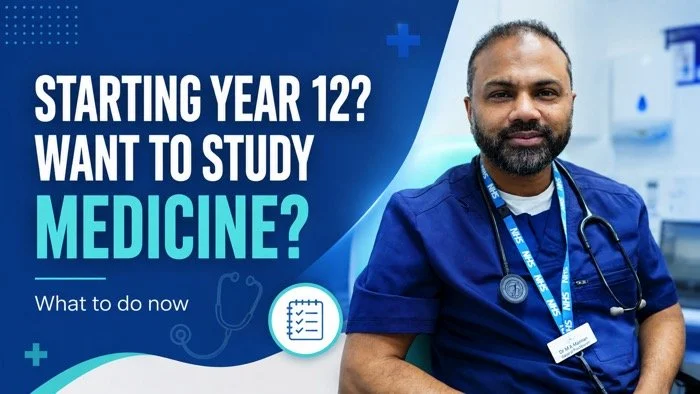
Starting Year 12 is exciting. It can also be slightly alarming when you want to study medicine.
Suddenly, people are talking about predicted grades, hospital work experience, the UCAT, personal statements and medical school interviews. Someone in your chemistry class may already claim to have completed three placements, read every book written by a surgeon and decided which medical speciality they want to enter.
Do not panic.
A strong medical school application is not built by collecting as many impressive-sounding activities as possible. It is built through good academic habits, sensible university research, meaningful experience with people, honest reflection and careful preparation at the right time.
Students beginning Year 12 in September 2026 will normally apply to medical school in autumn 2027 for 2028 entry. The medical application deadline is usually 15 October, although your sixth form may set an earlier internal deadline.
That gives you time — but Year 12 passes surprisingly quickly.
🟦 Your main priorities during Year 12 are to:
- Build the grades you will need
- Check that your subjects meet medical school requirements
- Understand how different universities select applicants
- Gain regular experience of working with people
- Keep a record of what you learn
- Prepare properly for the UCAT
- Attend open days and widening participation events
- Choose medical schools that suit your academic profile
- Develop the communication and reflection skills needed at interview
Here is how to approach each stage.
Your Year 12 medicine application timeline
You do not need to do everything in your first week of sixth form. The aim is to build your application gradually without allowing medicine preparation to damage your A-level grades.
September to December: establish the foundations
Your first term should be about settling into sixth form and understanding the size of the jump from GCSE to A level.
During this period:
- Check the subject requirements of a range of medical schools
- Review how your GCSE results might be used
- Establish a weekly study routine
- Look for a manageable volunteering role or part-time job
- Start recording useful experiences and reflections
- Explore medicine through official university events and reliable healthcare sources
- Speak to your sixth-form medicine adviser, if you have one
You do not need to begin intensive UCAT preparation at this stage.
January to April: start building evidence
By the spring term, you should have a better idea of your academic strengths.
This is a good time to:
- Research medical schools in more detail
- Apply for Year 12 summer schools and outreach programmes
- Attend online medical school events
- Arrange work experience where possible
- Continue a regular caring, service or volunteering role
- Build an evidence bank for your future UCAS application
- Learn what the UCAT involves without starting months of repetitive practice
May to June: plan your UCAT summer
As Year 12 exams approach, your schoolwork should remain the priority. These assessments may influence your predicted grades, so do not neglect them because you are worried about the UCAT.
During this period:
- Check the official UCAT registration and testing dates for your application cycle
- Apply for a UCAT bursary or access arrangements if eligible
- Decide when you are likely to sit the test
- Create a realistic preparation timetable
- Complete initial untimed practice to understand the question formats
- Continue researching universities, but do not finalise your four choices yet
July to September: sit the UCAT and choose strategically
The summer after Year 12 is normally the main UCAT preparation period.
Once you have your result, you can compare your score, GCSE profile, predicted grades and circumstances against the selection methods used by different medical schools.
This is when your university shortlist should become much more focused.
September to October of Year 13: complete the application
At the beginning of Year 13, you will need to:
- Finalise your four medical school choices
- Decide whether to use your fifth UCAS choice
- Complete the three UCAS personal statement questions
- Check every application detail carefully
- Submit before your school’s internal deadline
- Begin focused medical school interview preparation
1. Protect your A-level grades
It is easy to become distracted by everything surrounding a medicine application. However, none of it compensates for failing to meet a university’s academic requirements.
Your first responsibility in Year 12 is to become a strong A-level student.
That means:
- Reviewing work every week rather than waiting for assessments
- Asking for help as soon as you stop understanding a topic
- Practising exam questions throughout the year
- Learning from marked work
- Keeping practical records up to date
- Building revision materials as you go
- Taking internal exams seriously
🟢 A useful rule: your medicine application activities should fit around your education, not replace it.
Check your subject combination now
Medical school subject requirements are not identical.
For example, among currently published 2027-entry policies:
- Aston requires both Chemistry and Biology
- Anglia Ruskin requires either Chemistry or Biology, together with another accepted science-related subject
- Cambridge requires Chemistry and at least one other science or mathematics subject, while individual colleges may impose additional conditions
- Newcastle’s published standard-entry requirement does not specify that Chemistry or Biology must be taken
These policies can change between admission cycles. Students applying for 2028 entry must therefore check the requirements again when they are published.
Taking both Chemistry and Biology generally preserves a wide range of medical school options. However, you should never assume that every university has the same rules.
Understand how your GCSEs will be treated
There is no single answer to the question, “How many GCSE 9s do I need for medicine?”
Some medical schools set minimum GCSE grades and then give little or no additional advantage for higher results. Others score or rank applicants using several GCSE subjects.
Newcastle, for example, currently publishes no specific minimum GCSE requirement for its standard medical course, but it still scores an applicant’s best eight GCSE results. Other universities have explicit minimum grades in English Language, Mathematics and science subjects.
This creates an important distinction:
🟦 Meeting the minimum GCSE requirements does not always mean that your GCSE profile will be competitive.
When researching a medical school, find out:
- Which GCSE subjects are required
- Whether GCSEs are simply checked or actively scored
- How many GCSEs contribute to the score
- Whether achieved A levels can compensate for weaker GCSEs
- Whether contextual information changes the process
- Whether GCSE resits are accepted
2. Research medical schools by selection policy, not reputation
You are not trying to find the four “best” medical schools in the UK.
You are trying to find the four medical schools where:
- You meet the entry requirements
- Your academic profile will be competitive
- Your UCAT result suits the selection process
- You are comfortable with the course structure
- You would genuinely be willing to live and study
A university’s position in a general league table tells you very little about your probability of receiving an interview.
Create a medical school application tracker
You do not need an elaborate spreadsheet, but you should record the following for every university you are considering:
- Required A-level subjects and grades
- GCSE minimum grades
- How GCSEs are scored
- How the UCAT is used
- Whether an overall UCAT threshold is applied
- Whether individual UCAT sections have minimum scores
- How the Situational Judgement Test is used
- Whether the UCAS personal statement is scored
- Work experience expectations
- Interview format
- Resit policy
- Contextual eligibility
- Widening participation programmes
- Any regional or residency restrictions
- Course style and placement structure
Start with perhaps 10 to 15 possible medical schools. You can reduce the list once you have your predicted grades and UCAT result.
Use the Medical Schools Council tool — then verify everything
The Medical Schools Council’s entry requirements tool is a useful starting point because it brings together information supplied by UK medical schools.
However, admissions policies can change. Before applying, check each university's current admissions page and read the full policy rather than relying on a summary, an old video, or a social media post.
You can apply to a maximum of four medical courses through UCAS. Your fifth choice can be used for a different subject, left empty or, in a small number of circumstances, handled differently by a university with its own application arrangements.
3. Get meaningful work experience — not just impressive work experience
Many Year 12 students assume they need to shadow a consultant in a hospital.
They do not.
The Medical Schools Council makes clear that relevant experience can include caring, service-based and people-facing roles. Paid employment can be just as useful as unpaid volunteering when you can reflect on what you have learned.
Possible experiences include:
- Volunteering in a care home
- Supporting a community or disability organisation
- Helping at a youth club
- Working in a café, shop or restaurant
- Coaching a junior sports team
- Supporting a charity
- Helping at a food bank
- Working with children
- Taking on caring responsibilities
- Completing an official virtual work experience programme
Clinical shadowing can be interesting, but it is not essential at many medical schools. A student who spends six months regularly helping at a care home may have much more to discuss than someone who spends one afternoon silently following a surgeon.
What medical schools want you to learn
Your experience should help you understand areas such as:
- Communication
- Compassion
- Dignity
- Teamwork
- Responsibility
- Professional boundaries
- The needs of vulnerable people
- The realities of caring roles
- The importance of listening
- The pressures faced by health and social care services
Do not judge an experience by how impressive it sounds. Judge it by whether it taught you something meaningful.
Keep a reflection journal
After each shift, placement or significant experience, record a few brief notes.
Ask yourself:
- What happened?
- What was my role?
- What did I notice about communication or teamwork?
- What did I find difficult?
- What did I learn about caring for people?
- Did the experience challenge one of my assumptions?
- What would I do differently next time?
- How has this influenced my understanding of medicine?
Do not record names or identifiable personal information.
Your notes will be extremely useful when answering the UCAS questions and preparing for interviews. They will also help you avoid vague statements such as, “My work experience showed me that communication is important.”
4. Explore medicine beyond your school subjects
Medical schools want applicants who have made an informed decision. You do not need to know which speciality you want to enter, but you should understand that medicine involves much more than enjoying biology.
Doctors work with uncertainty, distressed patients, limited resources, multidisciplinary teams and significant professional responsibility.
During Year 12, explore topics such as:
- The role of a doctor
- Teamwork within healthcare
- Health inequalities
- Prevention and public health
- Consent and capacity
- Confidentiality
- Medical ethics
- Communication with patients
- The relationship between health and social care
- Pressures affecting the NHS
You do not need to read ten medical books in one month.
A better approach is to engage with one reliable article, lecture, podcast or university event and reflect on it properly.
Ask:
- What was the main issue?
- Why does it matter to patients?
- What are the competing viewpoints?
- What would make the situation difficult for a doctor?
- Has it changed my view of medicine?
🟢 Depth is more useful than volume. At an interview, thoughtful reflection is far more convincing than presenting a long reading list you can barely remember. **
5. Plan your UCAT preparation sensibly
The UCAT is one of the most important parts of the UK medical school application process.
Medical schools use it in very different ways. Some rank applicants primarily by their overall UCAT score. Others combine it with GCSE results, predicted or achieved grades, contextual information or a broader academic score.
The Situational Judgement Test can also be:
- Used as part of interview selection
- Added to a post-interview score
- Considered separately
- Used to reject applicants in a particular band
- Ignored completely
You should therefore never describe a UCAT score as universally “good” or “bad” without considering where you intend to apply.
When should you start UCAT preparation?
You do not need to spend all of Year 12 completing timed UCAT questions.
A sensible approach is to:
- Familiarise yourself with the test early
- Learn the question formats
- Identify your likely testing window
- Complete focused preparation during the summer
- Increase timed practice as your test approaches
- Use full mock tests nearer the test date
Official candidate advice commonly describes focused preparation periods of around four to eight weeks. The right length will depend on your other commitments and how quickly you improve.
Starting too early can lead to burnout and the repeated use of the same questions. Starting a few days before the test gives you little time to develop technique.
Use the official UCAT resources first
The UCAT Consortium provides free tutorials, question banks and practice tests. These should form the backbone of your preparation because they most closely reflect the official test.
Students who benefit from a clear timetable, live teaching and additional accountability can also consider the Blue Peanut UCAT Course alongside the official materials.
Commercial preparation is optional and is not officially endorsed by the UCAT Consortium. The key is to choose a preparation method you will use consistently, rather than repeatedly switching platforms.
Book early and plan around your summer
When booking opens:
- Register promptly
- Check whether you qualify for a bursary
- Apply early for access arrangements if needed
- Consider holidays, school events and family commitments
- Leave enough time to receive your result before finalising UCAS choices
- Avoid choosing a very late test simply to delay starting
Popular dates and testing locations can fill quickly.
Use your result to guide your university choices
Do not finalise all four medical schools before sitting the UCAT.
Once you have your score, investigate:
- Recent interview thresholds
- Whether applicants are ranked
- Whether GCSEs are combined with the UCAT
- Whether each test section has a minimum
- How the Situational Judgement Test is used
- Whether contextual adjustments are applied
Previous cut-off scores can be helpful, but they are not guarantees. Applicant numbers and score distributions change each year.
6. Prepare for the new UCAS personal statement format
The traditional single-block personal statement has been replaced by three structured questions for applicants entering university from 2026 onwards.
You are asked to address:
- Your reasons for wanting to study the course
- How your studies have prepared you
- What you have done outside formal education and why it has been useful
The answers share an overall limit of 4,000 characters, with a minimum character requirement for each section.
Build an evidence bank during Year 12
Do not try to write the finished application immediately.
Instead, keep brief notes under areas such as:
- Motivation for medicine
- Academic interests
- Work experience
- Volunteering
- Paid employment
- Caring responsibilities
- Teamwork
- Communication
- Leadership
- Challenges and setbacks
- Ethical issues
- Wider reading
- University events
- Personal development
For each example, record what you learned and why it is relevant. This will give you better material than trying to remember everything in September of Year 13.
Medical schools use the UCAS answers differently
A beautifully written application will not rescue an unsuitable academic or UCAT profile. However, that doesn't mean you should treat the UCAS questions casually.
Current policies illustrate the differences:
- Anglia Ruskin does not use the personal statement in selection
- Queen Mary University of London does not score it before, during or after interview
- Cardiff screens it but does not score it
- City St George’s uses it as part of its wider process and may review it after interview
Other universities may use your answers to explore your motivation and experiences at interview.
Write honestly and specifically. Do not invent experiences, exaggerate responsibilities or submit language that you could not naturally discuss in person.
7. Check contextual and widening participation routes
Contextual admissions are not an afterthought. At some medical schools, they can affect:
- The academic offer
- The UCAT threshold
- Whether you are guaranteed an interview
- How your academic results are scored
- Eligibility for a gateway year
- Access to preparation programmes
Eligibility may consider factors such as:
- Your home postcode
- The performance of your school
- Free school meal eligibility
- Time spent in care
- Young carer status
- Estrangement
- Refugee status
- Participation in an approved outreach programme
- Whether your parents attended university
The exact definitions differ between universities.
Current examples include Anglia Ruskin’s widening access arrangements, which can include UCAT adjustments and guaranteed progression points for eligible students, and Newcastle’s PARTNERS programme, which can lead to a substantially reduced academic offer.
Some programmes must be joined before you apply. Others have Year 12 summer schools, mentoring or residential components.
🟦 Do not assume you are ineligible. Check the published criteria carefully and ask the university if anything is unclear.
Equally, never select a contextual option unless the information is accurate and you meet the stated conditions.
8. Start developing interview skills — but do not memorise scripts
Most medicine interviews take place during Year 13, so you do not need to rehearse hundreds of model answers at the beginning of Year 12.
You can, however, start developing the underlying skills now.
Medical schools commonly use Multiple Mini Interviews, panel interviews or a combination of assessment methods. Interviews may test:
- Communication
- Motivation for medicine
- Reflection
- Teamwork
- Empathy
- Ethical reasoning
- Problem-solving
- Understanding of the profession
- Ability to respond under pressure
Useful interview habits to develop in Year 12
Practise:
- Explaining an idea clearly without using jargon
- Listening without interrupting
- Summarising another person’s viewpoint
- Discussing both sides of an ethical question
- Reflecting on mistakes without becoming defensive
- Giving specific examples of teamwork
- Identifying what you learned from a difficult situation
- Explaining why medicine suits you better than related careers
The aim is not to sound rehearsed. It is to help you feel comfortable organising your thoughts and speaking clearly.
Get structured support at the right stage
Once your UCAS application has been submitted and interview invitations begin to arrive, focused practice becomes much more valuable.
Blue Peanut offers a Medical School Interview Course covering the knowledge, communication and ethical reasoning needed for modern UK interviews. Students can then apply those skills under realistic time pressure through the Blue Peanut Mock MMI Circuits.
Blue Peanut’s teaching is led by practising doctors and experienced medical educators. Dr Abdul Mannan is an NHS GP, medical school tutor and former MBChB admissions assessor with more than 24 years of experience in medical education. His background helps ensure that teaching focuses on genuine understanding and reflection rather than artificial scripts.
9. Unusual medical school admission policies to know about
Medical school policies are far less uniform than many applicants realise.
The following examples are drawn from currently published 2027-entry information. They demonstrate why students applying for 2028 entry must check the new policies when released.
The University of Buckingham has a different timetable
Buckingham’s medical course currently stands out because it:
- Has a January start
- Is approximately four and a half years long
- Has an earlier September application deadline
- Allows applications through UCAS or directly to the university
- Uses its own computer-based assessment and interview process
- States that work experience carries no weight in selection
Its tuition fee structure is also different from publicly funded UK medical schools.
Cambridge colleges can set different conditions
Cambridge publishes university-wide requirements, but individual colleges may:
- Ask for particular additional subjects
- Set additional conditions
- Make higher offers
For 2027 entry, Cambridge also states that it will not use the UCAT Situational Judgement Test in selection.
You therefore need to check both the university requirements and the policy of the college you are considering.
Situational Judgement Test policies can be completely different
For currently published 2027 policies:
- Aston accepts applicants from all four SJT bands
- Cambridge does not use the SJT
- Newcastle rejects applicants in Band 4
- Queen Mary University of London rejects applicants in Band 4
A result that is acceptable at one medical school could therefore prevent an application at another.
Some universities do not use predicted grades for ranking
Cardiff states that it does not consider predicted grades during its selection process. Aston also states that it does not use predicted grades when ranking applicants for interview or offers.
This does not mean Year 12 performance is unimportant. Your school still needs evidence to produce suitable predictions, and other universities may rely heavily on them.
Some medical schools do not score the personal statement
Anglia Ruskin and Queen Mary University of London currently state that they do not score the personal statement in their selection processes.
By contrast, other universities may screen it, review it later or use it to generate interview questions.
UCAT rules may apply to individual sections
City St George’s currently publishes a minimum score requirement for each cognitive UCAT section as well as an overall cut-off that varies by year.
A reasonable overall result may therefore be insufficient if one section falls below the stated minimum.
UCAS Tariff points can matter
Queen Mary University of London has used a weighted combination of UCAT performance and UCAS Tariff points when selecting applicants.
This means its process may treat qualifications differently from a university that looks only at three predicted A-level grades and a UCAT score.
These examples are not reasons to favour or avoid a university. They are reminders that every application needs to be researched individually.
10. Avoid the most common Year 12 medicine mistakes
Choosing universities before receiving your UCAT result
You can research early, but your final choices should reflect your actual score.
Relying on last year’s cut-off
Previous data can indicate how a university selects applicants, but thresholds can rise or fall.
Collecting experiences without reflecting
Five placements with nothing meaningful to say about them are less useful than one sustained role that changed your understanding.
Neglecting A levels for UCAT preparation
The UCAT is important, but it does not replace the need to meet the academic offer.
Assuming every medical school needs hospital shadowing
Many do not. Relevant caring, service and people-facing experiences can provide excellent evidence.
Applying only because you like a city
You need to meet the selection criteria before location and lifestyle become relevant.
Ignoring contextual eligibility
You may miss a reduced offer, adjusted threshold, summer school or guaranteed interview.
Using old or unofficial information
Admissions policies found in historic forum posts and social media videos may no longer be accurate.
Writing scripted interview answers too early
Over-rehearsed answers often sound unnatural and can fall apart when the question is phrased differently.
Your Year 12 medicine checklist
By the end of Year 12, aim to have completed the following:
- ✅ Checked that your A-level subjects preserve suitable medical school options
- ✅ Established reliable study and revision habits
- ✅ Researched how your GCSE results may be used
- ✅ Started a regular volunteering, caring, service or employment role
- ✅ Kept a confidential reflection journal
- ✅ Attended medical school open days or online events
- ✅ Checked widening participation and contextual programmes
- ✅ Applied for relevant Year 12 summer schools
- ✅ Created a medical school comparison tracker
- ✅ Prepared for and completed the UCAT
- ✅ Used your UCAT result to refine your shortlist
- ✅ Built an evidence bank for the UCAS questions
- ✅ Developed a realistic understanding of medicine
You do not need a perfect application by Christmas of Year 12. You need consistent progress.
Frequently asked questions about starting Year 12 for medicine
Do I need all GCSE grades 8 and 9 to study medicine?
No. Medical schools use GCSEs in different ways. Some set minimum requirements, while others rank applicants using several GCSE subjects. Your aim should be to identify universities whose selection methods suit your results rather than assuming every medical school wants the same GCSE profile.
Do I have to take Chemistry at A level?
Many medical schools require Chemistry, but not all. Some accept Biology with another science, while a small number publish broader subject requirements. Chemistry and Biology together generally keep the widest range of choices open.
When should I start UCAT preparation in Year 12?
You can familiarise yourself with the test during Year 12, but intensive preparation is usually best completed during a focused period before your summer test. A preparation block of around four to eight weeks is common, although individual students differ.
Do I need hospital work experience?
No. Clinical shadowing can be useful, but many medical schools do not require it. Caring roles, community volunteering, paid employment and other people-facing experiences can all be valuable when you reflect on them properly.
How many medical schools can I apply to?
You can normally apply to a maximum of four medical courses through UCAS. Your fifth choice cannot usually be another standard medicine course, although you may use it for a different subject or leave it blank.
Should I start MMI preparation in Year 12?
You do not need intensive MMI practice throughout Year 12. Concentrate on developing communication, reflection, teamwork and ethical reasoning. Focused interview preparation is most useful after you submit your UCAS application.
What matters most in Year 12 for medicine?
Your academic progress comes first. Alongside this, build sustained experience with people, record what you learn, research admissions policies and prepare for the UCAT at the appropriate time.
Final advice for students starting Year 12
You do not need to behave like a medical student before you have finished sixth form.
You do need to show that you can work hard, learn from experience, communicate with others and make an informed decision about a demanding profession.
Use Year 12 to build evidence, not appearances.
Protect your grades. Work with people. Reflect honestly. Research every university carefully. Prepare for the UCAT in a focused way. Then apply where your individual profile gives you a realistic opportunity to succeed.
That is a much stronger strategy than trying to look like the “perfect” medicine applicant.
Relevant official links
Medical school applications
- Medical Schools Council: Applying to medical school
- Medical Schools Council: Entry requirements tool
- Medical Schools Council: Work experience guidance
- Medical Schools Council: Medical school interviews
- Medical Schools Council: Further support for applicants
UCAT and UCAS
- Official UCAT test dates
- Official UCAT preparation resources
- How universities use the UCAT
- UCAT bursary scheme
- UCAT access arrangements
- UCAS personal statement questions for 2026 entry onwards