Medical School Interview Hot Topics for 2027 Entry
Last updated: 28 September 2026
Here's something most applicants don't realise until they're sitting in the waiting room: your interviewers read the news too. Many of them are doctors. Some of them went on strike this year. Several will have spent a chunk of September reading about the Thirlwall report and arguing with colleagues about assisted dying.
So when a Multiple Mini Interview (MMI) station asks what you think about something in the headlines, it isn't a pub quiz. It's a window into how you think about the job you're applying for.
The past two years have been unusually busy for healthcare in the United Kingdom (UK) and for the National Health Service (NHS). Parliament voted on assisted dying three times. Resident doctors went on strike, then accepted a deal. A new law changed who gets priority for doctor training posts. England has had three Health Secretaries in 2026 alone.
This guide covers the hot topics most likely to come up in medical school interviews for 2027 entry. For each one you'll get what actually happened, why it matters to doctors and patients, and a practice question to try out loud. There are 45 more practice questions at the end, sorted by theme. 💙
🩺 Why Do Medical Schools Ask About Hot Topics?
Every UK medical school signs up to the Medical Schools Council's (MSC) Statement on the core values and attributes needed to study medicine. It's mapped to the General Medical Council's (GMC) Good Medical Practice, the professional standards every doctor in the UK works to.
Hot topic stations let interviewers check several of those values at once:
- 🧠 Insight into medicine. Do you understand the pressures doctors actually face, or just the version on hospital dramas?
- ⚖️ Ethical reasoning. Can you hold two opposing arguments in your head and weigh them fairly?
- 🗣️ Communication. Can you explain something complicated clearly, in a few minutes, to a stranger?
- 🤝 Respect. Can you disagree with a view without dismissing the people who hold it?
Notice what's missing from that list: memorising facts. You need enough knowledge to talk sensibly, but no examiner is marking you down for forgetting a vote count. They will mark you down for a one-sided rant, or for confidently getting the basics wrong.
🧭 How to Answer a Hot Topic Question
Most strong answers follow the same four-step shape. Practise it until it feels natural, then stop thinking about it.
1. Show you know what happened. Two or three sentences, no more. What is it, and why is it in the news?
2. Explain why it matters to patients and doctors. This is where you prove you're thinking like a future doctor rather than a newspaper reader.
3. Weigh both sides. Give the strongest version of each argument, not a straw man. If you can explain why reasonable, kind, intelligent people disagree, you're doing well.
4. Land somewhere. Give a considered view, and say what might change your mind. "It depends" is fine if you say what it depends on.
A Quick Worked Example
"Should the NHS give weight-loss injections to everyone who's eligible?"
A weaker answer jumps straight to "yes, obesity is a disease" or "no, people should just eat better". A stronger answer sounds more like this:
"Since June 2025, general practitioners (GPs) in England have been able to prescribe tirzepatide, which is sold as Mounjaro, to patients with severe obesity and several related conditions. It's being rolled out in phases to people with the greatest clinical need first. The case for wider access is strong: obesity drives type 2 diabetes, heart disease and joint problems, and preventing those could save money in the long run. But the NHS budget is finite, supply is limited, and there's a worry about the medication being seen as a replacement for longer-term lifestyle change. I think the phased approach is sensible because it targets the patients most likely to benefit, although I'd want to know more about what happens when patients stop the drug."
That's roughly 90 seconds of speaking, with plenty left in the tank for follow-up questions.
⚖️ Hot Topics in Medical Ethics and the Law
1. Assisted Dying
If you prepare one topic properly, make it this one. It's the ethics question interviewers reach for most, and the story has moved dramatically in the past few months.
What happened? The Terminally Ill Adults (End of Life) Bill would have allowed terminally ill, mentally competent adults in England and Wales, expected to die within six months, to request help to end their own lives. It passed the House of Commons by 314 votes to 291 in June 2025. It then stalled in the House of Lords, where a record number of amendments were tabled, and ran out of time when the parliamentary session ended in May 2026.
A new version was introduced in June 2026. On 11 September 2026, Members of Parliament (MPs) voted it down at second reading by 286 votes to 270, a surprising reversal given that the Commons had backed the idea twice before.
Elsewhere, Scotland's assisted dying bill was defeated in March 2026, while Jersey passed its own assisted dying law in July 2026. At the moment, helping someone end their life remains a criminal offence in England and Wales under the Suicide Act 1961.
Why does it matter to doctors? Doctors would have been the people assessing eligibility and prescribing the medication. That raises huge questions about the role of a doctor, the relationship between patients and clinicians, and whether some doctors should be allowed to opt out. The British Medical Association (BMA) has held a neutral position since 2021, and the government has stayed neutral too.
The arguments you should be able to explain
- For: respect for autonomy, relieving unbearable suffering, and the fact that some people already travel abroad to die, often earlier than they would otherwise choose.
- Against: the risk of vulnerable people feeling pressured to die so they're not a "burden", concerns about variable access to good palliative care, and whether prescribing lethal medication fits with a doctor's duty not to harm.
Be careful with vocabulary. Assisted suicide means the patient takes the medication themselves, which is what the bill proposed. Euthanasia means a clinician administers it. Mixing them up is a common and avoidable slip.
🎯 Practice question: "Parliament has now rejected assisted dying. Should doctors keep campaigning to change the law, or should the profession stay out of the debate?"
💡 Think about: whether doctors are campaigners or neutral experts, and whether a neutral position is itself a stance.
2. The Smokefree Generation
What happened? The Tobacco and Vapes Act became law on 29 April 2026. Anyone born on or after 1 January 2009 will never be legally sold tobacco, so the legal age of sale effectively rises by a year every year. The Act also bans advertising and sponsorship of vapes and nicotine products, and gives the government powers to extend smoke-free rules to certain outdoor places, such as around schools and hospitals. The main changes take effect from January 2027.
Why does it matter? Smoking is still the leading preventable cause of death in the UK, linked to around 80,000 deaths a year. This is the classic tension between public health and personal freedom, which makes it perfect interview material.
🎯 Practice question: "Two people aged 18 and 17 walk into a shop together. One can legally buy cigarettes for the rest of their life. The other never can. Is this fair?"
💡 Think about: autonomy versus paternalism, whether the approach should extend to alcohol or junk food, and the risk of an illegal market.
3. Weight-Loss Jabs on the NHS
What happened? Since June 2025, GPs in England have been able to prescribe tirzepatide (Mounjaro) for weight loss, as part of a phased rollout expected to reach around 220,000 patients over three years. The first patients to qualify had a body mass index (BMI) of 40 or more plus at least four of five weight-related conditions, including type 2 diabetes, high blood pressure and heart disease. In 2026, the government added financial incentives in the GP contract to encourage more practices to prescribe. Meanwhile, large numbers of people are buying these drugs privately.
Why does it matter? This topic touches almost everything interviewers like: resource allocation, prevention versus treatment, health inequality (who can afford to pay privately?), GP workload, and whether a medication should replace harder conversations about diet and exercise.
🎯 Practice question: "A patient who doesn't qualify for weight-loss injections on the NHS tells you she's bought them online. What issues does this raise, and how would you respond?"
💡 Think about: patient safety with unregulated suppliers, staying non-judgemental, and keeping the patient engaged with their GP.
Once your score gets you the interview
Your UCAT gets you the interview. The interview gets you the offer.
A mid-range score can win offers when your interview is strong, and even a high one can fall short without preparation. Our interview course is taught in small groups by NHS doctors, with realistic MMI practice and feedback on every station.
👩⚕️ Hot Topics About the Medical Workforce
These questions test whether you understand the career you're signing up for, including the parts that aren't glamorous.
4. The Resident Doctors' Dispute and the Ethics of Striking
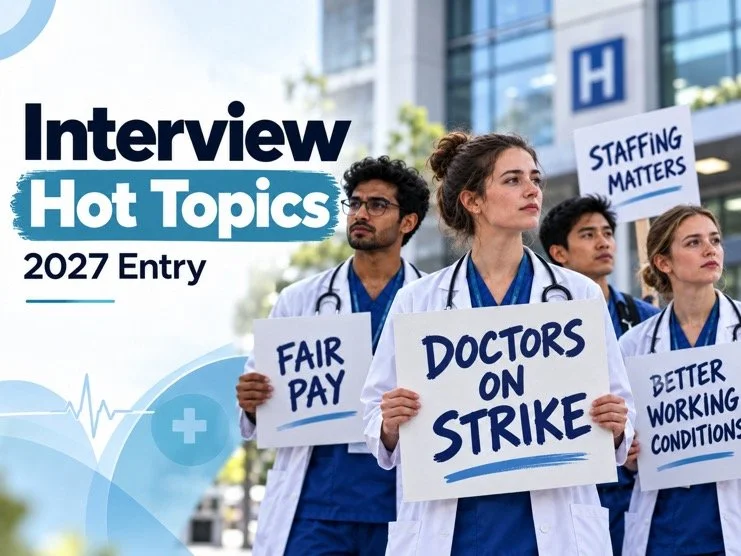
What happened? Resident doctors (the new name for what used to be called junior doctors in England) have been in dispute over pay since 2023. There were several five-day strikes in 2025 and a six-day walkout in April 2026. In June 2026, BMA members narrowly voted to accept a government deal, with 53% in favour on a 57% turnout.
The deal includes an average pay rise of 6.6% combined with the independent pay review body's recommendation, 4,500 extra speciality training places over three years, and funding for doctors' first two attempts at Royal College exams. Full pay restoration remains BMA policy, so this may not be the end of the story.
Why does it matter? "Is it ever ethical for doctors to strike?" is one of the most predictable interview questions around. You need to handle it fairly, whatever your personal view.
🎯 Practice question: "Is it ever right for doctors to go on strike?"
💡 Think about: the right to withdraw labour, patient safety during strikes, the long-term safety risk of doctors leaving the NHS, and how emergency care is protected during industrial action.
⚠️ Keep party politics out of it. You can discuss the ethics of striking without telling the panel who you'd vote for.
5. Doctor Unemployment and the Training Bottleneck
What happened? This one surprises applicants. After medical school and the two-year foundation programme, doctors compete for speciality training posts. Applications for those posts rose from roughly 12,000 in 2019 to nearly 40,000 in 2025, and many UK-trained doctors couldn't find a training job.
In response, the Medical Training (Prioritisation) Act became law in March 2026. UK graduates, along with doctors who have significant NHS experience, now get priority for foundation and speciality training, starting with recruitment for August 2026.
Why does it matter? It's an ethics question hiding inside a workforce question. On one side is fairness to UK graduates and the taxpayer's investment in training them. On the other is fairness to international medical graduates, many of whom have kept NHS services running for years.
🎯 Practice question: "Is it fair to prioritise UK medical graduates for NHS training posts over doctors trained abroad?"
💡 Think about: what "significant NHS experience" should mean, the ethics of recruiting doctors from countries with their own shortages, and what happens to rota gaps.
6. Physician Associates (Now Physician Assistants)
What happened? Physician associates are healthcare professionals, usually with a two-year postgraduate qualification, who work under the supervision of doctors. After growing concern about patients confusing them with doctors, the government commissioned an independent review led by Professor Gillian Leng. Her report, published in July 2025, made 18 recommendations. The role should be renamed physician assistant, and physician assistants shouldn't see undifferentiated patients (people whose problem hasn't been diagnosed yet) as the first clinician responsible for them.
The GMC began regulating the profession in December 2024. From 13 December 2026, anyone practising under the title in the UK must be registered with the GMC.
Why does it matter? It's really a question about the multidisciplinary team. Who does what, how do patients know who they're seeing, and how do you protect training opportunities for doctors?
🎯 Practice question: "A patient tells you she thought she'd been seen by a doctor, but it was a physician assistant. Why does this matter, and what should happen next?"
💡 Think about: informed consent, honesty, clear identification, and valuing every member of the team.
🛡️ Hot Topics in Patient Safety
7. The Thirlwall Inquiry Report
If assisted dying is the most likely ethics topic, this is the most likely patient safety topic. It was published just weeks before interviews begin.
What happened? The Thirlwall Inquiry examined how nurse Lucy Letby was able to murder and harm babies on the neonatal unit at the Countess of Chester Hospital between 2015 and 2016. Its report, published on 15 September 2026, found a complete failure to protect babies. It concluded that some babies would have been saved if concerns had been acted on sooner. Consultants raised concerns repeatedly, but senior managers were slow to act and were criticised for putting the hospital's reputation ahead of calling in the police.
The report made 17 recommendations, including an individual duty of candour for NHS managers, a path towards regulating managers, better monitoring on neonatal units, and closed-circuit television (CCTV) where insulin is stored. Health Secretary Yvette Cooper apologised in Parliament and accepted the need for manager regulation and culture change.
Why does it matter? It's about speaking up, being heard, and what happens when organisations protect themselves rather than patients. The GMC expects every doctor to raise concerns about patient safety, and the duty of candour requires honesty with patients when things go wrong.
⚠️ The inquiry didn't re-examine Letby's convictions, and it isn't your job to either. If asked, focus on the lessons for the NHS, not on the court case.
🎯 Practice question: "You're a medical student on placement and notice a colleague doing something you think is unsafe. A senior tells you not to make a fuss. What do you do?"
💡 Think about: escalation routes, Freedom to Speak Up Guardians, the duty to act, and how hard it genuinely is to speak up as a junior.
8. Maternity and Neonatal Safety
Closely linked, and worth a few minutes of reading: Baroness Valerie Amos led an independent national investigation into maternity and neonatal services in England, which published its final report in June 2026. It adds to a long line of maternity safety reviews, so expect interviewers to ask why the same lessons keep needing to be learnt.
🎯 Practice question: "Why do you think the NHS keeps repeating the same patient safety mistakes, and what would you change?"
🏥 Hot Topics About How the NHS Is Run
9. Who's in Charge?
This is where applicants trip up, because the answer keeps changing. Wes Streeting resigned as Health Secretary in May 2026. His successor, James Murray, lasted just over two months. In July 2026, new Prime Minister Andy Burnham appointed Yvette Cooper as Secretary of State for Health and Social Care.
You won't be asked to name every minister. But if you mention "the Health Secretary" and get the name wrong, it undermines an otherwise good answer.
Remember that health is devolved. The NHS in Scotland, Wales and Northern Ireland is run by each nation's own government, and several topics in this guide (including the weight-loss jab rollout, the 10 Year Health Plan and the assisted dying bill) apply to England or England and Wales only. If you're interviewing in Scotland, Wales or Northern Ireland, read up on that nation's own NHS too. 🏴🏴
10. The 10 Year Health Plan and the "Three Shifts"
What happened? In July 2025 the government published Fit for the Future, its 10 Year Health Plan for England. It's built around three big shifts:
- 🏘️ Hospital to community: more care in neighbourhood health centres and at home.
- 📱 Analogue to digital: a single patient record, an expanded NHS App, and more use of artificial intelligence (AI).
- 🍎 Sickness to prevention: tackling obesity, smoking and alcohol before they cause disease.
The government also announced that NHS England, the body that ran the health service day-to-day, would be abolished and merged into the Department of Health and Social Care (DHSC).
Why does it matter? Interviewers love the three shifts because they're a ready-made discussion. Every one sounds obviously good, but each has hidden costs.
🎯 Practice question: "Which of the three shifts would make the biggest difference to patients, and which would be hardest to deliver?"
💡 Think about: who gets left behind by digital care, whether prevention saves money quickly enough to matter, and whether community services have the staff to take on more work.
11. Artificial Intelligence in Healthcare
What happened? AI has moved from the future to the consulting room. The most visible example is the "AI scribe", or ambient voice technology, which listens to a consultation and drafts the clinical notes for the doctor to check. In January 2026, NHS England launched a registry of approved suppliers and suggested the technology could save clinicians two or three minutes per appointment. Its April 2026 guidance says patients must be told when an AI scribe is being used, and must be able to object.
Why does it matter? AI questions let interviewers test your balance. You should be able to explain the benefits (less admin, more eye contact, faster scan reporting) and the risks (errors, bias in training data, privacy, deskilling, and who is responsible when the AI gets it wrong).
🎯 Practice question: "A patient says she doesn't want an AI scribe recording her consultation. The doctor is running 40 minutes late. What should happen?"
💡 Think about: consent and autonomy, trust, and why the doctor's lateness doesn't change the answer.
👀 Other Hot Topics Worth Ten Minutes Each
You don't need an essay on every story. But a basic understanding of these will stop you from being caught out:
- 🚑 Corridor care and waiting lists. Patients being treated in hospital corridors have become a symbol of the pressure on emergency departments.
- 💉 Vaccine hesitancy and measles. Falling childhood vaccination rates and outbreaks of measles raise questions about trust, misinformation and access.
- 📋 The UK Coronavirus Disease 2019 (COVID-19) Inquiry. Its reports on pandemic preparedness and decision-making continue to be published.
- 🔔 Martha's Rule. Patients and families in hospital can request a rapid review from a separate team if they're worried someone is deteriorating.
- 📵 Digital exclusion. As GP appointments move online, what happens to patients without smartphones or confidence with technology?
- 🦠 Antimicrobial resistance. Evergreen, and a favourite for "what's the biggest threat to modern medicine?" questions.
- 🧓 Social care. Delayed discharges happen when patients are medically fit, but there's no care in place to send them home.
- 📚 The Cass Review. Its findings on gender identity services for young people raised wider questions about evidence-based medicine. Treat this one with particular care and balance.
💬 45 Hot Topic Practice Questions for Medical School Interviews
Set a timer for five to seven minutes per question and answer out loud. Don't script. The aim is to get comfortable thinking on your feet, not to memorise speeches.
⚖️ Medical Ethics and the Law
- Should assisted dying be legal in England and Wales? Argue both sides before giving your view.
- What is the difference between assisted suicide and euthanasia, and why does the distinction matter?
- If assisted dying became legal, should individual doctors be allowed to refuse to take part?
- The Commons voted for assisted dying in 2025 and against it in 2026. What does this tell you about how society makes ethical decisions?
- Is a generational smoking ban an acceptable limit on personal freedom?
- Should the approach taken with tobacco be extended to alcohol or junk food?
- Should weight-loss injections be available on the NHS to everyone who could benefit?
- A patient asks you to prescribe a weight-loss drug they've read about online. How do you handle the conversation?
- Should patients whose lifestyle has contributed to their illness be given lower priority for treatment?
👩⚕️ The Medical Workforce
- Is it ever ethical for doctors to go on strike?
- How should emergency care be protected during industrial action?
- What are the biggest challenges facing resident doctors in the NHS today?
- Why do you think some UK-trained doctors are leaving to work abroad?
- Is it fair to prioritise UK graduates for NHS training posts?
- What do international medical graduates contribute to the NHS?
- What is the role of a physician assistant, and how should they work alongside doctors?
- Why does it matter that patients know exactly who is treating them?
- Who is in a multidisciplinary team on a hospital ward, and what does each person contribute?
- Some people say medical school funding cuts threaten the future of the profession. How would you respond?
🛡️ Patient Safety and Professionalism
- What lessons should the NHS learn from the Thirlwall Inquiry?
- What is the duty of candour, and why does it matter?
- Should NHS managers be regulated in the same way as doctors and nurses?
- Why can it be so hard for junior staff to raise concerns?
- You make a mistake with a patient's medication. Nobody noticed. What do you do?
- What is a Freedom to Speak Up Guardian, and why might staff use one?
- Should CCTV be used on hospital wards? What are the benefits and drawbacks?
- Why do you think the same patient safety failures keep being repeated?
- What is Martha's Rule, and why was it introduced?
🏥 The NHS and Health Policy
- What are the biggest pressures facing the NHS at the moment?
- Which of the 10 Year Health Plan's three shifts is most important, and why?
- Moving care from hospitals into the community sounds sensible. What could go wrong?
- Why do you think NHS England is being merged into the Department of Health and Social Care?
- Should routine GP appointments be delivered online by default?
- How would you persuade a hesitant parent to vaccinate their child?
- Why do health outcomes differ between richer and poorer areas of the same city?
- Why do some patients stay in hospital after they're medically well enough to leave?
- If you had £1 million to spend on the NHS in your area, how would you spend it?
🤖 Technology and the Future of Medicine
- What are the benefits and risks of using AI in medicine?
- Should patients be allowed to refuse an AI scribe in their consultation?
- If an AI system makes a wrong diagnosis, who is responsible?
- Will AI make doctors better, or make them worse at thinking for themselves?
- How should doctors respond when patients arrive with information from social media or chatbots?
🧭 Current Affairs and You
- Tell us about a healthcare story in the news that interested you. Why?
- How do you keep up to date with what's happening in medicine?
- Has anything in the news this year changed your view of what being a doctor involves?
✅ Top Tips for Hot Topic Stations
Read little and often. Fifteen minutes a day beats a panicked six-hour cram the night before. Pick one reliable source and stick with it.
Use proper sources. Government announcements, the BMA, the GMC and The King's Fund are all more reliable than social media threads. Headlines often exaggerate, so read past them.
Keep a hot topics notebook. For each story, write three lines: what happened, why it matters to patients, and the best argument on each side. That's your revision guide.
Link topics together. The best answers connect ideas. Thirlwall links to the duty of candour. Weight-loss jabs link to the prevention shift. AI links to digital exclusion. Examiners notice.
Don't fake it. If you haven't heard of something, say so honestly and reason from first principles. "I haven't read about that, but thinking it through…" is far better than bluffing. Honesty is literally one of the values being assessed.
Don't preach. You're allowed opinions, but a strong opinion delivered without acknowledging the other side reads as poor judgement, not confidence.
Practise with a real person. Answering to your bedroom wall only gets you so far. You need someone to interrupt you with a follow-up question, because that's where interviews are won and lost. That's exactly what our MMI Courses are for: full-time circuits with trained interviewers and written feedback.
📌 Key Facts at a Glance
- 🗳️ Assisted dying: rejected by MPs at second reading on 11 September 2026 (286 to 270). It remains illegal in England and Wales.
- 🚭 Smokefree generation: The Tobacco and Vapes Act became law on 29 April 2026. Anyone born on or after 1 January 2009 can never legally be sold tobacco.
- 💉 Weight-loss jabs: GP prescribing of Mounjaro began in England in June 2025, with around 220,000 patients expected to be treated over three years.
- 🩺 Resident doctors: a deal was accepted in June 2026, including an average 6.6% pay rise and 4,500 extra speciality training places.
- 🎓 Training posts: The Medical Training (Prioritisation) Act became law in March 2026.
- 👥 Physician assistants: The Leng review (July 2025) recommended the new name. GMC registration is mandatory from 13 December 2026.
- 🛡️ Thirlwall Inquiry: reported on 15 September 2026 with 17 recommendations.
- 🏛️ Health Secretary (England): Yvette Cooper, since July 2026.
- 📘 10 Year Health Plan: published July 2025. Three shifts: hospital to community, analogue to digital, sickness to prevention.
❓ Medical School Interview Hot Topics: FAQs
Which hot topics are most likely to come up in 2027 entry interviews?
Nobody outside the admissions teams knows the actual questions. Based on how recent and how medically relevant they are, assisted dying, the Thirlwall report, the ethics of doctors striking, and AI in healthcare are the safest bets. Medical schools also recycle classic themes year after year, such as resource allocation and consent, so a new story often arrives as an old question in fresh clothes.
How up to date do I need to be?
Aim to know the main developments from roughly the last two years, plus anything big in the weeks before your interview. You don't need exact figures. You need to understand what happened and why it matters.
Do all medical schools ask about hot topics?
Most MMIs include at least one station touching on current issues in the NHS or medical ethics, and panel interviews often include a "tell us about something you've read" question. Check each school's admissions page to see how its interview is structured.
What if I disagree with the interviewer?
That's fine, as long as you're respectful and your reasoning is sound. Interviewers aren't looking for the "right" opinion on contested issues. They're looking for balanced, well-reasoned thinking.
Are hot topics different for dentistry interviews?
There's some overlap, but dental interviews focus on dentistry-specific issues too. If you're applying for dentistry, read our complete guide to UK dentistry interviews.
I'm interviewing in Scotland, Wales or Northern Ireland. Is this guide still relevant?
Yes, because the ethical questions travel well. But health is devolved, so some policies here apply only to England. Read up on your own nation's NHS priorities as well.
🔗 Useful Links
Official sources
- Medical Schools Council: Statement on the core values and attributes needed to study medicine
- General Medical Council: Good Medical Practice 2024
- UK Parliament: Terminally Ill Adults (End of Life) Bill 2026
- GOV.UK: Terminally Ill Adults (End of Life) Bill 2026 – government impact documents
- GOV.UK: Tobacco and Vapes Bill becomes law
- BMA: Government offer to resident doctors in England (June 2026)
- UK Foundation Programme: Medical Training (Prioritisation) Act becomes law
- GOV.UK: The Leng review – final report
- The Thirlwall Inquiry: Recommendations
- GOV.UK: Government response to the Thirlwall Inquiry
- GOV.UK: 10 Year Health Plan for England – Fit for the Future
More from Blue Peanut Medical
- 🎤 Medical school interview guide
- 🆓 Free medical school interview resources
- ⏱️ MMI courses with timed mock circuits and written feedback
- 🦷 Dentistry mock MMI circuit
- ⚖️ UCAT Situational Judgement tips: the same ethical reasoning skills you'll need at interview
- 🩺 Medicine work experience
- 🏫 How to choose a medical school
Blue Peanut interview course
Done reading about your score? Start preparing to win the offer.
Small-group interview and MMI preparation taught by NHS doctors, in Manchester, London or live online.