How UCAT Scores Are Calculated in the UK
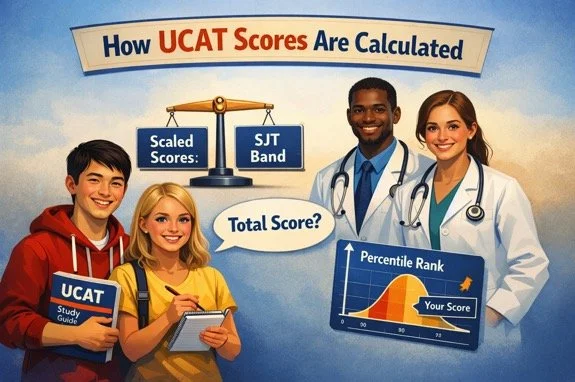
You’ve probably seen people talk about “getting 2600+” or “Band 1”, but the bit that often gets missed is how those numbers are actually produced. The UK UCAT scoring system looks simple on the surface (three subtest scores added together)… but underneath, it uses statistical scaling to keep things fair when different candidates sit slightly different versions of the test.
This guide breaks UCAT scoring down 🟦✅ — so you’ll understand what your score report really means, what you can calculate yourself, and what you can’t (and why).
What your UK UCAT score report shows
Your UCAT result is made up of two parts:
Your cognitive score out of 2700
In the UK UCAT, you sit three cognitive subtests — Verbal Reasoning (VR), Decision Making (DM) and Quantitative Reasoning (QR) — and each one gives you a scaled score from 300 to 900.
Those three scaled scores are then added together to give a total score from 900 to 2700.
A quick way to remember it:
🟩 Total UCAT score (UK) = VR + DM + QR (each 300–900 → total 900–2700).
Your Situational Judgement Test result as a band
The Situational Judgement Test (SJT) is reported separately as a band from 1 to 4, where Band 1 is the highest.
You don’t add SJT to your 2700 total, but it can still matter a lot for shortlisting by medical and dental schools.
The current UK UCAT structure
Since 2025, Abstract Reasoning has been withdrawn from the UK UCAT. The test now consists of three cognitive subtests (VR, DM, QR) plus SJT, with a cognitive total scored out of 2700.
If you’re comparing advice online, make sure it matches the “out of 2700” system — older “out of 3600” guidance is from the pre‑2025 structure.
Want to maximise your UCAT score? 🚀 Our doctor-led UCAT course, designed by experienced medical educators, gives you the strategies, practice, and confidence you need to perform at your best. 👉 Click here to start your preparation
Raw marks: how you earn points in each subtest
Before scaling happens, UCAT starts with something very straightforward: raw marks.
No negative marking
In the cognitive subtests, UCAT is marked on the number of correct answers, with no negative marking for incorrect answers.
That has a very practical takeaway:
🟦 Always put an answer in. A guess can only help, not hurt (because wrong answers don’t lose marks).
UCAT is not adaptive
Some admissions tests adjust in difficulty based on how you’re doing (adaptive testing). UCAT doesn’t work like that.
Officially, your performance on one question does not influence which other questions are presented.
So your job is consistent throughout: keep your accuracy high, keep moving, and don’t let a hard question derail your timing.
Cognitive subtests: what counts as a raw mark
Even though the final scores are scaled, it helps to know how raw marks are awarded:
Verbal Reasoning: questions are worth 1 mark each.
Quantitative Reasoning: questions are worth 1 mark each.
Decision Making is the exception. In DM:
Single-answer questions are worth 1 mark
Multiple-statement questions are worth 2 marks, and 1 mark can be awarded for partially correct responses
This is why you’ll sometimes hear “raw score” talked about carefully in DM: your raw mark isn’t simply “questions correct”, because not every DM question is worth the same.
SJT raw marking is different
In SJT, UCAT uses a model-answer approach:
You get full marks if your response matches the correct answer
You can get partial marks if your response is close to the correct answer
Those marks are then used to place you into Band 1–4.
Why UCAT uses scaled scores
If UCAT were just marked out of raw marks, people would immediately ask, “Isn’t that unfair if my questions were slightly harder?” That’s exactly why UCAT uses scaling.
Different subtests can’t be compared using raw marks
Officially, UCAT highlights that the number of questions varies between the cognitive subtests, so you can’t directly compare raw marks across them.
In other words, getting “30 marks” in VR is not directly equivalent to “30 marks” in QR because the sections differ in format and marking, and DM assigns different mark values to different question types.
Scaling helps keep results comparable
UCAT converts raw marks into scaled scores that share a common range (300–900) for each cognitive subtest.
UCAT also states that it uses standard equating methods (alongside content and statistical rules for selecting exam forms) to help ensure results remain comparable between years, which is part of how it maintains fairness over time.
“Scaled” does not mean “percent”
A scaled score is not a percentage, and it’s not a direct “you got X questions right” number.
Think of it like this:
🟨 Raw mark = how many points you scored on the questions
🟩 Scaled score = how that performance is translated onto the UCAT 300–900 scale
The translation step is where UCAT applies statistical analysis.
How raw marks become scaled scores
This is the part most students want to know — and it’s also where you need realistic expectations about what you can calculate yourself.
The official answer: it’s statistical and complex
UCAT is unusually direct about this: the scoring process is complicated, and Pearson VUE uses complex statistical analysis to arrive at a candidate’s UCAT score based on the answers selected.
So if you were hoping there’s a simple public formula like:
“Raw mark 28/44 = 650”
…that’s not how UCAT describes the process.
What you can safely understand as a candidate
Even without the full statistical model, UCAT gives enough information to understand the shape of the process:
You answer questions.
Your answers produce a raw mark in each cognitive subtest (with DM including partial marks on certain question types).
Those raw marks are converted to scaled scores (300–900) for VR, DM, and QR.
Those three scaled scores are added to produce your total score out of 2700.
Separately, your SJT answers are marked using full/partial credit and reported as Band 1–4.
That’s the UCAT scoring pipeline ✅.
Why two people with the same raw mark might not always get the exact same scaled score
UCAT uses different exam forms and applies equating to keep things comparable across forms and across years.
The key idea behind equating is fairness: if one set of questions is marginally harder, the scaling process can adjust so that candidates aren’t penalised just because of the particular form they received. UCAT doesn’t publish the full workings, but it does emphasise that equating methods are used to maintain comparability.
Can you convert your own raw marks into a scaled score at home?
You can estimate — but be cautious.
UCAT publishes deciles/percentiles and explains scaled ranges, but it also stresses that the scoring process involves complex statistical analysis, and mean scores can shift between years.
So while conversion tables online can be useful for rough tracking, the most reliable way to judge performance is:
🟦 Practise on resources aligned to the current format, then
🟦 Compare your final scaled score to official deciles/percentiles once published.
How your total UCAT score out of 2700 is calculated
Once you understand scaled scores, calculating your total is the easy bit.
The UCAT total score formula
Your UK UCAT total score is simply:
🟩 Total score = VR (300–900) + DM (300–900) + QR (300–900)
That gives a total range of 900–2700.
A worked example
Imagine your score report shows:
VR: 630
DM: 670
QR: 710
Your total cognitive score would be:
✅ 630 + 670 + 710 = 2010 (out of 2700)
Then your SJT would appear separately as a band.
Common mistakes students make with totals
One common mix-up is trying to “average” your score and treating that as your UCAT result.
Universities typically refer to your total score (the sum of cognitive subtests), though some also look at individual subtest scores and/or apply subtest cut-offs.
So when you’re talking about your UCAT score in the UK, the clearest default is the total out of 2700, plus your SJT band.
How SJT bands are calculated and what they mean
SJT is often underestimated because it isn’t added to the 2700. But it can still influence whether your application is considered, depending on where you apply.
How UCAT marks SJT
UCAT states that in SJT:
you get full marks if your response matches the correct answer
you get partial marks if your response is close
Those scores are then grouped into four bands.
What each band means
UCAT provides an official interpretation of each band (in simple terms):
🟦 Band 1: excellent performance; judgement similar to the expert panel in most cases
🟩 Band 2: good, solid performance; appropriate judgement frequently; many responses match model answers
🟨 Band 3: modest performance; appropriate judgement on some questions, substantial differences on others
🟥 Band 4: low performance; judgement tends to differ substantially from ideal responses in many cases
Why SJT still matters for applications
UCAT notes that an increasing number of universities use SJT in selection, with some excluding lower-performing candidates.
So even though SJT isn’t part of your 2700, it can still be “make or break” for certain choices — which is why it’s worth taking seriously.
How to interpret your score using deciles and percentiles
Once you have your UCAT score, the next question is usually: “Is this good?”
The best way to answer that isn’t by comparing to a random TikTok comment — it’s by using the official cohort statistics.
Deciles vs percentiles in UCAT terms
UCAT publishes deciles (and a percentile lookup) so you can understand how your result compares to the rest of that year’s candidates.
UCAT explains deciles like this:
each decile rank represents 10% of candidates
the 1st decile represents a score at the 10th percentile
the 2nd decile represents the 20th percentile, and so on
So, if your total score sits around the 7th decile, that generally means you performed better than roughly 60–70% of candidates that year.
Real example: official deciles from the 2025 test cycle
To make this concrete, UCAT’s published 2025 deciles show, for example, totals like 1880 at the 5th decile and 2010 at the 7th decile (with section deciles also provided).
This is useful for interpreting your score, but don’t treat any single year’s numbers as permanent cut-offs — UCAT warns that mean scores can shift between years, and direct comparison isn’t always possible.
When UCAT publishes the official stats
UCAT sets out a clear timeline:
Preliminary mean scores and deciles are published in mid‑September (because not everyone has tested before then).
Final mean scores, deciles and percentiles are published after testing ends.
If you’re sitting UCAT this year, those official updates are your best “reality check” for where you sit in the cohort.
How results are received and sent to universities
A few practical points that reduce stress later:
You receive a copy of your score report before you leave the Pearson VUE test centre, and it’s also accessible through your UCAT account (allow around 24 hours for upload).
For UK university applications, UCAT states it delivers results directly to your chosen UK universities in early November, and you do not need to enter your UCAT score on your UCAS application.
Using your score to choose universities strategically
UCAT is explicit that you should use your result to inform your UCAS choices, because otherwise, you may be wasting an application.
Universities can use UCAT scores in different ways — for example, as a major factor, as part of a weighted system with GCSEs, or by setting thresholds — and some may look at subtest scores rather than only the total.
A simple, sensible approach is:
🟦 Check your total score against the latest official deciles/percentiles
🟦 Check your SJT band
🟦 Then read each university’s admissions guidance carefully to see how they use UCAT that year
Key takeaways to remember
If you only remember five things, make them these ✅:
Your cognitive UCAT score is VR + DM + QR, out of 2700.
Each cognitive subtest score is scaled to 300–900 and not reported as a raw mark.
There is no negative marking, so answering every question matters.
SJT is banded 1–4 and uses full and partial marks based on closeness to model answers.
The scaling process involves statistical equating, and official deciles/percentiles are your best way to interpret your score in context.
Ending thought 🟩✨: UCAT scoring isn’t designed to be “mysterious” — it’s designed to be fair. Once you understand raw marks → scaled scores → total score + SJT band, you can focus on what actually improves results: accuracy, timing, and smart application choices based on official statistics.