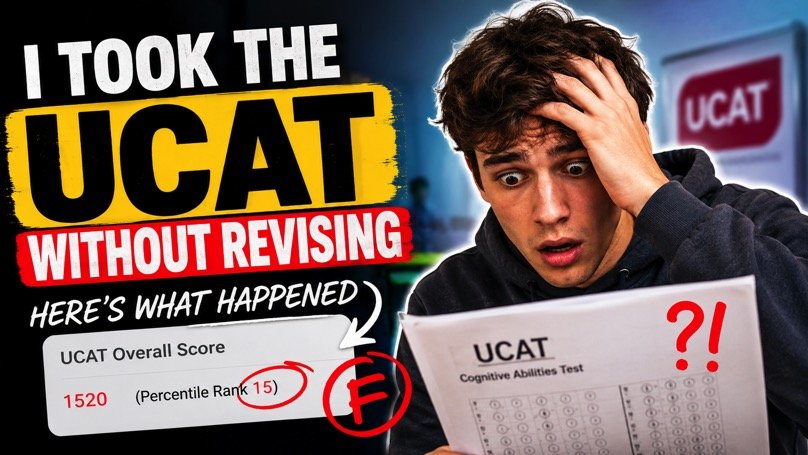
I genuinely thought I could wing it
I’ll be honest: I thought the UCAT would be the one part of the medicine application I could just “turn up” for. I was used to exams. I did well in class. I told myself it was an aptitude test, so surely revision mattered less.
That logic fell apart the moment I looked properly at what the UCAT actually is. It is a computer-based admissions test used by a consortium of UK and partner universities alongside academic qualifications and interviews. In its current format, the exam has four separately timed subtests — Verbal Reasoning, Decision Making, Quantitative Reasoning and Situational Judgement — and the standard test lasts 117 minutes 30 seconds, including instruction screens. The three cognitive sections are scored from 300 to 900 each, producing a total score from 900 to 2700, while Situational Judgement is awarded in Bands 1 to 4. Abstract Reasoning was withdrawn from the test in 2025, so this is the format candidates now sit.
In other words, the UCAT is not a harmless extra. It is one of the tools universities use to separate applicants who often have very similar grades, and official guidance makes clear that some universities place significant weight on it, while others use thresholds, subtest requirements or Situational Judgement filtering. Even the long-term research on the test shows its predictive value is modest rather than magical, yet statistically significant enough that universities use it alongside other measures.
So when people search, “Can I take the UCAT without revising?”, the honest answer is this: you can, but that does not make it a smart move 😅
What actually happened in the exam
The biggest shock was not that the questions were impossible. It was the speed. The UCAT is designed as a fast, pressurised exam, and once the test starts, it cannot be paused unless you have approved access arrangements. That means every second you spend figuring out the interface, second-guessing your method or staring blankly at a question is time you do not get back.
Verbal Reasoning hit first. This section gives you 44 questions in 22 minutes, and the official description is clear that it is about evaluating information in passages of text rather than using prior knowledge. That sounds manageable until you realise how quickly you need to read, locate key words and stay calm under pressure. UCAT’s own candidate advice recommends practising with written passages, such as news articles, and developing a strategy that suits you, whether that is skimming or keyword searching. If you walk in cold, you usually spend too long reading and not enough time answering.
Decision Making was the section that exposed unfamiliarity. Officially, it tests whether you can make sound decisions and judgments using complex information. In practice, that means question types that can feel strange if you have not seen them before. The UCAT gives you 35 questions in 37 minutes, and top candidates are specifically advised to learn the question types, brush up on Venn diagrams and basic probability, and practise timings using the flag-and-review function. If you have not revised, it is not always the content that beats you — it is hesitation.
Quantitative Reasoning was where basic maths stopped feeling basic. On paper, 36 questions in 26 minutes does not sound ridiculous. In reality, it is mental arithmetic, estimation and calculator use at speed, often after your concentration has already been dented by earlier sections. UCAT says candidates should familiarise themselves with the on-screen calculator, keyboard shortcuts, and navigation in advance, as this can save valuable time on test day. Past high scorers also recommend brushing up on basic maths skills and mental arithmetic. If you do not know the test tools, even easy sums can become expensive mistakes.
Situational Judgement was not the easy rescue section I had imagined. It contains 69 questions in 26 minutes and is scored in Bands 1 to 4 rather than 300 to 900. Official UCAT guidance says that an increasing number of universities use the SJT in selection, with some excluding lower-performing candidates, and candidate advice specifically suggests reading the GMC’s Good Medical Practice to understand the professional behaviours the section aims to test. That matters because this section is not just about “being nice”; it is about recognising safe, ethical and appropriate behaviour in clinical-style scenarios. In the latest full-cycle statistics, only 21% of candidates achieved Band 1 in 2025.
What happened overall was simple: I did not fail because I was incapable of doing the UCAT. I underperformed because I was trying to learn the exam as I took it.
Why taking the UCAT without revising is such a gamble
The first problem is that the UCAT is not something you can casually “have a go” at. Officially, you may only sit the test once in any year, and the UCAT FAQ explicitly says candidates should not take it early as a “practice run”. The Consortium also points out that test content and scoring can change from year to year, which makes a throwaway attempt even less useful.
The second problem is that there is no secret “easy version” of the paper to save you. UCAT states that several test forms are created each year, that forms are selected at random, and that scores are equated and balanced so that results are equivalent across forms. So no, you cannot rely on luck carrying you through an unrevised attempt.
The third problem is that revision does seem to matter. The UCAT says its official materials are free, representative of the live test, and the best place to start. A national BMC Medical Education study found that using the free official UCAT practice tests, attending school-based preparation, using paid materials and spending more time preparing were all associated with higher UCAT scores. It does mean preparation is not optional if you want to give yourself a fair chance.
The latest official score data makes that even clearer. In the 2025 cycle, based on 41,354 tests taken, the mean total cognitive score was 1891. The 8th decile started at 2100, the 9th decile at 2220, and only 21% of candidates achieved SJT Band 1. In practical terms, that means walking in unprepared is not bold. It is a high-risk bet in a very competitive field.
Why it matters for your medical school choices
One weak UCAT does not just sting your pride. It can genuinely change where you should apply. The UCAT Consortium says universities use the test in different ways: some treat the total score as a major factor, some combine it with GCSE or other academic measures, some look at subtests, some set thresholds, and some use the Situational Judgement band to filter candidates.
That is why the official advice is to use your result to inform your UCAS choices and avoid wasting an application. You receive a score report before leaving the Pearson VUE test centre, it is uploaded to your UCAT account shortly afterwards, and you know your result well in advance of the UCAS deadline. For the 2026 cycle, testing starts on 13 July; the booking deadline is 16 September at 15:00 UK time; the last test day is 24 September; and the UCAS deadline is 15 October 2026.
The good news is that a disappointing score is not the end of the road. UCAT’s own wellbeing advice reminds candidates that there is more to life than a single admissions test and that different routes remain, including applying strategically, considering other course options, or reapplying in a later year. So if you have already taken the UCAT without revising and it went badly, do not spiral. Regroup. Be realistic. Then make smart choices from here.
The UCAT revision plan I wish I had followed
The best part is that the “better plan” does not have to be dramatic or expensive. UCAT says the official preparation materials are free and explicitly states that you do not need paid tutoring to do well. What you do need is a method.
🟢 Start by learning the exam before trying to beat it. The official preparation order is sensible: begin with the Tour Tutorial and Question Tutorials, then move on to Question Banks, and only after that use timed Practice Tests. UCAT also says getting used to the calculator, keyboard shortcuts, navigator, and flag-and-review function can save valuable time. That is revision too. Revision is not just doing hundreds of questions — it is becoming fluent in how the exam works.
🟡 Build accuracy before chasing speed. The Question Banks are there to help you recognise the question styles you will actually see in the live test, and the “Explain Answer” feature lets you understand why you got something wrong. That matters because unrevised candidates often make the same error repeatedly without noticing the pattern. If possible, practise on a desktop or laptop rather than a phone, because UCAT says that it better reflects the real testing experience.
🔵 Then switch to timed work. UCAT recommends using its practice tests nearer your test date to review performance under timed conditions, and past top candidates say a “little-and-often” routine works well. Their advice is to spread preparation across roughly four to eight weeks, understand the format first, and then use official mocks once you are closer to the exam. That is exactly the stage I skipped — and it is exactly the stage that teaches you how not to panic when the clock is moving.
🟠 Book smart, not late. Official guidance says to register early, book early and avoid a late test date where possible. For candidates applying in the current 2026 cycle, registration opens on 20 May 2026, booking opens on 23 June 2026, testing starts on 13 July 2026, and the final test day is 24 September 2026. If you need access arrangements or a bursary, those need to be sorted in good time as well. Leaving the test itself late and leaving preparation late is a nasty combination.
🔴 Learn one crucial test habit: move on. The UCAT has no negative marking, so perfectionism about answering every question is often worse than making the best choice you can and flagging a question for later. Past candidates explicitly recommend practising timing and using flag-and-review for harder questions. If I had understood that earlier, I would have stopped treating every awkward question like a showdown.
Final thoughts
So, what happened when I “took the UCAT without revising”? I learned the hard way that the UCAT is not a test you bluff with school confidence alone. It is a timed admissions exam that rewards familiarity with the format, comfort with the tools, and enough preparation to stay calm when the pressure kicks in. The official advice to use the free preparation resources is there for a reason, and the research showing a link between preparation and better performance backs that up.
If you are tempted to sit the UCAT without revising, here is the honest takeaway: you might get through it, but you are making an already competitive process harder than it needs to be. Give yourself a few weeks. Use the official UCAT resources. Learn the rhythm of the exam. Then walk into test day feeling prepared rather than surprised. That is not overkill — it is common sense. ✅