University of Manchester Dental School Interview Questions for 2027 Entry
So you've got your UCAT score, your personal statement is in, and Manchester has come back with an interview invitation. First things first — well done. Manchester interviews a minority of the students who apply, so getting this far already puts you ahead of most of the field.
Now comes the part that actually decides whether you get an offer. Manchester's interview isn't a test of what you know. It's a conversation, spread across five short stations, designed to find out whether you're someone they'd trust in a surgery with a real patient in the chair. That's a very different thing to revise for than a chemistry exam, and it catches a lot of well-qualified applicants off guard.
This guide covers everything you need to know about Manchester's dentistry interview for 2027 entry: how the school decides who gets called, exactly how the interview works, what it's actually testing, and more than 40 example questions sorted by topic so you can practise properly. 🦷
🏫 An Introduction to Manchester Dental School
The University of Manchester's School of Dentistry sits within the Faculty of Biology, Medicine and Health, and it's one of the largest dental schools in the UK. Every year it takes 67 home students and 4 international students onto the five-year BDS (UCAS code A206), alongside a smaller Foundation Year route for applicants without the right science background, and a separate BSc Dental Hygiene and Therapy course.
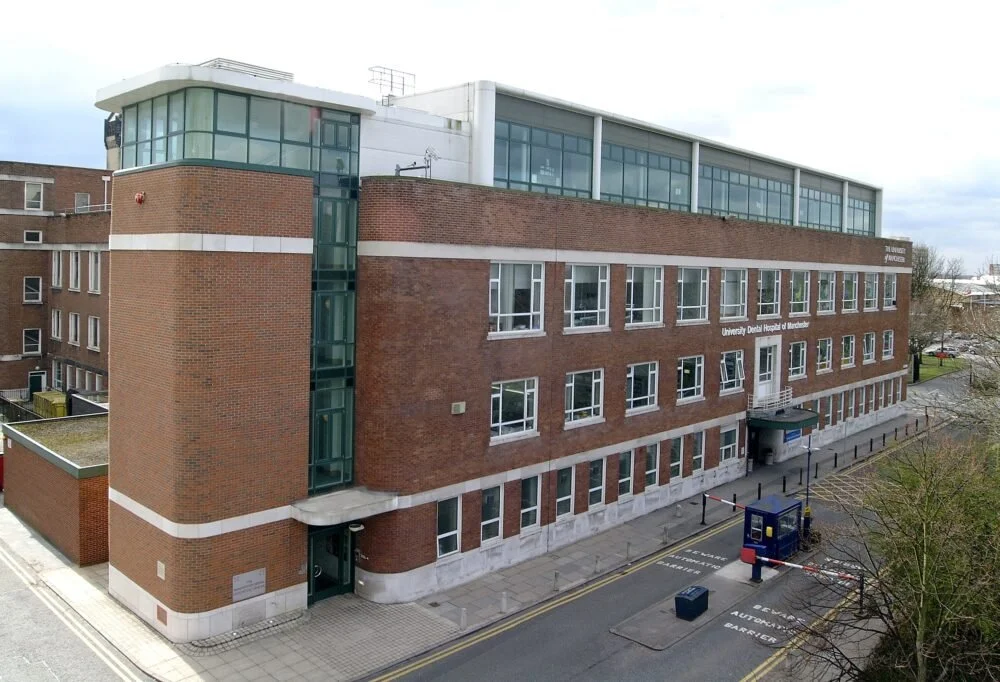
The course itself is built around early clinical exposure. You're introduced to the clinical environment in your very first semester, and treatment of real patients begins early in the course — first through the University Dental Hospital of Manchester, which treats somewhere in the region of 90,000 patients a year, and then through community outreach clinics across Greater Manchester, in places like Oldham, Bolton and Trafford. Teaching leans heavily on enquiry-based learning (EBL) and team-based learning (TBL) rather than traditional lectures, which means you're expected to direct a good deal of your own learning from year one.
One detail worth knowing before you apply: Manchester trains its BDS students and its Dental Hygiene and Therapy students side by side, with students from both courses working together as a team to treat shared patients. That's a genuinely distinctive feature — most dental schools don't build this kind of interprofessional teamwork into the course structure so directly, and it's a strong theme to understand before your interview.
Applicants should also be aware of a live policy change relevant to the 2027/28 intake specifically: the Government's 10 Year Health Plan for England proposes that newly qualified dentists complete a minimum period of NHS service after graduating, expected to apply from students entering a dental course of study in the 2027/28 academic year. More detail is expected from the Department of Health and Social Care in due course, but it's worth knowing this is on the table if you're applying for 2027 entry.
📊 How Manchester Stands Out: Rankings and Student Experience
UK rankings
In the Complete University Guide's 2027 Dentistry subject league table, published in June 2026, Manchester sits 7th in the UK, with an overall score of 96 out of 100. Above it are Glasgow, Dundee, Queen's Belfast, Liverpool, Bristol and Sheffield; just below are King's College London, Leeds and Birmingham.
The genuinely interesting detail sits underneath the headline rank. On the Complete University Guide's research quality measure, Manchester actually scores higher than every dental school ranked above it — Glasgow, Dundee, Belfast, Liverpool, Bristol and Sheffield all score lower on research quality than Manchester does. In other words, Manchester's overall position is being held back by its entry-standards and student-satisfaction scores relative to the very top of the table, not by the quality of the research its academics produce. That's a useful thing to be able to say if you're asked why you chose Manchester specifically.
Worldwide rankings
Manchester's dentistry programme also carries genuine international standing. In the QS World University Rankings by Subject 2026, Manchester's dentistry programme climbed to 48th in the world — an improvement on its previous year's position, according to the University's own announcement. Zoom out to the whole institution, and Manchester ranked 35th in the world and 7th in the UK in the QS World University Rankings 2026, 56th in the world in the Times Higher Education World University Rankings 2026, and 46th in the world (6th in the UK) in the Academic Ranking of World Universities 2025.
None of these are dentistry-specific league tables, but they matter for a practical reason: they feed directly into Manchester's academic reputation, which is one of the five components QS uses to build its dentistry subject ranking. A strong all-round university reputation genuinely helps the dental school's own standing.
Student experience
Manchester's own promotional material for offer-holders states that 100% of Dentistry graduates report using what they learned on their course in their work 15 months after graduating, based on Discover Uni data — a strong outcome for a clinical degree.
Where Manchester consistently scores well with current students is the breadth of the clinical experience itself. Being treated as a working member of a dental team from Year 1 — not just an observer — is the theme that comes up again and again in the School's own student blog network, alongside the social side of studying in a big, lively city. Manchester's Dentistry cohort also benefits from being embedded in a wider faculty that runs Ethical Grand Challenges and a University Living Lab, giving students genuine opportunities to work on real sustainability and social responsibility projects alongside their clinical training — not just talk about them in a personal statement.
🎯 How Manchester Decides Who Gets an Interview
Manchester's selection process runs in two clear stages, and understanding both is the key to knowing where you actually stand.
Stage one: the academic threshold
Every application is first screened against Manchester's published academic requirements. For 2027 entry, that means:
- A-level: AAA including Chemistry and Biology (or Human Biology). A combination of three sciences is also acceptable, but Manchester won't offer combinations of very similar subjects, such as Biology and Human Biology together, or Maths and Further Maths together.
- Contextual offer: AAB including Chemistry and Biology/Human Biology, for eligible applicants under Manchester's contextual admissions criteria.
- UK refugee or care-experienced offer: ABB including Chemistry and Biology/Human Biology.
- GCSE: at least seven GCSEs at grade 7 (A) or above, including English Language, Maths and at least two science subjects at a minimum of grade 6 (B). Applicants confirmed as WP+ or WP++ under Manchester's Contextual Data Eligibility tool need six GCSEs at grade 7 rather than seven.
Applicants who don't meet this threshold don't progress any further, regardless of their UCAT score.
Stage two: UCAT ranking
Applicants who clear the academic threshold are then ranked by their overall UCAT score. Manchester publishes a minimum UCAT threshold each cycle — clear it, and you're automatically invited to interview. Fall short, and your application still isn't dead: Manchester says explicitly that it assesses these applications holistically, using everything available to it, rather than screening them out on UCAT score alone.
One rule applies regardless of your total score: Manchester does not consider applicants who score Band 3 or Band 4 on the Situational Judgement Test (SJT) element of the UCAT. This is stricter than a lot of UK dental schools, several of which will still consider a Band 3. If your SJT comes back as a 3 or a 4, it's worth being realistic about Manchester's chances however strong your cognitive score is.
Your personal statement is also a required part of the UCAS form and is used in the admissions process — Manchester's admissions team reserves the right to review it at any stage of your application. Any statement flagged by UCAS's similarity detection service results in an automatic unsuccessful decision, whatever percentage of similarity is detected, so it genuinely has to be your own work.
🦷 How Manchester Interviews: Format, Structure and Delivery
Manchester interviews every single applicant who receives an offer — there is no route onto the course without one.
Format: a five-station Multiple Mini Interview (MMI). Each of the five stations is marked independently by a different interviewer, so no single person forms your overall impression.
Timings: each station lasts seven minutes, with a gap of two minutes or longer between stations. You'll be allocated a random starting station and rotate through the remaining four in order.
Delivery: interviews are held in person, on campus at the University of Manchester. The only exception is candidates who are domiciled overseas and classified as paying the overseas tuition fee — they're able to interview remotely, though they're also welcome to travel and attend in person if they'd prefer to.
What to expect at each station: there's no advance information given before a station begins, and no reading or writing component to any of them — everything is verbal. Interviewers are drawn from university staff and clinical settings, all specifically trained for the role including in equality and diversity, and Manchester also brings in patient and lay representatives, current dental students, and simulated patients across its stations.
Tone: Manchester describes its interview as formal but friendly, and deliberately conversational rather than a grilling. Its own guidance to applicants is refreshingly blunt: don't walk in planning to reel off your entire list of work experience, and don't try to shoehorn the names of ethical principles into every answer to sound impressive. Interviewers can tell the difference between a genuine, spontaneous answer and a rehearsed one — and they consistently rate the former more highly. That said, applicants should expect some elements to be deliberately challenging, since the course itself is testing whether you can handle pressure calmly.
Manchester is also explicit that it does not endorse or recommend any commercial interview preparation provider, and states there's no evidence that such courses make any difference to outcomes.
⏰ When the Interviews Are Held
Manchester's dentistry interviews normally run from January to March. If you're invited, you'll receive detailed information by email beforehand explaining the format and logistics.
Key dates to have in your diary for the 2027 entry cycle:
- 16 September 2026 — UCAT booking deadline
- 24 September 2026 — final day of UCAT testing
- 15 October 2026, 18:00 — UCAS deadline for dentistry, medicine, veterinary and Oxbridge courses
- Early November 2026 — UCAT results delivered to universities
- January–March 2027 — Manchester dentistry interviews take place
- Spring 2027 — Manchester aims to notify all applicants of its final decision
🤔 What Topics Are Covered in the Manchester Dentistry Interview
Manchester is unusually transparent about exactly what its interview stations are designed to explore. Rather than a mystery, its own published guidance names six specific areas, which is precisely why we've used them to structure the example questions further down this article.
Ability to communicate. Interviewers want evidence you can express an idea clearly, follow a reasoned argument, and hold a natural two-way conversation rather than deliver a monologue.
Motivation for studying dentistry. Manchester says plainly that this is the question candidates most often answer with a coached, over-rehearsed response — and the one where genuine, specific evidence of what shaped your decision stands out the most.
Previous experience. Your work experience doesn't need to have been in a conventional dental setting. What matters is what you took from it emotionally as well as factually — not just what you saw, but what it changed about your understanding.
Ethical and other issues. There's rarely a single correct answer here. Interviewers are assessing whether you can coherently weigh up both sides of a dilemma, not whether you land on the "right" conclusion.
Team working. Dentists lead multidisciplinary teams as well as working within them, so expect questions about both following and leading.
Hobbies and interests. Manchester is candid that this isn't about what you happen to do in your spare time — it's about whether you have a life outside your studies at all, and what you've got out of it.
Manchester also states clearly that you will not be asked questions about your gender identity, sexuality, marital or parental status, race, religion or social background — though you're welcome to draw on your own personal experiences in your answers if you choose to.
📈 How Many Are Interviewed, and How Many Get Offers?
Manchester publishes its admissions statistics openly, and the most recently confirmed figures — for 2026 entry — give a realistic picture of the odds.
Home applicants (2026 entry): 981 applications were received. 319 applicants were shortlisted for interview, a shortlisting rate of 32%. Of those interviewed, 139 received an offer — 43% of everyone who made it to interview.
Overseas applicants (2026 entry): 135 applications were received. 37 were shortlisted for interview (27%), and 9 went on to receive an offer (24% of those interviewed).
Manchester is upfront that these figures shift meaningfully from year to year — the Home shortlisting rate alone has ranged from around 27% to 55% over the last several admissions cycles — so treat any single year's numbers as context rather than a prediction for your own application. The consistent takeaway, though, is this: getting an interview at Manchester is the hardest part of the whole process. Once you're through the door, roughly two in every five Home applicants who interview go on to receive an offer.
🧮 How Manchester Uses the UCAT
All applicants for the five-year BDS must sit the UCAT in the year they apply — it's valid for that cycle only, and reapplicants must resit it. (If you come across a reference to "Casper" on Manchester's website, that's for the separate BSc Dental Hygiene and Therapy course — BDS Dentistry applicants sit the UCAT, not Casper.)
How it's used: applicants are first ranked according to their overall UCAT score. Anyone whose score exceeds Manchester's published threshold for that cycle is automatically invited to interview. Applicants below the threshold aren't automatically rejected — their application moves into a holistic assessment route, where the Academic Lead for Admissions considers the full picture, including individual UCAT subtest scores, rather than the overall total alone.
The SJT rule, again: whatever your cognitive score, Manchester does not consider applicants who achieve Band 3 or Band 4 on the UCAT's Situational Judgement Test.
2026 entry thresholds (the most recently published figures):
- Standard threshold: 2,200
- Widening Participation Plus (WP+) threshold: 2,100
⚠️ A crucial scale warning. The UCAT changed significantly in 2025, when Abstract Reasoning was removed from the test. The maximum possible score dropped from 3,600 to 2,700. Manchester's 2026 entry thresholds (2,200 / 2,100) are on this new 2,700-point scale. Its thresholds from 2025 entry and earlier — figures like 2,840–2,950 for 2025 entry, or 2,820 for 2024 entry — were set on the old 3,600-point scale and are not directly comparable. If you see an old Manchester threshold quoted anywhere, check which scale it's on before you panic or celebrate.
Mean UCAT scores, 2026 entry (new 2,700-point scale): the average score across all applicants was 2,054; the average among those shortlisted for interview was 2,240.
A note on 2027 entry: Manchester had not published its 2027 entry UCAT threshold at the time of writing — these figures only appear on its statistics page once each cycle has run its course. Use the 2026 entry numbers above as your best available guide, and check Manchester's own application statistics page nearer the time for the confirmed 2027 figures.
✍️ What Is the Interview Scoring Method?
Each of the five MMI stations is scored independently by the interviewer running that station, using a standard assessment form — so your overall result is built from five separate snapshots rather than one person's single impression of you.
You will not be told the outcome on the day. The completed assessment forms are collated afterwards, and the Academic Lead for Admissions makes the final decision on your application, which will be either a conditional offer or a rejection.
Any offer is conditional on: achieving the required grades in outstanding exams (where relevant), satisfactory completion of health screening in line with Higher Education Occupational Physicians standards, an offer holder declaration, and clearance through the Disclosure and Barring Service (DBS).
If you're unsuccessful, Manchester will provide interview feedback on written request to its admissions office — but only to applicants who did not receive an offer.
📬 When Are Offers Released?
Manchester aims to notify every applicant of its final decision by spring each year, through UCAS. Given interviews run from January to March, this means some applicants may hear back within weeks of their interview, while others invited later in the cycle may wait longer for a decision. There's no single release date to watch for — decisions come out on a rolling basis as the Academic Lead for Admissions works through the interview cohort.
💬 40+ Example Manchester Dentistry Interview Questions, by Topic
Manchester's MMI stations are entirely verbal — there's nothing to read and nothing to write — so the best way to practise is exactly how you'll be tested: out loud, with someone asking you the question cold, and a seven-minute timer running. The questions below are grouped under the same six areas Manchester itself names as the focus of its interview.
🗣️ Communication and Rapport
- Tell me about a time you had to explain something complicated to someone without your background knowledge. How did you check they'd understood?
- A patient tells you they're terrified of the dentist and haven't been for ten years. What do you say to them in the first minute?
- How would you explain to a nervous seven-year-old what you're about to do during a check-up?
- Describe a situation where you had to listen carefully to someone before you could actually help them.
- Two people give you completely different accounts of the same disagreement. How do you get to the truth of it?
- What makes someone a good listener, in your view — and can you give an example of when you've been one?
- How would you check that a patient with limited English has genuinely understood a treatment plan you've explained?
🎯 Motivation for Studying Dentistry
- Why dentistry, rather than medicine or another healthcare career?
- What single experience has most shaped your decision to apply?
- Dentistry involves a lot of routine, repetitive procedures. What appeals to you about that, alongside the more complex cases?
- What do you think is the least glamorous part of a dentist's job, and are you prepared for it?
- If you didn't get an offer this year, what would you do next?
- What do you think you'll personally find hardest about the BDS course?
- Where do you see yourself professionally in ten years' time?
🩹 Previous Experience and Work Insight
- Tell me about a piece of work experience that changed your view of what dentistry actually involves.
- What have you learned about the day-to-day life of a dental team, beyond the dentist themselves?
- Describe a moment during your work experience where you felt genuinely useful, even in a small way.
- What surprised you most during your time observing or working in a dental or healthcare setting?
- How did you find opportunities for work experience, and what did you do when access to it was difficult?
- Beyond formal work experience, what else have you done to find out about the profession?
- Tell me about a time your work experience didn't go the way you expected. What did you take from it?
⚖️ Ethical and Professional Scenarios
- A close friend asks you to help them cheat in a college exam. What do you do?
- You notice a colleague has made a mistake with a patient's records. Do you say anything, and to whom?
- A patient asks you not to tell their partner about a diagnosis. How do you respond?
- Should a dentist ever be able to refuse to treat a patient because of their own personal beliefs?
- You suspect a patient isn't being honest with you about their smoking habits, and it's affecting their treatment. What do you do?
- Is it ever acceptable to bend the truth slightly to reassure a frightened patient?
- A patient can't afford the private treatment you'd recommend, and the NHS alternative is less effective long-term. How do you handle that conversation?
- While treating a child, you notice something that concerns you about their welfare at home. What's your next step?
🤝 Team Working and Leadership
- Describe a time you worked in a team where not everyone pulled their weight. What did you do about it?
- What role do you usually end up taking on in a group project or team activity?
- Tell me about a time you disagreed with someone in a team, and how you resolved it.
- Dentists lead teams of nurses, hygienists, therapists and receptionists. What makes a good team leader, in your view?
- Give an example of a time you had to compromise to get something done as a group.
- What have you done that demonstrates leadership, even outside a formal position or title?
🎨 Hobbies, Interests and Resilience
- Tell me about something you do outside your studies, and why it matters to you.
- Have you achieved anything outside school that you're particularly proud of?
- Describe a time something didn't go to plan for you. How did you respond?
- How do you manage stress, and how might that translate to a demanding five-year course?
- What do you do to switch off, and roughly how much time do you give it each week?
- Tell me about a time you had to keep going with something difficult, even when you wanted to give up.
🏛️ Questions Specific to Manchester Dental School
Beyond the general topics above, it's worth being ready for questions that only really make sense if you know Manchester's own course in some detail. Generic "why this university" answers are easy for interviewers to spot, and Manchester's own guidance says as much.
- Why Manchester specifically, rather than any other UK dental school?
- Manchester teaches through enquiry-based learning and team-based learning rather than traditional lectures. How do you feel about that style of learning, and how is it different from how you learn now?
- You'll be treating real patients in outreach clinics across Greater Manchester early in the course. How do you feel about that level of early responsibility?
- Manchester's dentistry and dental hygiene and therapy students work together as a team to treat the same patients. Why do you think that matters for a future dentist?
- Is water fluoridation an effective means of preventing tooth decay?
- What do you understand by the term "sustainable dentistry," and why might a dental school build it into the curriculum?
- Manchester's dental hospital serves some of the most deprived parts of Greater Manchester. What particular challenges might that bring for a dentist working there?
- The Government has proposed that newly qualified dentists complete a minimum period of NHS service after graduating, likely to apply from the 2027/28 intake. What's your view on that policy?
- What would you want to get involved with outside your course if you came to study dentistry in Manchester?
💙 What Students Say About the Manchester Interview
Manchester's own dentistry student blog network is full of first-hand accounts of the interview and application process, and a handful of themes come up again and again.
The nerves fade fast once you're in the room. Students consistently describe the format as far more conversational than they expected going in — closer to a genuine chat about their experiences than an interrogation, which matches exactly what Manchester's own guidance promises.
The hobbies station catches people off guard. Applicants often prepare heavily for the ethics and motivation stations and then find themselves stumped when asked a simple, direct question about what they actually do for fun — a reminder that this station is being taken just as seriously as the others.
Work experience stories don't need to be dramatic to land well. The students who write about their interviews tend to say that a small, honestly reflected-on moment — noticing how a dental nurse calmed a nervous patient, say — went down better than trying to recount an impressive-sounding but shallow list of placements.
One bad station doesn't sink the whole interview. Because each of the five stations is marked by a different interviewer, a stumble early on genuinely doesn't follow you round the circuit. Former candidates often mention resetting mentally between stations rather than dwelling on how the last one went.
The wait afterwards is the hardest part. With decisions released on a rolling basis through spring rather than all at once, several students describe the weeks after interview as more nerve-wracking than the interview itself.
🌟 Top Tips to Succeed at the Manchester Dentistry Interview
Practise in genuine seven-minute bursts. Manchester's timing is exact and unusually short for an MMI. Time yourself properly rather than rehearsing answers of any old length — a well-structured answer that comfortably fills seven minutes with room for follow-up questions is a different skill from a rehearsed two-minute speech.
Don't over-rehearse — Manchester actively marks it down. Its own published advice specifically warns against reciting your full work experience history from memory or trying to work the names of ethical principles into every answer. Have a handful of loose pointers in mind, not a script.
Build a genuine "why Manchester" answer. Know the specifics: enquiry-based and team-based learning, early clinical exposure through the University Dental Hospital and outreach clinics, and the fact that BDS and Dental Hygiene and Therapy students train together. Vague answers about the city or the course "having a great reputation" won't hold up under a follow-up question.
Prepare real, reflected-on work experience — not a list. Manchester explicitly says it wants to hear what you gained emotionally as well as factually from your experience, not just where you went and for how long.
Practise ethical scenarios without chasing a "correct" answer. Manchester's interviewers aren't looking for a particular viewpoint. They're looking for balanced, structured reasoning that considers more than one side before you reach a conclusion.
Take hobbies and interests seriously. Don't dismiss this as small talk. Be ready to say why something matters to you and how much time you actually give it, not just that you do it.
Remember there's nothing to read or write. Every station is entirely verbal, so practise thinking on your feet without notes to lean on — that's a different skill from writing a personal statement, and it needs its own practice.
Reset between stations. Each one is marked independently. A station that felt shaky is not a reason to walk into the next one rattled.
Check your fee status early if you're applying from overseas. Only candidates classified as paying the overseas fee can interview remotely — everyone else attends in person on campus, so plan travel well ahead of your interview window.
📋 Key Facts at a Glance
- 🦷 Course: BDS Dentistry, 5 years, UCAS code A206, institution code M20
- 🎓 A-level offer: AAA including Chemistry and Biology/Human Biology (AAB contextual, ABB refugee/care-experienced)
- 📚 GCSE requirement: at least seven GCSEs at grade 7+, including English Language, Maths and two sciences at grade 6+ (six GCSEs at grade 7+ for WP+/WP++ eligible applicants)
- 🧮 Admissions test: UCAT, required every application cycle; ranked by overall score
- 🚫 SJT rule: Band 3 or Band 4 on the UCAT's Situational Judgement Test is not considered, regardless of cognitive score
- 📊 2026 entry UCAT threshold: 2,200 standard / 2,100 WP+ (on the current 2,700-point scale — 2027 entry threshold not yet published)
- 🗣️ Interview format: five-station Multiple Mini Interview (MMI), 7 minutes per station, 2+ minute gaps between
- 📍 Interview delivery: in person on campus (overseas fee-status candidates may interview remotely)
- ⏰ Interview months: January to March
- 🎟️ Places available: 67 home + 4 international per year for the five-year BDS; 6 places on the Foundation Year route
- 📈 2026 entry applications: 981 Home, 135 Overseas
- ✅ 2026 entry shortlisted for interview: 319 Home (32%), 37 Overseas (27%)
- 🏆 2026 entry offers made: 139 Home (43% of those interviewed), 9 Overseas (24% of those interviewed)
- 📬 Offers released: via UCAS, aim to notify all applicants by spring
- 🇬🇧 UK ranking (Dentistry): 7th, Complete University Guide 2027
- 🌍 World ranking (Dentistry): 48th, QS World University Rankings by Subject 2026
- 🏅 University overall (QS World Rankings 2026): 35th in the world, 7th in the UK
🔗 Useful Links
University of Manchester — official pages
- BDS Dentistry (first-year entry), 2027 entry — full course and entry requirements
- Dentistry at Manchester — School of Dentistry overview
- Interviews — Dentistry application process
- University Clinical Aptitude Test (UCAT) — Dentistry
- Non-academic information — Dentistry
- Completing the UCAS form — Dentistry
- Decision and feedback — Dentistry
- Application statistics — Dentistry
- Frequently asked questions — Dentistry
- Manchester Biology, Medicine and Health student blog
Admissions test and rankings bodies
- UCAT Consortium — official website
- UCAT Consortium — Test Format and Scoring
- Dental Schools Council — Entry requirements for UK dental schools, 2027 entry
- General Dental Council
- Complete University Guide — Dentistry subject league table
Blue Peanut resources
- MMI Courses and Mock MMI Circuits
- Medical School Interview Course
- UCAS Personal Statement Review — feedback from NHS doctors
Admissions policies, thresholds and application statistics change every cycle. Always confirm the current requirements directly on the University of Manchester's own admissions pages before you submit your UCAS application.