University of Sheffield Dental School Interview Questions for 2027 Entry
Here is the number that matters most at Sheffield: 71 places, roughly 1,250 applications. 😬
And here is the number that should reassure you: around 300 people get invited to a selection day. Clear that hurdle and you are competing in a much smaller room than the one you started in.
Sheffield is also one of the few dental schools in the United Kingdom that has not moved to the Multiple Mini Interview (MMI). There is no circuit of buzzers and six-minute stations here. You get a semi-structured panel interview of up to 15 minutes with two academics and a senior dental student, plus a separate group task testing how you behave around other people. And it happens on campus — Sheffield says flatly that it does not offer online selection days.
This guide covers how you get shortlisted, exactly what the day looks like, how the University Clinical Aptitude Test (UCAT) is used, when everything happens — and 80 practice questions written in the format Sheffield actually uses.
🦷 An introduction to Sheffield Dental School
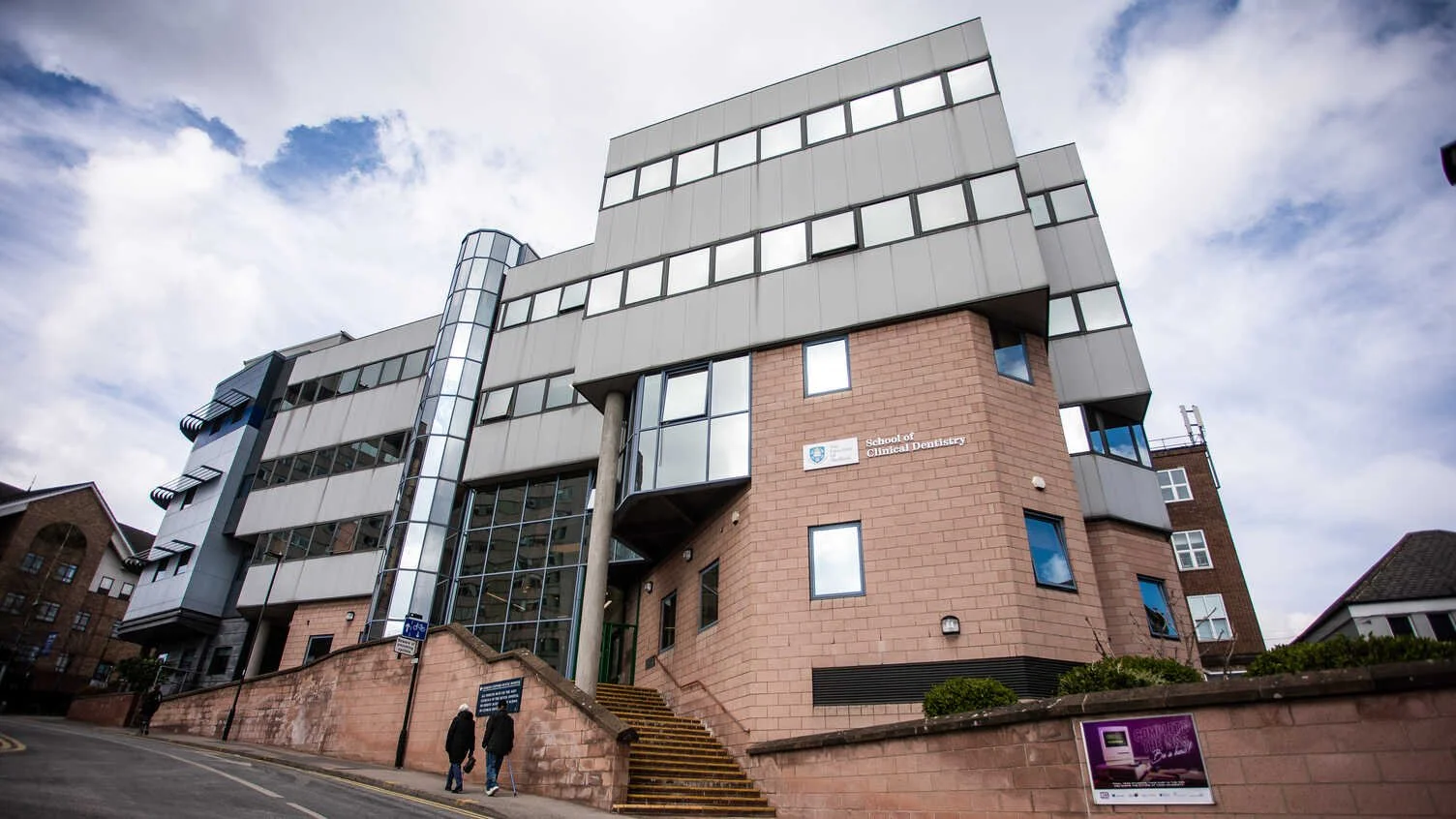
The School of Clinical Dentistry sits on Claremont Crescent, a few minutes' walk from the main University of Sheffield campus and — crucially — right next door to the Charles Clifford Dental Hospital, the specialist National Health Service (NHS) dental hospital that serves South Yorkshire and beyond. That adjacency is the whole logic of the course. Your lecture theatre and your clinic are effectively the same building.
The Bachelor of Dental Surgery (BDS) is a five-year programme, University and Colleges Admissions Service (UCAS) code A200, built around themed modules rather than traditional standalone units:
- Years 1–2 — Integrated Clinical Sciences (ICS), Clinical Knowledge and Skills (CKS), Personal and Professional Development (PPD) and Clinical Practice (CP), with early clinical exposure from your first year
- Year 3 — Clinical Knowledge and Skills and Clinical Practice continue; you begin planning your research project
- Years 4–5 — advanced Clinical Knowledge and Skills, Clinical Practice with Outreach (CPO) and Integrated Clinical Practice (ICP)
Assessment is a mix of written and digital exams, practical exams, Objective Structured Clinical Examinations (OSCEs), reflective reports, oral case discussions, a research project and a Dentistry Portfolio documenting your clinical encounters.
What makes Sheffield Dental School stand out?
Four things genuinely separate Sheffield from the other fifteen dental schools:
🤝 The whole team trains together. This is Sheffield's signature. Dental Surgery, Dental Hygiene and Dental Therapy students learn side by side — the school's own words are "we believe in training the whole team together." Most schools teach these groups separately and expect graduates to work out team dynamics later. Sheffield builds it in from Year 1. Expect to be asked about this at interview.
🏥 Charles Clifford Dental Hospital on the doorstep. A specialist NHS dental hospital immediately adjacent to the school, covering oral and maxillofacial surgery, paediatric dentistry, orthodontics and restorative dentistry.
🥽 Serious kit. The Clinical Skills Learning Environment (CSLE) is equipped to the standard a qualified dental team would use, alongside a virtual reality simulation suite, phantom head simulators, Anatomage tables for layer-by-layer three-dimensional anatomy, and plastinated specimens.
🌱 Sustainability leadership. Sheffield is recognised as a leader in environmental sustainability in dental education — an unusual specialism, and a genuinely good thing to have an opinion about if it comes up.
📊 Rankings and student experience ratings
Dentistry subject rankings
- 6th in the United Kingdom — Complete University Guide, Dentistry subject league table 2027
- Top 10 in the United Kingdom — Times and Sunday Times Good University Guide 2026, Dentistry
In the Complete University Guide's 2027 dentistry table, Sheffield scores 95 for graduate prospects, 87 for research quality, 79 for student satisfaction and 69 for entry standards. 🎓
The 95 graduate prospects figure is the one to notice. It is among the strongest in the table, and it is the metric that actually answers the question "will this degree get me a job?"
The University of Sheffield worldwide
- 82nd in the world and 14th in the UK — Quacquarelli Symonds (QS) World University Rankings 2027
- 108th in the world and 12th in the UK — Times Higher Education (THE) World University Rankings 2026, and 46th most international university in the world
- 13th in the UK — Complete University Guide 2027 and Times and Sunday Times Good University Guide 2026
- 33rd in the world — QS Sustainability Rankings 2026
- A founding member of the Russell Group
- In the Research Excellence Framework (REF) 2021, 92% of the University's research and impact was rated world-leading or internationally excellent
Student experience ratings — Sheffield's strongest suit
This is where Sheffield is genuinely exceptional, and it is worth knowing when someone asks you why you want to come here.
⭐ University of the Year for Student Experience — Times and Sunday Times Good University Guide 2026
🗳️ Number one in the Russell Group for student voice and for its Students' Union — National Student Survey (NSS) 2026
🏆 Number one Students' Union in the UK — StudentCrowd University Awards 2025, and in the Whatuni Student Choice Awards in 2024, 2023, 2022, 2020, 2019, 2018 and 2017
Seven Whatuni wins are not a fluke. Sheffield students consistently rate the place they study more highly than students almost anywhere else in the country — and for a five-year course where you will be tired, stressed and living in the same city throughout, that matters more than most applicants realise. 💙
🎯 How Sheffield Dental School decides who to call for interview
Sheffield's shortlisting runs in three distinct phases, and it publishes them openly. Screening happens between October and December.
Phase 1: the academic and UCAT gate
You must clear three things simultaneously:
- Meet the minimum academic requirements
- Achieve an average or above total score in the cognitive components of the UCAT
- Achieve Band 1 or Band 2 in the UCAT Situational Judgement Test (SJT)
Fail any one of these and you do not reach Phase 2. This is a pass/fail screen, not a scored one.
Phase 2: the personal statement and reference
Applications that clear Phase 1 are reviewed by trained staff who read your personal statement and reference looking for evidence of:
- Career exploration — do you actually know what dentistry is?
- Relevant personal qualities and values
- Commitment to the programme you have applied to
Since 2026 entry the UCAS personal statement is three structured questions rather than one continuous essay, so make sure each of those three things has somewhere obvious to live in your answers.
Phase 3: the UCAT ranking
Everyone who passes Phase 2 is then ranked by their UCAT cognitive score, and approximately 300 applicants are invited to a selection day.
What this three-phase design actually means for you
🔑 Read Phase 1 and Phase 3 together and the strategy becomes obvious. In Phase 1 the UCAT is a gate — "average or above" is a modest bar. In Phase 3 it is a ranking tool, and that is where a strong score genuinely buys you a place at the selection day.
So an average UCAT gets you through the door of Phase 1, gets your statement read, and then may well leave you below the line when 300 invitations are handed out. Do not treat "average or above" as the target. Treat it as the minimum. 💡
🧪 How the University Clinical Aptitude Test (UCAT) is used at Sheffield
The rules
- Everyone must sit the UCAT in the current admissions cycle. Results are valid for that cycle only — if you reapply, you must retake it.
- Cognitive components: average or above total in Phase 1; used to rank for interview in Phase 3.
- Situational Judgement Test: Band 1 or Band 2 required. Band 3 and Band 4 do not progress.
The SJT requirement is doing more work than you think
Sheffield's SJT rule quietly removes a large chunk of the applicant pool. In the 2025 UCAT cycle, the national band distribution was Band 1: 21%, Band 2: 39%, Band 3: 29%, Band 4: 10%.
Add those up. Roughly 39% of all UCAT candidates finished in Band 3 or 4 — and at Sheffield, every one of them is out at Phase 1, regardless of a brilliant cognitive score or straight A*s. ⚠️
If you take one practical thing from this article, make it this: do not treat the SJT as the bit you cannot revise for. At Sheffield it is a hard gate.
What does "average" actually mean?
The UCAT Consortium publishes mean scores each autumn. For the 2025 cycle — the most recent complete published figures at the time of writing, across 41,354 tests — the means were:
- Verbal Reasoning: 602
- Decision Making: 628
- Quantitative Reasoning: 661
- Total cognitive mean: 1891
🚨 The scale change you must understand before comparing any old numbers
Abstract Reasoning was removed from the UCAT from 2025 onwards. The test now has three cognitive subtests instead of four, and the maximum total score is 2700, not 3600.
That means every UCAT threshold, cut-off or "average" you find in an article, forum post or tutoring guide written before 2025 is on a completely different scale and cannot be compared to your score. If a page tells you a dental school wanted 2600, check which scale that is on before you panic. On the old scale 2600 was around 72%; on the new scale it would be a near-perfect result.
Sheffield does not publish a numerical UCAT cut-off for either phase, and the effective Phase 3 threshold shifts every year with the strength of the applicant pool. Aim high rather than aiming at a number. 📈
📚 Academic entry requirements for 2027 entry
- A-levels: AAA including Chemistry and Biology, plus a pass in the practical element of any science A-levels taken. The third subject can be anything except General Studies.
- Contextual offer (Access Sheffield / Access to Sheffield for Dentistry): AAB including Chemistry and Biology
- International Baccalaureate (IB): 36 points, with 6 in Higher Level Chemistry and Biology
- Scottish qualifications: AAABB at Higher plus AA at Advanced Higher in Chemistry and Biology
- BTEC Extended Diploma: D*DD in Applied Science, with Distinctions in the Chemistry and Biology units
- Access to Higher Education Diploma: 45 Level 3 credits — 39 at Distinction, 6 at Merit — in a relevant subject
- GCSEs: English Language at grade 7/A, plus Maths and Science at 7/A. Sheffield adds a useful reality check: "Most applicants who secure an interview have a minimum of 6 GCSEs at grade 7/A including Maths, English Language and Science."
- English language (international applicants): IELTS 7.0 overall with a minimum of 6.5 in each component
The rules that catch people out
📌 Resits are allowed — with a condition. If you are repeating A-levels, you must have achieved a minimum grade B in each subject at first sitting. If you did not, Sheffield's advice is to wait, achieve AAA, and apply afterwards.
📌 AS grades are not considered. Sheffield uses achieved A2 grades or predicted grades.
📌 Taking longer than two years over your A-levels is fine. So is resitting, within the rule above.
📌 Deferred entry is welcomed — and assessed competitively through exactly the same process. This is the opposite of several other dental schools, and worth knowing if a gap year is part of your plan. ✅
📌 Transfers are not accepted, from UK or overseas dental schools, because of General Dental Council (GDC) requirements and government-controlled place numbers.
🔬 Career exploration: what Sheffield expects instead of a work experience checklist
Sheffield does not publish a required number of shadowing days. What it asks for is career exploration — evidence that you have made an informed choice.
That means being able to show:
- Knowledge of the profession, and how it compares with other healthcare careers
- Experience in healthcare settings, ideally within general dental practice
- Conversations with dental professionals about what the job is really like
- An understanding that dentistry involves sustained, intricate manual tasks in high-pressure situations, and emotionally demanding clinical work that requires resilience
Sheffield's own free course — use it
The school runs a free six-week online course called Discover Dentistry, created by Professor Christopher Stokes and hosted on the University's Blackboard platform. It covers the dental team, tooth anatomy, specialisms such as paediatric dentistry and oral surgery, dental materials, dental public health, ethics, and research happening at Sheffield.
Doing a dental school's own course before you interview there is worth close to free marks. It gives you specific, Sheffield-flavoured things to talk about in a section of the interview explicitly called "career exploration". 🎯
🗣️ How Sheffield Dental School interviews: format, structure and timings
The headline: this is not an MMI
Most UK dental schools now run Multiple Mini Interviews. Sheffield does not. The Dental Schools Council lists Sheffield's format for 2027 entry as a "Semi-Structured Panel Interview with additional Interpersonal skills test."
You will attend a selection day with two distinct assessed components.
Component one: the panel interview
- Format: semi-structured panel interview
- Length: up to 15 minutes
- Panel: usually two members of academic staff and a senior dental student
"Semi-structured" is the important word. The panel works from a defined set of areas, so every candidate is asked about the same things — but they can follow up on your answers rather than reading from a fixed script. Expect the phrase "tell me more about that."
The three assessed areas
Sheffield names them explicitly:
- Career exploration — your motivation for dentistry and your current knowledge of the profession
- Personal qualities, communication skills, relevant experience and values
- Commitment to Sheffield — specifically this course, at this school
Sheffield also states that interviewers expect applicants to demonstrate thorough research and the ability to apply that knowledge to new scenarios. In other words: memorised facts are not enough. You will be asked to do something with what you know. 🧠
Component two: the interpersonal skills test
A separate group-based task, assessed against three named criteria:
- 🤝 Respect
- 👥 Teamwork
- 💬 Communication
This is the part applicants most often under-prepare for, because it is nothing like anything a school interview has trained you for. You are in a room with other candidates — people who, technically, are competing with you for the same 71 places — and you are being marked on how well you work with them.
The single most important thing to understand about the group task
The person who dominates the discussion does not win. The three criteria are respect, teamwork and communication — not leadership, and not having the best idea. An assessor watching you talk over a nervous candidate has just seen you fail two of the three criteria in one sentence.
The strongest performers do unglamorous things: bring in the person who hasn't spoken, summarise where the group has got to, check the time, build on someone else's idea, and say whose idea it was. ⭐
Delivery: on campus, no exceptions
Sheffield is unambiguous: "All selection days take place on campus. We do not offer online selection days."
No video link, no breakout rooms, no backup Zoom. Budget for the train to Sheffield and, if you are travelling far, a night before. 🚂
Values-based recruitment runs all day
Sheffield operates values-based recruitment aligned to the NHS Constitution: working together for patients, respect and dignity, commitment to quality of care, compassion, improving lives, and everyone counts.
And it comes with teeth. Sheffield states that any applicant who displays values or behaviours contravening this at any point during the application process will have their application rejected. That includes how you speak to the receptionist, the student ambassador, and the other candidates. Assume you are being observed from the moment you arrive. ⚠️
📅 When are Sheffield dentistry selection days held?
The timeline for 2027 entry:
- 15 October 2026 — UCAS deadline (a maximum of four of your five choices may be dentistry)
- October to December 2026 — the three screening phases
- January 2027 — interview invitations usually issued; you choose from a range of available dates
- January to March 2027 — selection days held on campus
- By the end of March 2027 — outcomes communicated
Sheffield lets shortlisted applicants select from a range of dates, which is unusually accommodating. Specific 2027 dates are published on the school's admissions page — check it once invitations go out. 📬
🧠 What topics are covered in the Sheffield dentistry interview?
Pulling everything Sheffield publishes together, prepare for:
- Motivation for dentistry and why not medicine
- Knowledge of the profession — the dental team, the GDC, NHS dentistry and its pressures
- Reflection on your career exploration — not what you did, but what you understood
- Communication — explaining, listening, adapting to your audience
- Teamwork and leadership awareness
- Self-motivation and responsiveness to feedback
- Resilience and realism about intricate, high-pressure, emotionally demanding work
- NHS Constitution values and professional ethics
- Applying knowledge to new scenarios you have not prepared for
- Commitment to Sheffield specifically — the course, the team-training model, the city
- Respect, teamwork and communication in the group task
🔢 How many are interviewed, and how many get offers?
- Approximately 1,250 applications are received each year
- Approximately 300 applicants are invited to a selection day
- 71 places are available
Sheffield states that it makes more offers than there are places to account for applicants who decline or firm elsewhere, and it operates a formal reserve list to meet government-regulated intake targets.
What the numbers really say
Roughly one in four applicants gets a selection day. From there, with 71 places and offers exceeding that number, your odds improve dramatically — realistically, a meaningful proportion of interviewees receive an offer.
The bottleneck at Sheffield is screening, not interviewing. Which is exactly why the SJT band requirement and the Phase 3 UCAT ranking deserve far more of your attention than most applicants give them. 💪
✅ What is the interview scoring method?
Sheffield does not publish a numerical marking scheme, a station-by-station breakdown or a pass mark. What it does publish is the framework the scoring sits on, which is nearly as useful:
The panel interview is scored against three named areas — career exploration; personal qualities, communication, experience and values; and commitment to Sheffield.
The interpersonal skills test is scored against three named criteria — respect, teamwork and communication.
Values-based recruitment overlays everything, and a values breach is disqualifying rather than merely low-scoring.
Because the panel is semi-structured, every candidate is assessed against the same areas, which makes the day fairer than a free-flowing chat — and much more predictable to prepare for. Map your preparation onto those six named things and you have covered the mark scheme. 🎯
Sheffield also provides feedback on request after the process, which is worth knowing if you end up reapplying.
📮 When are offers released?
Sheffield aims to inform applicants of the outcome of their selection day by the end of March. For 2027 entry, expect decisions across February and March 2027, with the reserve list moving later in the cycle if firm acceptances fall short.
If you are on the reserve list, you are not rejected. You are waiting for the intake target maths to resolve. 🤞
❓ 80 example Sheffield dentistry interview questions, sorted by assessed area
These are written in Sheffield's own format — panel questions for the interview, and group task briefs for the interpersonal skills test — and grouped by the areas Sheffield says it assesses.
Practise the panel questions to a clock. You have up to 15 minutes for the whole interview across three assessed areas, which realistically means 90 seconds to two minutes per answer. If your "why dentistry" answer runs four minutes, you have just spent a quarter of your interview on one question. ⏱️
🎯 Career exploration: motivation for dentistry
- Why dentistry? And why not medicine?
- When did you first seriously consider dentistry, and what has kept you interested since?
- What would you say to someone who told you dentistry is just a well-paid trade?
- Which part of dentistry appeals to you least, and how do you know you could live with it?
- Talk us through what you have done to test whether this career is genuinely right for you.
- What have you read, watched or attended recently about dentistry that changed your thinking?
- This is five years of study followed by Dental Foundation Training. How do you feel about committing to that at seventeen?
- If you spent forty years in general practice in one town, would that still appeal to you?
- What is the difference between a dentist, a dental therapist and a dental hygienist?
- If you do not get a dentistry place this year, what will you do?
🔍 Career exploration: knowledge of the profession
- Walk us through a typical day for a general dental practitioner working in the NHS.
- Who is in the dental team, and what does each member actually contribute?
- What is the General Dental Council, and what does it do?
- What do you think are the three biggest challenges facing NHS dentistry right now?
- What do you understand by the term "dental deserts"?
- From a patient's point of view, what is the difference between NHS and private dental treatment?
- What is a Unit of Dental Activity, and why do dentists talk about them so much?
- Name a recent development in dentistry that interests you, and explain why.
- What is evidence-based dentistry, and why does it matter in practice?
- How does oral health in the UK differ between the richest and poorest areas, and why?
- What role does prevention play in modern dentistry, and is the system set up to reward it?
- The Government's 10 Year Health Plan proposes that newly qualified dentists work in the NHS for a minimum period. What do you make of that?
🪞 Career exploration: reflecting on your experience
- Tell us about the observation or work experience you have done. What surprised you most?
- Describe something you saw a dental professional do well. What specifically made it effective?
- Describe something you saw that you would do differently, and explain your reasoning.
- What did your experience teach you about the parts of the job that are not clinical?
- What did you learn about how dental professionals deliver news a patient does not want to hear?
- Tell us about a time in a caring or customer-facing role when you dealt with someone difficult.
- If you could not get dental work experience, what did you do instead, and what did you take from it?
- What did you take from the Discover Dentistry course, or from other online learning about the profession?
- What is the least glamorous thing you have seen in a dental setting, and how did you react to it?
💬 Personal qualities: communication skills
- Explain to us, as though we were a nervous ten-year-old, what a filling is and why they need one.
- Teach us something you know well in two minutes. It does not have to be scientific.
- How would you explain a treatment plan to a patient whose English is limited?
- What makes someone a good listener? Give us an example of when you listened well.
- Tell us about a time your communication went wrong. What did you change afterwards?
- How would you tell a patient that their own habits are causing their pain, without them becoming defensive?
- A patient has read something alarming online about root canal treatment. How do you respond?
- How does the way you speak change between an older patient, a child, and a friend your own age?
💪 Personal qualities: resilience, self-motivation and feedback
- Tell us about feedback that was hard to hear. What did you actually do with it?
- Describe a genuine failure, and what changed as a result of it.
- Dentistry means repeating intricate manual tasks under time pressure, for hours. What makes you think you can do that?
- How do you cope when something you are practising simply will not come right?
- What do you do to look after your own wellbeing, and would it survive a five-year clinical course?
- Stress and burnout rates in dentistry are high. What do you understand about why that is?
- What have you taught yourself in the last year purely because you wanted to?
- How do you organise yourself when several deadlines land in the same week?
👥 Personal qualities: teamwork and leadership
- Tell us about a team you were part of that was not working. What did you do about it?
- When have you had to follow a decision you disagreed with?
- What does good leadership look like to you? Have you ever led anything?
- Describe a time you had to rely on someone else to get something done.
- How do you handle a team member who is not pulling their weight when you are not in charge?
- What is the difference between being assertive and being difficult?
- What have you learned about teamwork from something outside school — a job, a sport, music, volunteering?
🤍 Values, ethics and professionalism
- The NHS Constitution lists values including compassion, respect and dignity, and working together for patients. Which do you find easiest, and which hardest?
- A patient asks you to whiten a healthy set of teeth that you think already look fine. What do you consider?
- A patient who smokes heavily wants implants. Talk us through your thinking.
- Should patients who repeatedly miss appointments lose their place on an NHS list?
- You see a fellow student post a photograph of a patient's mouth on social media. What do you do?
- What does professionalism mean for a dental student, before they qualify?
- Is it ever acceptable to treat a patient who has not fully understood what you are proposing?
- Should sugary drinks be taxed more heavily? Make the case both ways.
- What would you do if you made a clinical mistake that the patient never noticed?
- A colleague asks you to cover for them after they arrive late for the third time. What do you do?
🧩 Applying knowledge to new scenarios
Sheffield explicitly says interviewers look for the ability to apply your research to new situations. These are the ones you cannot rehearse — practise the thinking, not the answer.
- There is one emergency appointment left today and three patients who want it. How would you decide?
- A new practice opens in an area where a third of five-year-olds have visible decay. What would you prioritise in the first year?
- What role should artificial intelligence play in diagnosing dental disease, and where should it stop?
- If you could change one thing about how dentistry is delivered in the United Kingdom, what would it be and what would it cost?
- How would you persuade a teenager who has never seen a dentist to come back for a second appointment?
- A patient cannot afford the treatment you believe is best. Talk us through your options.
🏫 Commitment to Sheffield
This is a named assessed area. Vague enthusiasm will not score.
- Why Sheffield, rather than the other three dental schools on your UCAS form?
- What do you know about how our course is structured?
- We teach through themed modules — Integrated Clinical Sciences, Clinical Knowledge and Skills, Personal and Professional Development, and Clinical Practice. Why do you think we do it that way?
- We train Dental Surgery, Dental Hygiene and Dental Therapy students together. What is the argument for that, and what would you gain from it?
- Our students have clinical exposure from the first year at Charles Clifford Dental Hospital. How do you feel about that?
- What appeals to you about outreach placements in general practices and community clinics?
- Have you been to an open day, or spoken to a Sheffield student? What did you take from it?
- What have you seen of Sheffield as a city, and could you live here for five years?
- Our school is recognised for its work on sustainability in dental education. Does that matter to you?
- What would you contribute to the School of Clinical Dentistry beyond your clinical work?
🤝 Group task briefs: preparing for the interpersonal skills test
Sheffield does not publish what the group task involves, so these are realistic practice briefs built around the three named criteria — respect, teamwork and communication. Run them with four or five friends and a timer, and afterwards ask each person what the others did well.
- Your group has £500 to run an oral health campaign at a local primary school. Agree a plan in ten minutes and present it.
- Rank six patients in order of who should receive the last emergency appointment of the day, and reach a group decision everyone can live with.
- Build the tallest free-standing structure you can with the materials provided. You have eight minutes.
- Each member of the group holds one piece of information that nobody else has. Work out the answer together.
- Agree the three qualities that matter most in a dentist, and be prepared to defend the choice as a group.
- Discuss whether fluoride should be added to all UK water supplies and reach a shared position.
- Plan how your group would spend one day supporting a care home with residents' oral health.
- Reach a group decision about how a dental practice should handle repeated missed appointments.
🚫 What loses marks in a group task
- Talking over people, or restating your idea louder when it does not land
- Going silent because you cannot see an obvious gap to speak into
- Treating it as a debate to win rather than a task to complete
- Ignoring the time limit until someone else raises it
- Agreeing with everything to seem pleasant — that scores nothing on communication
✅ What gains marks
- "We have got about three minutes left — shall we agree the top two?"
- "Building on what you said about the budget…"
- "I do not think we have heard from you yet — what do you think?"
- "I disagree, but I can see why that works — can we test it against the brief?"
- Volunteering to summarise, note-take or keep time when nobody else does
💬 What students say about the Sheffield selection day
⚠️ The themes below are drawn from recurring feedback shared by applicants and current students over several cycles, paraphrased rather than quoted from named individuals. Treat them as a steer, not as gospel.
"It felt like a conversation, not an interrogation." The most common theme by far. A three-person panel sounds intimidating on paper, but candidates repeatedly describe a warm, curious tone — including from the dental student, who several people said was the friendliest face in the room.
"Fifteen minutes goes very quickly." Applicants who had rehearsed to a timer said it was the most useful thing they did. Those who had not consistently report being cut off mid-answer or running out of time before the "commitment to Sheffield" questions came up.
"They followed up on everything." Because the interview is semi-structured, candidates describe being asked "why?" and "tell me more about that" repeatedly. Answers that sounded rehearsed reportedly attracted the most follow-ups — and shallow claims fell apart fast.
"The group task caught me off guard." The single most repeated regret. Applicants who had drilled panel answers said they had done nothing at all to prepare for working in a group, and had not considered that being quiet could cost them just as much as being domineering.
"Everyone was surprisingly nice to each other." Several candidates noted that the other applicants were not the sharks they expected, and that the group task worked much better once people stopped competing. That is not a coincidence — it is the criteria doing their job.
"Being on campus mattered." Because Sheffield does not run online selection days, applicants get a real look at the school, the hospital next door and the city. Several said the day itself was what moved Sheffield up their list.
"They wanted to know why Sheffield." Repeatedly flagged. Applicants who could name the team-training model, the modules or the outreach placements felt on solid ground. Those who offered generic praise for the city said they felt the answer land flat.
🌟 Top tips for the Sheffield dentistry interview
1. Protect your SJT. 🎯 Band 3 or 4 ends your Sheffield application at Phase 1, whatever else you have done. Around 39% of candidates land there nationally. Practise SJT questions properly — this is the highest-leverage revision you can do for Sheffield.
2. Do not aim for "average" on the UCAT. Average clears Phase 1. The Phase 3 ranking is what actually hands out the 300 invitations.
3. Rehearse to fifteen minutes, not to a question list. Three assessed areas in a quarter of an hour means roughly 90 seconds to two minutes per answer. Time yourself. Cut before the day, not on it.
4. Prepare for the group task as seriously as the interview. 🤝 It is half of what is assessed and almost nobody practises it. Get four friends and run the briefs above.
5. Learn the three panel areas and the three group criteria. Career exploration; personal qualities, communication, experience and values; commitment to Sheffield. Respect, teamwork, communication. Six things. That is your mark scheme.
6. Build a "commitment to Sheffield" answer with actual nouns in it. Charles Clifford Dental Hospital. Team training with hygiene and therapy students. Themed modules. Outreach placements in Year 4. The virtual reality simulation suite. Specifics beat enthusiasm every time.
7. Do the Discover Dentistry course. 📚 It is free, it is six weeks, it is Sheffield's own, and it gives you concrete material for the career exploration section.
8. Have five stories, not fifty facts. ⭐ A job, a team, a failure, a caring role, a moment you led something. Five well-reflected experiences can answer forty different questions. Depth beats breadth when the panel follows up.
9. Expect the follow-up. Semi-structured means they will push. For every claim you plan to make, know the "why?" and the "tell me more" that follows it.
10. Learn the NHS Constitution values and have an honest opinion. Working together for patients, respect and dignity, commitment to quality of care, compassion, improving lives, everyone counts. Values-based recruitment is not a slogan here.
11. Behave well all day, to everyone. ⚠️ Sheffield states plainly that values breaches at any point in the process mean rejection. That includes how you treat the other candidates in the group task and the students showing you round.
12. Plan the journey. 🚂 No online option exists. Book travel early, and if you are coming a long way, consider staying the night before. Nobody has ever interviewed well straight off a delayed 5am train.
13. Read your personal statement again on the train. It got you through Phase 2. The panel has it in front of them.
14. Ask a real question at the end. You have a senior dental student in the room — arguably the best-informed person you will ever meet about what this course is actually like. Use them.
⚡ Key facts at a glance
🏛️ Dental school: School of Clinical Dentistry, University of Sheffield — Claremont Crescent, adjacent to Charles Clifford Dental Hospital
🎓 Degree: Bachelor of Dental Surgery (BDS), 5 years, UCAS code A200
🥇 Rankings: 6th in the UK for dentistry (Complete University Guide 2027); top 10 (Times and Sunday Times Good University Guide 2026); university 82nd in the world (QS 2027), 108th (THE 2026)
⭐ Student experience: University of the Year for Student Experience (Times and Sunday Times 2026); number one Russell Group for student voice and Students' Union (NSS 2026); number one Students' Union (StudentCrowd 2025)
📅 Application deadline: 15 October 2026 (maximum four dentistry choices)
📝 Entry requirements: A-levels AAA including Chemistry and Biology plus practical pass · contextual AAB · IB 36 with 6,6 at Higher Level in Chemistry and Biology · Highers AAABB plus Advanced Higher AA in Chemistry and Biology · BTEC D*DD Applied Science · GCSE English Language, Maths and Science at 7/A, with most interviewees holding six GCSEs at 7/A
🔁 Resits: Permitted if a minimum grade B was achieved in each subject at first sitting. AS grades: not used. Deferred entry: welcomed. Transfers: not accepted
🧪 Admissions test: University Clinical Aptitude Test (UCAT), current cycle only — reapplicants must retake
⚠️ UCAT use: Phase 1 requires an average or above cognitive total and SJT Band 1 or 2; Phase 3 ranks applicants by cognitive score for interview invitations. No numerical cut-off published
📉 2025 UCAT national means: VR 602, DM 628, QR 661, total 1891 (new 2700 scale — pre-2025 figures on the old 3600 scale are not comparable)
🦷 Career exploration: No fixed hours required; healthcare or dental practice experience valued, plus Sheffield's free six-week Discover Dentistry course
🗣️ Interview format: Semi-structured panel interview, up to 15 minutes, with usually two academic staff and one senior dental student — plus a separate group interpersonal skills test
📍 Delivery: On campus only — Sheffield does not offer online selection days
✅ Assessed: Panel — career exploration; personal qualities, communication, experience and values; commitment to Sheffield. Group task — respect, teamwork, communication. Values-based recruitment throughout
👥 Numbers: approximately 1,250 applications · approximately 300 interviewed · 71 places · more offers made than places, plus a reserve list
📆 Screening: October–December 2026 · Invitations: usually January 2027 · Selection days: applicants choose from a range of dates · Outcomes: by the end of March 2027
🩺 Also required on acceptance: Enhanced Disclosure and Barring Service (DBS) check, occupational health screening, and proof of childhood vaccinations
💬 Feedback: available on request after the process
🔗 Useful links
- University of Sheffield — Dental Surgery BDS, 2027 entry
- Sheffield — Dental Surgery admissions and selection process, 2027 entry
- Sheffield School of Clinical Dentistry
- Sheffield School of Clinical Dentistry — Undergraduate study
- Sheffield — Discover Dentistry free online course
- Sheffield — Our facilities
- University of Sheffield — Rankings and reputation
- University of Sheffield — Open days
- Dental Schools Council — Entry requirements for 2027 entry (PDF)
- Dental Schools Council
- UCAT Consortium — official test information
- UCAT Consortium — Test statistics
- UCAT Consortium — How universities use the UCAT
- General Dental Council — Standards for the Dental Team
- NHS Constitution for England
- UCAS — Applying to university
- Complete University Guide — Dentistry league table
- Sheffield Teaching Hospitals — Charles Clifford Dental Hospital