I Have No Medicine Work Experience – What Can I Put in My Personal Statement?
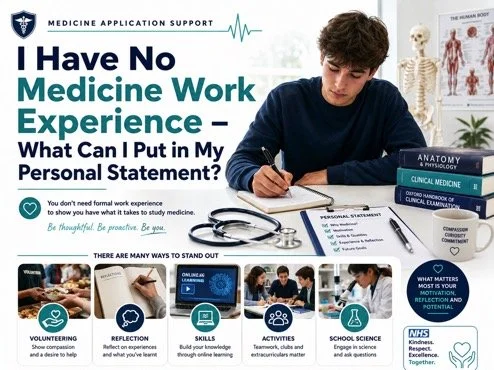
So the hospital never emailed back. The GP surgery said no. Your school's careers adviser shrugged. And now you're staring at a blank personal statement wondering whether your dream of studying medicine is over before it's begun.
Take a breath. It isn't. 💙
UCAS itself tells applicants not to panic if they haven't got the experience yet – there's still time to get it, and there are plenty of other ways to show you've developed the skills a doctor needs. Even better, the Medical Schools Council (the organisation representing all UK medical schools) now talks about "relevant experiences" rather than formal work experience. That's a deliberate choice of words, and it works in your favour.
This guide walks you through exactly what admissions tutors are really looking for, the free alternatives to hospital shadowing that medical schools genuinely respect, and how to write about them so your personal statement stands out – even without a single day on a ward.
Why Medical Schools Don't Expect Hospital Work Experience Anymore
Here's something most sixth formers don't realise: admissions tutors know how hard it is to arrange clinical placements. Hospitals have safeguarding rules, GP surgeries are stretched, and – let's be honest – students whose parents happen to know a consultant have always had an unfair head start.
Medical schools have responded by shifting the goalposts, in a good way. What they assess is not where you went, but what you understood. The Medical Schools Council is clear that insight into medicine can come from volunteering, part-time jobs, conversations with healthcare professionals, virtual programmes, reading and reflection – not just shadowing.
In other words, two students could write about wildly different experiences – one shadowed a surgeon, one stacked shelves in a pharmacy on Saturdays – and the shelf-stacker could easily score higher. It all comes down to reflection, which we'll get to shortly. 🩺
What Admissions Tutors Actually Assess
When tutors read your personal statement, they're looking for evidence of:
- A realistic understanding of medicine – the pressures and frustrations as well as the rewards
- Core values and skills – empathy, communication, teamwork, resilience and integrity
- Genuine motivation – a reason for choosing medicine that goes deeper than "I like science and helping people"
- Reflection – the ability to learn from what you've seen and done
Notice that "two weeks in a hospital" appears nowhere on that list.
Free Alternatives to Medical Work Experience That Universities Respect
If you can't get a placement, these options are recognised, accessible and – crucially – free.
1. Virtual Work Experience 💻
Virtual work experience went mainstream during the pandemic and never went away. Two programmes stand out because they're backed by the medical profession itself:
Observe GP
Created by the Royal College of General Practitioners, Observe GP is a free interactive video platform for aspiring medics aged 16 and over. You'll watch real members of a primary care team at work, see how they communicate with patients and handle uncertainty, and complete reflective exercises along the way. It's supported by the Medical Schools Council as a suitable form of relevant experience – so you can mention it in your personal statement with confidence.
Top tip: download the free reflective diary that comes with it and fill it in as you go. Those notes will write half your personal statement for you.
BSMS Virtual Work Experience
Brighton and Sussex Medical School runs a free online work experience course covering six medical specialties, complete with short reflective write-ups. Because it's run by an actual UK medical school, it carries real weight – and it shows initiative that you sought it out.
2. Volunteering in a Caring Role 🤝
UCAS and the Medical Schools Council both emphasise that working alongside people in a caring or service role is just as valuable as clinical shadowing – especially with people who are ill, elderly, disabled or vulnerable. Consider:
- Care homes and nursing homes – observe how effective care is delivered and chat with residents
- Hospices – many run structured volunteer schemes for sixth formers
- Charities, food banks and helplines – meaningful contact with vulnerable people counts
- Befriending schemes – regular visits to isolated older people build exactly the communication skills medicine demands
A few hours a week over several months looks far better than a one-off fortnight, because it demonstrates commitment – something every medical school prizes.
3. Part-Time Jobs (Yes, Really) ☕
Waiting tables, working a till, coaching kids' football on Sundays – these all develop communication, teamwork, responsibility and the ability to stay calm when everything's going wrong at once. The Royal College of General Practitioners explicitly notes that applicants can use examples from part-time work to demonstrate skills like communication.
The trick is to connect the dots for the reader. Don't just say you worked in a café; explain how calming down a furious customer taught you to listen before responding – and why that matters at a GP's desk.
4. Caring for a Family Member 💙
If you've helped care for a relative who is unwell or disabled, that experience is valid and valuable. Focus on what you learned about the realities of illness, the healthcare system and the needs of the person you cared for, rather than dwelling on the emotional difficulty. Handled thoughtfully, it can be one of the most powerful things in a statement.
5. Conversations, Reading and Wider Research 📚
The Medical Schools Council suggests simply having a conversation with your GP or another healthcare professional to gain insight into the day-to-day reality of the job. Beyond that:
- Read articles in medical journals such as the BMJ (many student-friendly pieces are free)
- Follow NHS news and current ethical debates – these come up at interview
- Listen to medical podcasts and watch documentaries, then reflect critically on them
- Read the General Medical Council's Good Medical Practice – it sets out what's expected of every doctor in the UK, and referencing its values shows real maturity
How to Write About It: Reflection Beats Description Every Time
This is the section to bookmark. The single biggest mistake applicants make – with or without work experience – is describing what they did instead of reflecting on what they learned.
The Golden Formula
For every experience, ask yourself three questions:
- What happened? (One sentence, maximum.)
- What did I learn or realise? (This is the heart of it.)
- How does this connect to a career in medicine? (Be specific – link it to a skill or value doctors need.)
A Quick Before-and-After
❌ "I volunteered at a care home every Saturday for six months, where I helped serve meals and talked to residents."
✅ "Volunteering weekly at a care home, I noticed how a resident with dementia grew calmer when I slowed my speech and maintained eye contact. It showed me that communication in healthcare is about adapting to the person in front of you – something I saw echoed in the consultations on Observe GP."
The second version is barely longer, but it proves insight, observation and genuine engagement. That's what earns interviews.
Fitting It Into the New UCAS Personal Statement Format
From 2026 entry onwards, the UCAS personal statement is no longer one long essay. You now answer three structured questions, with 4,000 characters in total across all three:
- Why do you want to study this course or subject?
- How have your qualifications and studies helped you prepare?
- What else have you done to prepare outside of education, and why are these experiences useful?
Question three is where your volunteering, virtual work experience, part-time job and wider reading live. Notice the wording: why are these experiences useful? UCAS is practically begging you to reflect rather than list. Give each experience a sentence of context and two or three sentences of insight, and you'll be answering the question exactly as intended.
Start Today: Your Two-Week Action Plan ✅
Worried you're behind? Here's what you can realistically do before the fortnight is out:
- This week: register for Observe GP and start the BSMS virtual course. Begin a reflective diary – a notes app is fine.
- This week: email or visit two local care homes, a hospice and a charity shop about volunteering. Ask your school if they have contacts too.
- Next week: ask your GP surgery whether a doctor or nurse would spare fifteen minutes for a career chat. Read the opening chapters of Good Medical Practice.
- Ongoing: follow NHS news, note down anything that makes you think, and keep volunteering regularly rather than in one burst.
Do all that, and in a month's time you'll have more genuine, reflective material than many applicants who spent a week silently trailing a consultant.
The Bottom Line
No hospital placement? You are not at a disadvantage – you're simply taking a different route to the same destination. Medical schools have redesigned their admissions guidance precisely so that students without connections can compete fairly. What they cannot teach you, and what they're desperate to see, is insight, commitment and honest reflection.
You can build all three starting this afternoon, from your bedroom, for free. So close this tab, open Observe GP, and get going. Your future patients won't care whether you shadowed a surgeon at seventeen – but they will care that you learned how to listen. 💙
Useful Links
- UCAS – Medicine Personal Statement Guide
- UCAS – Personal Statement Advice: Medicine
- Medical Schools Council – Work Experience Guidance
- Observe GP – Royal College of General Practitioners
- Brighton and Sussex Medical School – Virtual Work Experience
- General Medical Council – Good Medical Practice
- NHS Health Careers – Applying to Medical School