Medicine Personal Statement Conclusion Examples: How to End Your Statement in the New UCAS Format
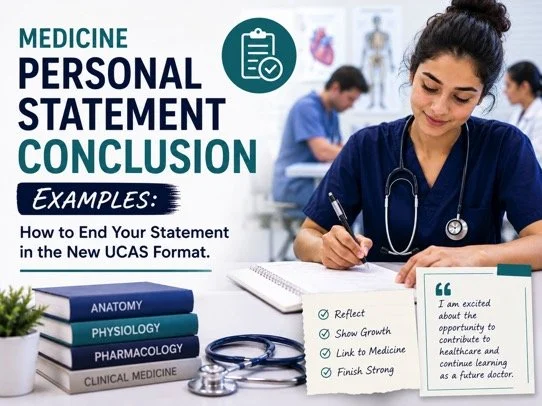
You've written about the ward round that changed how you see medicine. You've reflected on your EPQ, your volunteering at the care home, and that conversation with a junior doctor that stuck with you. And now you're staring at the final few lines wondering how on earth to finish.
Here's the good news: ending a medicine personal statement is far less mysterious than it feels — and thanks to the new UCAS format, you may not need a traditional conclusion at all. 💙
Do You Still Need a Conclusion in the New UCAS Medicine Personal Statement?
Short answer: not in the way you might think.
Since the 2026 entry cycle, UCAS has replaced the single 4,000-character essay with three structured questions:
- Why do you want to study this course or subject?
- How have your qualifications and studies helped you prepare for this course or subject?
- What else have you done to prepare outside of education, and why are these experiences useful?
The overall limit is still 4,000 characters across all three answers, with a minimum of 350 characters each. Crucially, admissions teams read your three answers together, as one statement.
That changes the maths on conclusions. In the old format, a closing paragraph rounded off a single essay. Now, if you write a full introduction and conclusion for each answer, you'll burn hundreds of precious characters saying very little — three times over.
So what replaces the conclusion?
Think of it as three strong final sentences rather than one concluding paragraph. Each answer should end with a line that lands: a reflection, a forward-looking thought, or a sentence that ties your evidence back to medicine. Your third answer, being the last thing admissions tutors read, does the heaviest lifting — its final line is effectively the conclusion of your whole statement.
💙 Rule of thumb: no answer should simply stop after its last example. Every answer should end on reflection, and the final line of Question 3 should leave the reader in no doubt that you understand what you're signing up for — and want it anyway.
What Makes a Good Ending? (According to the People Who Read Them)
Medical schools are refreshingly consistent about what they want. The Medical Schools Council's guidance on personal statements emphasises reflection over lists: it's not what you did, it's what you learned and how it shaped your understanding of medicine. The General Medical Council's Good Medical Practice and Outcomes for Graduates describe the qualities schools are selecting for — honesty, empathy, teamwork, resilience and a realistic grasp of the demands of the job.
A good ending, then, does three things:
- Shows realism. You know medicine is long, demanding and sometimes bruising — and you're choosing it with your eyes open.
- Shows reflection. It draws a genuine lesson from your experiences rather than repeating them.
- Shows direction. It looks forward, briefly and without melodrama, to studying medicine and the career beyond.
What it should not do is introduce brand-new material. If you find yourself mentioning your Duke of Edinburgh award for the first time in your closing line, it belongs earlier — or not at all.
Medicine Personal Statement Conclusion Examples
The examples below are written for the new format, so you'll find endings for each of the three questions plus full "final line of the statement" examples. Please don't copy them — UCAS runs every statement through similarity-detection software, and admissions tutors have read every borrowed sentence a hundred times. Use them to understand the shape of a good ending, then write your own.
Endings for Question 1: Why do you want to study medicine?
Your first answer sets out your motivation. End it by connecting your reasons to a realistic understanding of the career.
Example 1 ✅
"Shadowing in the respiratory clinic showed me that medicine is rarely about dramatic saves; more often it is about small, careful decisions made with and for patients. That slower, more human version of medicine is the one I want to practise."
Example 2 ✅
"I am not drawn to medicine despite its difficulty but partly because of it: it is one of the few careers where scientific problem-solving and human connection are demanded in equal measure, every day."
Why these work: both endings are specific, reflective and realistic. Neither claims a lifelong calling or a burning passion — phrases that tell admissions tutors nothing.
Endings for Question 2: How have your studies prepared you?
This answer covers your academic preparation — A-levels, Highers, your EPQ, wider reading. End by linking what you've learned to how medicine is actually studied and practised.
Example 1 ✅
"Researching antibiotic resistance for my EPQ taught me to sit with uncertainty: the more I read, the less settled the science appeared. I now see that comfort with ambiguity is not a weakness in medicine but a working requirement."
Example 2 ✅
"Chemistry taught me precision; biology taught me systems thinking; but it was learning to defend my EPQ conclusions under questioning that best prepared me for how medical knowledge is really built — through evidence, challenge and revision."
Endings for Question 3: What else have you done to prepare?
This is where your work experience, volunteering and wider commitments live — and its final line closes your entire statement. Aim for a sentence that draws everything together.
Example 1 ✅
"A year of Sunday shifts at the care home taught me more about communication than any book: how to listen to a resident with dementia, how to notice what isn't said. These experiences have not romanticised medicine for me — they have shown me its weight, and confirmed that it is a weight I want to carry."
Example 2 ✅
"Between volunteering, part-time work and captaining my football team, I have learned to manage my time, take responsibility for others and keep going when things are hard. I know these same habits will be tested far more severely at medical school — and I am ready for that test."
Example 3 ✅
"None of these experiences has given me the certainty of a doctor; they have given me something more honest — a clear-eyed view of the career and a settled determination to pursue it."
What if my school still asks for an old-style statement structure?
Some teachers and advisers still draft statements as a single essay before splitting it across the three questions, and some resources online describe the pre-2026 format. If you're working that way, a traditional concluding paragraph of two to three sentences is fine at the drafting stage — just make sure that by the time your statement is split into the three UCAS boxes, each answer stands on its own and you haven't wasted characters on three separate sign-offs.
Conclusion Clichés to Avoid ❌
Admissions tutors read thousands of statements. These endings appear in a startling number of them:
- "I have wanted to be a doctor since I was young." Unverifiable and unpersuasive — motivation matters, not its age.
- "Medicine is my passion." Show it through evidence; don't announce it.
- A famous quote. Hippocrates, Osler and Paulo Coelho have concluded enough personal statements. Tutors want your words.
- "I believe I have the skills to be an excellent doctor." Assertions without evidence carry no weight — and slightly overreach for someone who hasn't started medical school yet.
- A summary of everything you've already said. In a 4,000-character statement, repetition is a luxury you can't afford.
- Anything grandiose. You are applying to study medicine, not to save humanity. Measured beats messianic, every time.
A Simple Formula for Your Final Line
If you're stuck, try this structure for the last sentence of Question 3:
💙 What your experiences taught you + honest acknowledgement of the challenge + quiet confidence.
For example: "[Experience] showed me [realistic insight about medicine]; far from putting me off, it has confirmed that this is the career I want."
Then redraft it until it sounds like you. Read it aloud. If you can't imagine saying it to an interviewer with a straight face, it isn't finished.
Frequently Asked Questions
How long should the conclusion of a medicine personal statement be?
In the new three-question format, one or two sentences at the end of each answer is plenty. Character space is scarce — every line spent concluding is a line not spent evidencing.
Should I mention a specific medical school in my ending?
No. Your statement goes to every university you apply to, so naming one school risks alienating the other three.
Can I end with my career aspirations, like wanting to be a surgeon?
Tread carefully. It's fine to show forward thinking, but committing firmly to a speciality can look naive — most doctors change their minds during training. Expressing a broader interest with curiosity works better.
Will admissions tutors really notice my final line?
Yes. Along with your opening, it's one of the most memorable parts of your statement — and in the new format, the end of Question 3 is the last impression you leave before your UCAT score and predicted grades take over.
Final Thoughts
The new UCAS format has quietly killed the traditional conclusion — and that's liberating. Instead of agonising over one grand closing paragraph, you need three honest final sentences that show reflection, realism and quiet determination. Write endings you'd be happy to defend in an interview, avoid the clichés, and let your evidence do the persuading. Good luck. 💙
Useful Links
- UCAS: Personal statements — official guidance on the three-question format
- Medical Schools Council: Applying to medical school — how medical schools use your statement
- GMC: Good Medical Practice — the professional standards your statement should reflect
- GMC: Outcomes for Graduates — what medical schools must develop in their students
- NHS Health Careers: Applying to medical school — official NHS advice for aspiring medics