Are Free UCAT Materials Enough or Do You Need a UCAT Course
Introduction
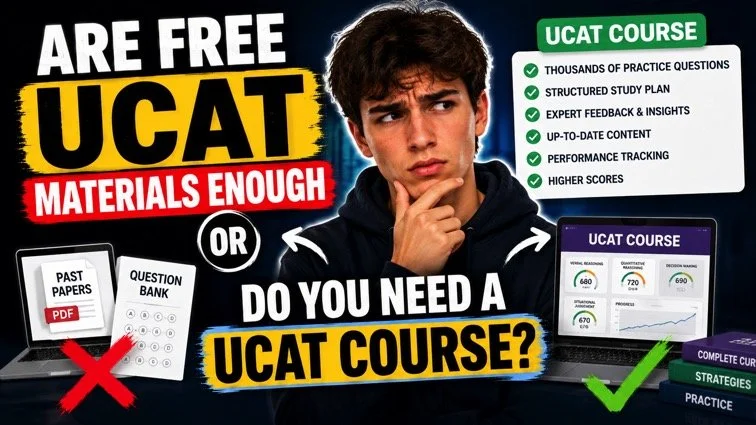
Free UCAT materials are a strong starting point, and some students do score highly using only the official resources. The UCAT Consortium says it is not necessary to purchase extra materials to score well, and one 2025 candidate reported scoring 2520 using only the official UCAT preparation resources. But the UCAT is also a fast, four-subtest admissions test used by universities in different ways, with some medical schools applying threshold scores and some using the Situational Judgement Test in selection. For many students, that means free materials should be the foundation of preparation, not the whole plan.
🎯 The better question is not “Can I do the UCAT for free?” It is “What gives me the best chance of turning practice into a competitive score?” Recent research on large-scale educational tests found that test preparation can improve overall performance, but there was little evidence that sample items and practice tests alone produced this effect. In a national UCAT study, the use of official timed practice tests, paid commercial materials, school-based preparation courses, and spending more time preparing were all associated with higher UCAT scores, although access to paid support was more common among less-deprived candidates and those at grammar or independent schools.
What free UCAT materials do well
The official UCAT resources are genuinely useful. The Consortium recommends candidates use the official preparation materials, which include a preparation plan, the Tour Tutorial, Question Tutorials, question banks, and timed practice tests. Those materials are representative of the live test, and they are the best way to learn the screen layout, timing, built-in calculator, navigation tools, and the overall style of the exam.
That is why free materials should always be part of your UCAT revision. They help you understand what the exam actually looks like, rather than what somebody on TikTok or YouTube says it looks like. If you are at the very start of the process, it can also help to use a structured free starter resource. Blue Peanut’s free UCAT course is positioned as a beginner-friendly route into the current exam format, with section guides, free tutorials, worked examples, and videos to help students begin preparing more effectively before moving to deeper support if needed.
Why free materials alone often stop short
Free practice is realistic, but it is not built for long-term tracking
One of the biggest problems with relying on free official materials alone is that they are not designed to function as a comprehensive revision system. The official UCAT question banks do not retain your progress, and the official practice tests are not set up to save your results or provide a score. Even top-scoring candidates quoted by UCAT talk about doing a practice test and then tracking scores in a spreadsheet to monitor progress. That can work, but for a busy sixth-form student juggling school, UCAS planning, and maybe interviews later on, it creates extra admin at the very point when revision should feel simpler.
Practice questions are not the same as strategy
The official Question Tutorials do include strategies, but UCAT itself says the example questions in those tutorials “will not cover every aspect of the test.” That matters because the UCAT is not just about recognising question styles. It is about choosing the fastest method, avoiding traps, staying calm under time pressure, and knowing what to skip. The 2025 meta-analysis on large-scale tests is helpful here: broader test preparation improved performance, but the authors found little evidence that using sample items and practice tests alone explained those gains. In other words, doing lots of questions is not the same thing as learning how to perform better.
The national UCAT study points in the same direction. It did not prove that paying money automatically buys a top score, and it certainly does not mean every commercial course is worth it. What it did show is that structured support mattered: official practice tests, school-based courses, paid materials, and more preparation time were all associated with stronger performance. For students who are bright but inconsistent, that is a strong argument for guided preparation rather than isolated practice.
Outdated advice wastes time
⚠️ Another issue with free materials is age. The UCAT changed in 2025, when Abstract Reasoning was withdrawn from the test. The Consortium also warns that free advice and practice found on the web are unlikely to contain the correct test content unless they have been published in the current test year. That means old blog posts, recycled PDFs, and outdated free videos can do real damage by sending students towards the wrong format, the wrong timing, or the wrong mix of questions.
This is where many students get stuck. They are revising hard, but the revision is fragmented: a few official questions here, a random YouTube strategy there, an old set of notes from a friend, then one mock near the end. That does not always produce a clear, measurable route from “I am practising” to “my score is actually improving.”
What a high-quality UCAT course adds
A revision plan you can actually follow
Official UCAT guidance says top-performing candidates typically spend about 30 hours preparing and start around 6–8 weeks before their test. That is a manageable amount of time, but only if you know what to do with it. A good commercial UCAT course gives you order: what to learn first, how to divide your time across sections, when to move from untimed to timed work, and how to review mistakes instead of repeating them. Blue Peanut’s course page explicitly frames the course around a clear, structured revision plan so students do not have to guess what to do next.
Feedback that shows you why your score is stuck
Free questions can tell you whether an answer was right or wrong. What they usually do not do is diagnose the pattern behind repeated mistakes. In education more broadly, the Education Endowment Foundation describes feedback as a high-impact, well-evidenced approach and notes that effective feedback gives specific information on how to improve. The EEF also highlights metacognition and self-regulation as high-impact approaches, built around planning, monitoring, and evaluating your learning. That is exactly what many UCAT students struggle to do on their own. Blue Peanut’s live small-group teaching and personalised support are designed around that missing step: not just more questions, but guidance on how to change performance.
Better analytics, more mocks, less guesswork
The official UCAT materials are excellent for authenticity, but they are limited as a tracking tool. By contrast, Blue Peanut’s complete course bundle includes access to Medify with 20,000+ practice questions, full mock exams, detailed explanations, and performance analytics. That matters because score improvement usually comes from identifying weak patterns early and acting on them quickly. If one student is losing marks due to timing in Decision Making and another is losing marks due to careless calculator use in Quantitative Reasoning, they should not be revising in the same way. Analytics make that difference visible.
Accountability when motivation dips
Most UCAT students do not fail because they are not intelligent enough. They drift because revision becomes repetitive, school gets busy, and nobody is checking whether the work they are doing is still the right work. A commercial course adds momentum. Blue Peanut’s course combines live teaching, ongoing support, full recordings, and bonus tutorials you can revisit until your exam. That kind of structure makes it easier to stay consistent through June, July, and August, especially when motivation naturally drops.
Why Blue Peanut is a strong choice for serious UCAT preparation
There is an important point to be honest about here: the UCAT Consortium does not endorse commercial providers, and it actively tells candidates to be sceptical about inflated coaching claims. That is sensible advice. It means students should not buy a course because it sounds impressive. They should buy one because it is current, transparent, and clearly adds value beyond what free materials already offer.
That is why the Blue Peanut UCAT course is a strong fit for students who want more than a pile of free resources. It is built around small-group live teaching by NHS doctors, ongoing support, full course recordings, bonus tutorials, and includes Medify access. Blue Peanut also presents its wider team as practising GPs and medical school tutors, and the site highlights insights from former admissions assessors, undergraduate teaching experience, and research-led expertise. For a sixth-form student who wants clarity, not noise, that is a much stronger environment than trying to self-coach from scattered free content alone.
It also helps that Blue Peanut does not force a false choice between free and paid support. The site already offers free UCAT resources for beginners, then gives students the option to step up to a fuller course when they need more structure, more accountability, and more personalised feedback. That is the most sensible journey for many applicants: start free, then upgrade when you want a sharper strategy and a better system. ✅
Quick answers students search for
Are free UCAT materials enough?
For a small number of organised students, yes. The UCAT Consortium says it is not necessary to buy extra materials to score well, and one 2025 candidate reported scoring 2520 using only official resources. But official practice alone does not ensure progress, does not yield scores in mocks, and does not replace the benefits of strategy teaching, tracking, and feedback. For many students, free materials are the right starting point, but not the full preparation plan.
Is a UCAT course worth it
A UCAT course is worth it if you need structure, feedback, accountability, and more realistic performance tracking than the free official resources provide on their own. It is especially useful if your scores are plateauing, you are not sure how to review mistakes, or you want expert input on timing and technique. A course is less important if you are highly self-directed, already improving steadily, and happy building your own tracking system from the official materials.
When should you move from free prep to a course?
The best time is before your preparation becomes repetitive. Official UCAT guidance says high-performing candidates often start around 6–8 weeks before the test and spend about 30 hours preparing. If you are a few weeks in and still cannot explain why your score is stuck, or you are doing questions without a clear plan for improvement, that is usually when a commercial course begins to add real value.
Final thoughts
Free UCAT materials absolutely matter. Every serious student should use the official resources because they best reflect the live test. But relying on free materials alone assumes you can do several difficult things on your own: build a preparation plan, accurately identify your weak areas, find up-to-date advice, review errors properly, and stay consistent under pressure. Some students can do that. Many would rather not gamble on it in such a high-stakes admissions test.
So the most persuasive case for a commercial course is not that free resources are bad. It is that free resources are incomplete for many learners. They teach you the format. A strong course teaches you the process. If you want a more structured route through your UCAT preparation, with live small-group teaching, ongoing support, full recordings, and Medify included, the Blue Peanut UCAT course is built for exactly that step up.