Why Most Students Fail the UCAT
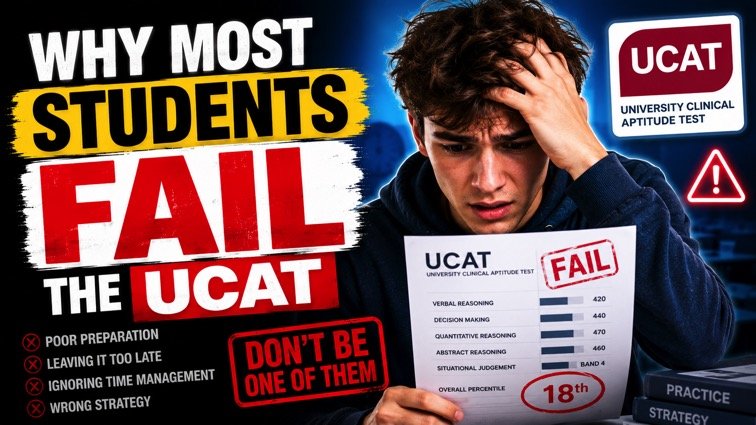
If you are worried about “failing” the UCAT, the first thing to know is this: the exam does not work like a standard school test with a universal pass mark. The UCAT Consortium says universities use scores in different ways; not all universities have a minimum score requirement, and no single score guarantees selection. In real life, students usually say they “failed” when they scored below the level needed for their target medical or dental schools, or when they performed well below their own practice standard.
That matters because the current UCAT is a very specific kind of challenge. Since 2025, it has consisted of Verbal Reasoning, Decision Making, Quantitative Reasoning, and the Situational Judgement Test, with a total cognitive score ranging from 900 to 2700 and a standard test time of just under two hours. In 2025, 41,354 candidates sat the test, the mean total cognitive score was 1891, and the 50th-percentile score was 1880. You may also sit the test only once per cycle, so there is no safe “practice run” with the real exam.
Most students who underperform are not short of intelligence. They simply prepare for the wrong kind of exam. They revise it like a content paper, use unrepresentative resources, practise without properly reviewing, ignore the software and timing, or let stress and poor admin decisions cost them marks on the day. That pattern is exactly what the official UCAT guidance, past candidate advice and wider research on test anxiety and time pressure point towards.
What failing the UCAT really means
The biggest misunderstanding is thinking that the UCAT score has a single fixed meaning. It does not. The Consortium tells candidates to use their results before the UCAS deadline to make smarter choices, because universities use the test differently. Some set a fixed threshold score, some weight the UCAT alongside academic results such as GCSEs, some use it mainly in marginal cases, and an increasing number use the Situational Judgement Test in selection, with some excluding lower-performing candidates. So a UCAT score is never simply “good” or “bad” on its own; it only makes sense in relation to where you plan to apply.
That is why the phrase “fail the UCAT” is emotionally understandable but technically misleading. Around half of the 2025 candidates scored 1880 or below, yet those students were not all automatically shut out of medicine or dentistry. The real failure is often strategic: sitting the exam without understanding how it works, then applying as if every university uses the score in the same way.
The same point applies to SJT. Many students still treat it as the extra section at the end, even though official guidance says more universities are using it in selection and that some exclude low-performing candidates. The 2025 results also show that only 21% of candidates reached Band 1, while 10% fell into Band 4. If you neglect SJT, you may not feel the damage immediately, but it can quietly reduce your application options later.
Why students underperform on the UCAT
The UCAT punishes vague preparation. It rewards candidates who understand the exact format, train the exact skills, and repeat the exact conditions they will meet on test day. When students underperform, the reason is usually not one dramatic mistake. It is a stack of smaller mistakes that get exposed under time pressure.
They prepare for the wrong exam
Many students still prepare as if the UCAT were primarily about knowledge. It is not. The official test format states that the UCAT assesses mental abilities that universities consider important, and that in Verbal Reasoning, you are not expected to use prior knowledge to answer questions. Decision Making is also designed so that specific mathematical or logical terminology is not required. In other words, this exam is far more about processing, judgement and speed than memorising facts from biology or chemistry.
They also get caught by outdated advice. The UCAT changed in 2025: Abstract Reasoning was removed, the cognitive score became 900 to 2700, and the official site explicitly warned that some commercial advice and materials could now be incorrect. If a student is following old threads, old blogs or recycled course notes, they may be practising for a version of the exam that no longer exists.
Another common mistake is ignoring the mechanics of the test itself. The Consortium recommends starting with the Tour Tutorial and Question Tutorials before moving to Question Banks and timed Practice Tests, and it says familiarising yourself with the onscreen tools can save valuable time on the day. Students who skip that stage often lose easy marks simply because they are clumsy with the calculator, slow with navigation, or unfamiliar with shortcuts and the flag-and-review function.
They practise badly
Doing lots of questions is not the same as preparing well. The students who improve the fastest usually follow a structured preparation plan, regularly review mistakes, and get expert feedback on weak areas rather than endlessly completing random question banks. Official high-scoring candidates often describe a deliberate approach: complete a mock, analyse performance carefully, then spend targeted time improving the exact skill that cost marks.
This is where many students struggle when relying entirely on free materials. Free resources can be useful for understanding the UCAT format and accessing official practice questions, but they are often limited in depth, structure, and personalised feedback. Students frequently jump between YouTube videos, Reddit advice, outdated question banks, and random free mocks without any clear progression. As a result, they practise inconsistently and never fully understand why they are losing marks.
In contrast, students attending a high-quality commercial UCAT course often benefit from several advantages:
A clear week-by-week study structure
Access to large banks of realistic practice questions
Timed mock exams that reflect current UCAT standards
Tutors who can identify weaknesses quickly
Proven timing strategies for each section
Accountability and motivation from scheduled lessons
This matters because the UCAT is a skills-based exam. Most students do not naturally know how to approach Decision Making, manage Verbal Reasoning timing, or maximise marks in Situational Judgement. Expert guidance can dramatically shorten the learning curve and prevent students from wasting weeks using ineffective methods.
A good UCAT course also reduces one of the biggest causes of poor scores: practising the wrong way. Many weaker candidates spend hours working through questions without properly reviewing them. Stronger candidates are far more analytical. They track mistakes, identify patterns, and adjust their strategy after every mock. Commercial courses often build this reflective process directly into their teaching, which is why many students improve faster than when self-studying alone. ✅
That does not mean every expensive course guarantees success. Some students still perform poorly because they passively rely on teaching without practising enough. However, students who combine consistent independent practice with expert tuition are usually in a much stronger position than students trying to prepare entirely alone using scattered free materials.
There is also a confidence factor. The UCAT is an extremely high-pressure exam, and uncertainty damages performance. Students who have regular tutor support, realistic mocks, and proven strategies often walk into the exam calmer and more prepared. Under severe time pressure, that confidence can easily translate into extra marks. 🎯
They lose marks to nerves, timing and admin
The UCAT is fast enough that perfectionism becomes dangerous. Verbal Reasoning gives 22 minutes for 44 questions, Quantitative Reasoning gives 26 minutes for 36, and SJT gives 26 minutes for 69. At the same time, there is no negative marking, and the system allows you to flag questions for review. Students who keep wrestling with one horrible question because they “must” solve it end up paying twice: they wreck their timing and still do not guarantee the mark.
Stress makes that even worse. Research reviewed by Cambridge University Press links test anxiety to reduced working memory and poorer cognitive performance, and a recent Scientific Reports study found that time pressure pushes people towards simpler, more repetitive choices while reducing sensitivity to uncertainty. The UCAT’s own wellbeing guidance also warns that too much stress can affect mental health and recommends realistic, little-and-often preparation, regular breaks, familiarity with the test day and test tools, and relaxation strategies for nerves.
Then there are the completely avoidable practical mistakes. Access arrangements, such as rest breaks or extra time, must be approved before booking and cannot simply be added later to an existing booking. If you turn up without the correct photo ID, you will not be allowed to take the test and will forfeit the fee. These are not glamorous points, but they matter. Some students do not underperform because of reasoning ability at all; they underperform because they left the boring admin too late.
What successful UCAT preparation looks like
🟢 Good UCAT preparation is surprisingly boring. It uses official materials, starts with understanding the test, builds skill before speed, reviews mistakes properly, and gradually shifts into timed practice. That is also exactly the sequence the Consortium recommends: Tour Tutorial first, then Question Tutorials, then Question Banks, then timed Practice Tests nearer the test date. Official past candidate advice echoes the same idea: practise, track progress, work on weak areas, and keep your life balanced enough that the exam does not take over everything.
🔴 Bad UCAT preparation looks busier, but it is much less effective. It usually means revising on your phone, skipping the official interface, answering random questions without logging why you were wrong, leaving SJT until the end, and assuming that a paid course will rescue you from poor habits. The official question banks and practice tests are intended for desktop use to reflect the live experience, and the Consortium is explicit that tutoring is not required to do well. What matters more is whether your preparation actually mirrors the exam.
The strongest candidates also respect the hidden parts of performance. They understand that confidence is not fluff; it affects how well you can actually use your ability under pressure. The official candidate advice mentions keeping score records, using realistic test conditions, relaxing before the exam, and still making room for normal recreational activity. That is not accidental. A candidate who is calm, familiar with the software and used to timed pressure is far more likely to convert ability into marks than someone equally clever but completely chaotic.
A clear plan if you are behind
🎯 Start with a real baseline. Take one official timed practice test on a desktop or laptop, under proper exam conditions. Then do not just record the score. Write down why marks were lost: timing, misreading, weak number fluency, poor SJT judgement, or getting stuck too long. One official top performer described using a spreadsheet to track progress, then spending time targeting the weak skill, rather than blindly repeating more questions.
🧠 Use the official order, not your panic order. Begin with the Tour Tutorial so the software is not new to you. Then work through the Question Tutorials to learn how each question type works. Use the Question Banks to build familiarity, and save the timed Practice Tests for nearer the exam, when you are ready to review your performance under pressure. This is the structure the UCAT itself recommends.
⏱️ Train a skip-and-return mindset. Because the test is separately timed, the clock is always part of the question. Because there is no negative marking, an educated guess is usually better than burning a minute you cannot afford. Learn to flag, move on and come back only if time allows. Students who say they “ran out of time” often did not have a knowledge problem at all; they had a decision problem.
😌 Protect your mark on test day before test day arrives. Keep preparation little and often, not all-night and chaotic. Practise with the tools you will actually use. Sort out your ID and booking details early. If you may be eligible for a bursary or access arrangements, deal with that before booking rather than after. The calmer your logistics are, the more of your brain is available for the exam itself.
Final thoughts
Most students do not fail the UCAT because they are incapable of medicine. They fail because they misunderstand what the exam rewards. The UCAT has no universal pass mark; universities use it differently, and not all courses treat the score in the same way. What consistently hurts candidates is preparing for the wrong test, with the wrong materials, in the wrong way.
The good news is that these are fixable problems. A more official, more deliberate and more realistic approach to UCAT preparation is not just “good advice”; it is the pattern backed by the Consortium’s own guidance, by past high-scoring candidates, and by research on anxiety and practice testing. If you want to avoid failing the UCAT, stop asking whether you are clever enough and start asking whether your preparation actually matches the exam you are sitting. ✅