University of Glasgow Dental School Interview Questions for 2027 Entry
Glasgow is the dental school that quietly tops the tables. It is also one of the toughest tickets in the United Kingdom — roughly 200 applicants get an interview each year, and the invitation lands in your inbox in December after a University Clinical Aptitude Test (UCAT) score you will never be told the cut-off for. 😬
If you are applying for the Bachelor of Dental Surgery (BDS) at the University of Glasgow for 2027 entry, this guide walks you through the whole process: how you get shortlisted, exactly what the Multiple Mini Interview (MMI) looks like, when it happens, how it is scored — and more than 60 practice questions written in the station format Glasgow actually uses.
🦷 An introduction to Glasgow Dental School
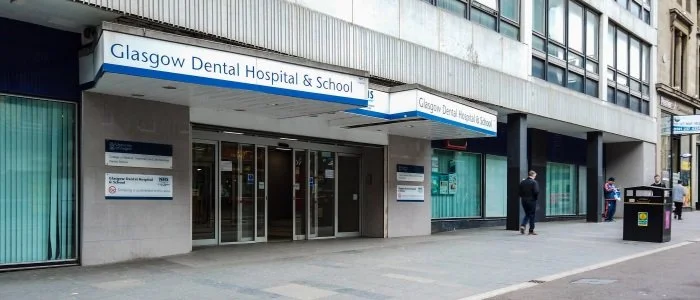
Glasgow Dental Hospital and School was established in 1879, which makes it older than the Football League and the light bulb patent. It sits in the city centre on Sauchiehall Street, a short walk from Glasgow Central and Queen Street stations, and is the second-largest dental school in the United Kingdom, teaching around 400 undergraduate students at any one time.
The Bachelor of Dental Surgery (BDS) is a five-year, integrated programme sitting within the University of Glasgow's School of Medicine, Dentistry and Nursing. You are not waiting years to see a patient:
- Year 1 — biomedical sciences (anatomy, physiology, microbiology) alongside your introduction to clinical dentistry
- Year 2 — operative dentistry, prosthodontics and periodontics; you begin managing patients
- Year 3 — restorative work expands, plus extractions, radiographs, paediatric outreach placements and a compulsory elective study project
- Year 4 — oral medicine, sedation, orthodontics and broader clinical skills
- Year 5 — half your time in the Dental School, half in outreach centres in Public Dental Service areas across the west of Scotland
That final-year outreach split is the bit graduates talk about most. You finish the degree having worked in real community clinics with real patient lists, not just in a teaching hospital chair.
What makes Glasgow Dental School stand out?
A few things genuinely separate Glasgow from the other sixteen dental schools:
🥇 It is ranked first in the UK for dentistry in more than one major league table — not a "top ten" claim, an outright first.
🏥 Scale and case mix. As the second largest dental school in the country, and sitting in a city with significant oral health need, Glasgow students see a volume and variety of clinical cases that smaller schools cannot match.
🌍 Research strength. In the Research Excellence Framework (REF) 2021, 95% of the University of Glasgow's dentistry research was rated world-leading or internationally excellent. Much of it focuses on community oral health — highly relevant if you care about health inequality.
🚌 Outreach is baked in, not bolted on. Placements in the Public Dental Service are a core part of Year 5, not an optional extra.
💷 **Free treatment clinics.The school runs clinics offering free dental treatment to the public, which is where much of your supervised experience comes from.
📊 Rankings and student experience ratings
Dentistry subject rankings
- 1st in the United Kingdom — Complete University Guide, Dentistry subject league table
- 1st in the United Kingdom — Times & Sunday Times Good University Guide, Dentistry
- 4th in the United Kingdom — Guardian University Guide, Dentistry
In the Complete University Guide's dentistry table, Glasgow scores 100 for entry standards, 97 for graduate prospects, 87 for research quality and 85 for student satisfaction — a rare combination of being both the hardest to get into and one of the best rated once you are in.
The University of Glasgow worldwide
- 79th in the world and 12th in the UK — Quacquarelli Symonds (QS) World University Rankings 2026
- 84th in the world and 10th in the UK — Times Higher Education (THE) World University Rankings 2026, including 26th globally for research quality and 33rd for international outlook
- A member of the Russell Group, and one of only four ancient universities in Scotland (founded 1451)
Student experience and life in the city
Glasgow does very well for students. In the Quacquarelli Symonds (QS) Best Student Cities ranking, Glasgow places 4th in the world for "Student View" — the measure built directly from what students who study there actually say about the place. It also ranks 7th globally for student mix. The city is cheaper than Edinburgh, the music scene is legendary, and the Dental School is in the centre of it rather than on a distant campus.
On outcomes: 97.1% of Glasgow dentistry graduates are in work or further study within 15 months, 100% of those working are in graduate-level jobs, and the average professional salary reported is around £45,000. 🎓
🎯 How Glasgow Dental School decides who to call for interview
Glasgow's shortlisting is unusually blunt, and that is actually helpful — there is no mystery scoring matrix to reverse-engineer.
Step 1: the academic gate
You must be predicted to meet, or hold, the entry requirements. For 2027 entry:
- A-levels: AAA in three different subjects, including Biology (or Human Biology) at grade A and Chemistry at grade A. Plus six General Certificate of Secondary Education (GCSE) subjects at grade A/7–9, with Maths/Physics and English acceptable at B/6 if the others are A/7.
- Scottish Highers: AAAAB at Higher, plus BB at Advanced Higher, which must be in Biology and Chemistry. Higher Biology and Chemistry at grade A, Higher Maths or Physics, and National 5 English at grade B.
- International Baccalaureate (IB): 36 points including three Higher Level subjects at 6,6,6, with Chemistry and Biology at Higher Level.
Two rules that catch applicants out every year
Glasgow does not consider resits — qualifications must be obtained at the first sitting, from any country or exam board. And deferred entry applications are not considered, so you must apply for a gap year after you receive your result, not build it into your application. ⚠️
Applications close on 15 October, and remember you can use only four of your five Universities and Colleges Admissions Service (UCAS) choices for dentistry.
Step 2: the UCAT ranking
Once you clear the academic bar, applicants are ranked by UCAT score, and roughly the top 200 are invited to interview. That is essentially the whole shortlisting mechanism.
Step 3: the personal statement
Glasgow tells the Dental Schools Council that the personal statement is "used for interview selection and subject to review prior to offer." In practice, your UCAT does the heavy lifting for the shortlist, but your statement is read — and read again before an offer is confirmed. Since 2026 entry, the UCAS personal statement is three structured questions rather than one essay, so make sure your motivation for dentistry, your reflection on experience, and your evidence of relevant skills are each doing real work.
Step 4: work experience — the good news for 2027 entry
No work shadowing is required for September 2027 entry. Glasgow states plainly that it recognises dental shadowing is increasingly hard to obtain. Instead, it points applicants towards alternative forms of shadowing or voluntary work "which involves caring for and interacting with different people," and towards its own free online course, "Become a Dentist," on FutureLearn.
Do not read that as "experience does not matter." It means the type of experience is flexible — a care home, a customer-facing Saturday job, a peer mentoring role, a St John Ambulance shift. What matters is that you can reflect on it at the interview. 💡
🧪 How the University Clinical Aptitude Test (UCAT) is used at Glasgow
This deserves its own section because Glasgow's approach is distinctive.
The UCAT is a gate, not a weighting. Glasgow's own guidance is unusually direct: "if your score is deemed to be too low then you will not be selected for interview, regardless of your qualifications." Straight A grades will not rescue a weak UCAT here.
The Situational Judgement Test (SJT) band is not used at all. Glasgow states: "we do not take into consideration the Situational Judgement Test (SJT) banding in our decision-making." This is genuinely unusual — many dental schools reject Band 4 outright. At Glasgow, your cognitive total determines your ranking. Sit the SJT properly anyway, because your other three dental choices will almost certainly care.
The cut-off is never released during the cycle. Glasgow publishes historic cut-offs only after the fact. The score varies year to year with cohort performance, and is "normally above the national average."
Historic UCAT cut-off scores (and the trap in reading them)
The lowest UCAT score considered for interview, as published by Glasgow Dental School:
- 2025 entry — Home 2660, Rest of UK (RUK) 2770, International 2740
- 2024 entry — Home 2600, RUK 2660, International 2590
- 2023 entry — Home 2500, RUK 2670, International 2730
- 2022 entry — Home 2570, RUK 2690, International 2880
- 2021 entry — 2600 across all categories
Why you cannot compare your own score to those numbers
🚨 Read this before you panic or celebrate. Every one of those figures is on the old UCAT scale, when the test had four cognitive subtests including Abstract Reasoning and a maximum total of 3600. Abstract Reasoning was removed from 2025 onwards, so the test now has three cognitive subtests — Verbal Reasoning, Decision Making and Quantitative Reasoning — and a maximum of 2700. A score of 2660 out of 3600 is roughly 74%; 2660 out of 2700 would be an almost perfect score. The old numbers are not comparable to yours. Use them only to see the pattern — Rest of UK applicants have usually needed a higher score than Scottish/Home applicants, because there are far fewer places for them.
Widening access and adjusted offers
Glasgow operates contextual admissions for applicants living in Scotland. Eligible applicants — typically through Access Glasgow and having completed the REACH programme — can receive an adjusted offer of AAABB at Higher plus B at Advanced Higher. One hard limit: a grade concession will never be offered for a Chemistry or Biology qualification, and meeting the adjusted requirements does not guarantee admission.
🗣️ How Glasgow Dental School interviews: format, structure and timings
The format: online Multiple Mini Interviews
Glasgow uses Multiple Mini Interviews (MMIs) instead of a traditional panel interview. The school describes it as a series of short activities — role play, discussion, or practical tasks — designed to assess the qualities that matter in dental practice.
For 2027 entry, the Dental Schools Council lists Glasgow's interview format as "Online MMIs," and Glasgow's own June 2026 open day briefing said interviews for 2027 are "likely to be virtual MMI style interviews." Interviews were historically held in person over a weekend in February, so treat online delivery as the working assumption and check your invitation email carefully. 💻
Structure and timings
- Normally 7 stations in total
- 6 minutes per station, which includes 1 minute of reading time
- So realistically about 5 minutes of talking per station
- The full circuit takes just under 45 minutes
- One assessor per station, scoring your performance at that station only
That last point is the single most reassuring fact about Glasgow's MMI: the stations are independent. A poor performance at one station does not follow you to the next. Every door you walk through — or every breakout room you join — is a completely clean slate. 🔄
Station types you should prepare for
Glasgow names three categories explicitly:
- Role play — you interact with an actor or assessor playing a patient, a colleague, or a member of the public
- Discussion — a conversation-style station built around a question, a scenario or an ethical dilemma
- Practical activity — a task rather than a conversation, testing how you work through something under time pressure
A word on the practical stations
The practical element ties directly to Glasgow's stated interest in manual dexterity, creativity and spatial awareness. Do not, however, turn up with a portfolio: Glasgow explicitly states "we do not require a portfolio for entry and no examples should be brought to interview."
📅 When are Glasgow dentistry interviews held?
The timeline for 2027 entry runs like this:
- 15 October 2026 — UCAS deadline
- December 2026 — interview invitations issued
- Late January / early February 2027 — interviews held (historically over a weekend)
- By 31 March 2027 — all decisions communicated through UCAS
If you have not heard by early January, that usually means you were not shortlisted, though Glasgow does confirm all decisions through UCAS by the end of March. 📬
🧠 What topics are covered in the Glasgow dentistry interview?
Glasgow publishes its assessment criteria openly, which is a gift. Assessors are looking for evidence that you can:
- Be diligent and ethical
- Demonstrate empathy and respect for other people's points of view
- Show strong communication skills
- Work effectively in a team and show leadership potential
- Be self-critical, self-reflective and self-motivated
- Think independently, solve problems and be creative
- Display manual dexterity, creativity and spatial awareness
- Show genuine motivation for dentistry
Seven stations, roughly eight qualities — expect most of them to appear, some combined into a single station.
🔢 How many are interviewed, and how many get offers?
- Around 200 applicants are selected for interview each year.
- Glasgow does not publish its total intake or the number of offers made. What it does publish: for September 2025 entry, the target intake for Rest of UK applicants (England, Wales and Northern Ireland) was 13 places.
- Intake targets are set by the Scottish Government and the Scottish Funding Council, not by the university, which is why the Rest of UK and international allocations are so tight.
The honest summary: getting the interview is the hardest single step, and if you are applying from England, Wales or Northern Ireland, the competition for those handful of places is fierce. Once you are at the MMI, the odds improve dramatically compared with the pre-interview stage. 💪
✅ What is the interview scoring method?
Glasgow's scoring is refreshingly simple:
- There is an assessor at each of the seven stations
- That assessor scores your performance at that station alone
- Scores from all stations are then added together for a total
- Candidates are ranked on that total, alongside the academic requirements, to decide offers
There is no published pass mark for individual stations and no published weighting between them. Because the total is what counts, consistency beats brilliance. Seven solid performances will out-score four dazzling ones and three car crashes.
📮 When are offers released?
All decisions are normally made by the end of March and communicated through UCAS. Glasgow's own guidance says applicants will know the outcome by 31 March. For 2027 entry, that means offers landing across February and March 2027. 🤞
❓ 67 example Glasgow dentistry interview questions, sorted by assessed quality
These are written in Glasgow's own station format — some as discussion prompts, some as role-play briefs, some as practical activity tasks — so you can practise the way the day actually runs. Give yourself 1 minute to read and 5 minutes to respond, and time it. ⏱️
🎯 Motivation for dentistry and insight into the profession
- Why dentistry rather than medicine? Be specific.
- What did you learn about dentistry that you could not have learned from a textbook?
- Dentistry is a career of small, repetitive, precise tasks. What makes you think you would enjoy that?
- What do you think is the hardest part of being a dentist, and how would you cope with it?
- Tell the assessor about a time you saw a dental professional communicate well with a patient. What did they do?
- What are the arguments for and against fluoridating the public water supply?
- Access to National Health Service (NHS) dentistry in Scotland is a live political issue. What do you understand about it?
- What does a dentist actually do in a day, beyond drilling and filling?
- Which do you think has done more for oral health in the last fifty years — fluoride toothpaste or the dental profession?
- If you did not get a place at any dental school this year, what would you do next?
⚖️ Diligence, ethics and professionalism
- Discussion station: A patient asks you to remove a healthy tooth because they dislike how it looks. How do you respond?
- A patient who smokes 20 cigarettes a day asks for dental implants. What are your considerations?
- Discussion station: You notice a fellow student posting photographs of patients' mouths on social media. What do you do?
- Should patients who repeatedly miss appointments be removed from an NHS dental list?
- A parent refuses fluoride varnish for their six-year-old. Talk through your approach.
- What does the General Dental Council (GDC) expect of a dental student, and why does it matter before you qualify?
- Is it ever acceptable to treat a patient who has not given full consent?
- Discussion station: You are running 40 minutes late. Your next patient is elderly and has travelled by two buses to get to you. How do you handle the clinic?
- Should cosmetic dentistry be advertised to teenagers on social media?
- What would you do if you made a clinical mistake that the patient did not notice?
💗 Empathy and respect for other people's viewpoints
- Role play: A patient is in the chair and has become visibly distressed. They are refusing treatment they clearly need. Speak with them.
- Role play: You must tell a patient that the treatment they had last month has failed and needs redoing. They are angry.
- Role play: A young child is terrified of the dental chair. Their parent is losing patience. Manage the situation.
- Tell us about a time you changed your mind after listening to someone you disagreed with.
- A patient tells you they cannot afford the treatment you have recommended. What do you say?
- Role play: A friend confides that they have been struggling and have fallen badly behind with coursework. Speak with them.
- How would you communicate with a patient who does not speak English and has no interpreter present?
- What does dignity mean when treating an older patient with dementia?
- A patient's oral hygiene is very poor, and they seem embarrassed. How do you raise it?
- Role play: Break the news to a patient that their tooth cannot be saved and must be extracted.
🗨️ Communication skills
- Practical task: Explain how to brush teeth properly to an eight-year-old, in language they would understand.
- Explain photosynthesis — or any topic you know well — to someone with no science background, in two minutes.
- Role play: Take a message from a colleague and relay it accurately to the assessor.
- Practical task: Describe a shape to the assessor, who cannot see it, so that they can draw it accurately. You may not name the object.
- How would you explain the risks of a procedure without frightening the patient out of having it?
- What makes someone a good listener? Give an example of when you listened well.
- Role play: A patient has read something alarming online about root canal treatment and mercury fillings. Reassure them.
- When has your communication gone wrong, and what did you change afterwards?
🤝 Teamwork and leadership
- Describe a time you worked in a team that was not functioning. What did you do about it?
- Who is in a dental team, and what does each member contribute?
- Discussion station: You are leading a group project and one member is not doing their share. Talk through how you handle it.
- Is a good dentist necessarily a good leader?
- Tell us about a time you had to follow someone else's decision that you disagreed with.
- What have you learned about teamwork from something outside school — sport, music, a job, volunteering?
- Discussion station: A dental nurse tells you they think you have made an error mid-procedure. What do you do?
- How would you build trust with a team you have just joined?
🪞 Self-reflection and self-motivation
- What is your biggest weakness, and what have you actually done about it?
- Tell us about a genuine failure and what changed as a result.
- How do you cope with stress? Give a specific example, not a general strategy.
- What feedback have you received that was hard to hear?
- Dentistry has high rates of burnout. How will you look after yourself over a 40-year career?
- What have you done in the last year purely because you wanted to learn it?
- How would your closest friend describe you, and would you agree?
🧩 Independent thinking and problem-solving
- Discussion station: There are not enough NHS dentists in rural Scotland. Suggest three solutions and argue for the best one.
- Should sugary drinks be taxed more heavily? Build the case both ways.
- Practical task: You are given a set of data on childhood tooth decay by postcode. What does it tell you, and what would you do about it?
- How would you decide which of three patients gets the last appointment of the day?
- What role should artificial intelligence play in diagnosing dental disease?
- Discussion station: A dental practice is running at a loss. Suggest what it could change, and what it must not change.
- If you could change one thing about how dentistry is delivered in the United Kingdom, what would it be?
✋ Manual dexterity, creativity and spatial awareness
- Practical task: Using only the materials provided, build a free-standing structure at least 20 centimetres tall in four minutes.
- Practical task: Follow a set of written instructions to fold, cut or assemble an object — accuracy matters more than speed.
- Practical task: Reproduce the diagram in front of you as precisely as you can, using your non-dominant hand.
- Practical task: Wire bending — reproduce the shape shown using the wire provided.
- What activities have you done that have developed your fine motor control?
- How comfortable are you working in a mirror image, and where have you practised that?
- Practical task (online adaptation): Talk the assessor through building an object step by step while they follow your instructions on camera.
🏴 Questions specific to Glasgow Dental School
Expect at least one station to test whether you understand this school rather than dentistry in general.
- Why the University of Glasgow specifically, and not the other three dental schools on your UCAS form?
- Glasgow's fifth year splits your time between the Dental School and outreach centres in the Public Dental Service. Why does that appeal to you?
- Glasgow has some of the highest levels of oral health inequality in Western Europe. What does that mean for the dentists trained here?
- What do you know about the Childsmile programme in Scotland, and why does a Glasgow dental student need to know about it?
- Glasgow Dental Hospital and School has been running since 1879 and is the second largest in the country. What are the advantages and disadvantages of training somewhere that big?
- Dental care in Scotland is funded and organised differently from England. What differences are you aware of?
- Glasgow does not require dental work shadowing. What have you done instead to prepare for this course?
- Our students treat patients from Year 2. How do you feel about being responsible for a real patient that early?
- What would you contribute to the Glasgow Dental School community beyond your clinical work?
- You would be studying in a city centre hospital serving a very mixed population. How would you prepare for that?
- Glasgow says it looks for diligence, ethics, empathy, communication, teamwork, leadership, self-criticism, independent thinking, problem-solving, manual dexterity, creativity and spatial awareness. Which of those is your strongest, and which needs the most work?
💬 What students say about the Glasgow MMI
⚠️ The themes below are drawn from recurring feedback shared by applicants and current students over several cycles, paraphrased rather than quoted from named individuals. Treat them as a steer, not as gospel.
"The six minutes go faster than you think." Almost everyone says the same thing: the clock is brutal. With one minute of reading built in, you get roughly five minutes to actually perform. Applicants who had rehearsed with a timer said it was the single most useful thing they did.
"It felt friendly, not adversarial." Glasgow assessors are frequently described as warm and encouraging rather than stony-faced. Several students mentioned assessors nodding, smiling and prompting gently when someone froze.
"The practical station threw me — in a good way." Candidates consistently report being surprised by a hands-on or instruction-following task, and equally consistently say nobody expected them to be perfect at it. What mattered was staying calm, keeping talking, and not giving up when it went wrong.
"Nobody grilled me on my personal statement." Because Glasgow's stations are standardised, several applicants noted there was far less of the "tell me about this line in your statement" interrogation than at other schools. That does not mean you can forget what you wrote.
"The role plays felt real." Applicants describe actors who genuinely stay in character, including when upset or annoyed. Students who had practised with a friend playing an unhappy patient — rather than just reading model answers — felt far better prepared.
"Reset between stations." The advice repeated most often by Glasgow students: if a station goes badly, let it go before the next one starts. Because assessors score independently, the damage really is contained — but only if you do not carry it with you.
🌟 Top tips for the Glasgow dentistry interview
1. Practise to a six-minute clock — every single time. 🕕 One minute reading, five minutes performing. Set a timer on your phone. If your answers routinely run long, cut them before the day, not on it.
2. Structure your minute of reading. Read the brief twice. First pass: what is being asked of me? Second pass: what are the two or three points I must land? Then start.
3. Treat every station as a fresh start. Say it out loud in the corridor or between breakout rooms if you have to. Independent assessors mean a bad station is genuinely survivable.
4. Prepare for online delivery properly. 💻 Test your camera, microphone and internet. Sit somewhere quiet with a plain background and good light on your face. Have a backup — a phone hotspot — ready. Look at the camera, not at your own face on screen.
5. Do not memorise scripts. Assessors score against criteria, and rehearsed monologues read as flat and evasive. Learn a few structures instead — for ethics: consider the patient, the professional duty, the options, the decision.
6. Have five stories ready, not fifty. ⭐ Five well-reflected experiences (a job, a team, a failure, a caring role, a leadership moment) can answer forty different questions. Depth of reflection beats the length of your list.
7. Know Glasgow's own criteria. They are published — diligence, ethics, empathy, communication, teamwork, leadership, self-criticism, independent thinking, problem-solving, dexterity, creativity, spatial awareness. Map your stories onto that list.
8. Read up on Scottish dentistry. 🏴 Childsmile, oral health inequality in the west of Scotland, NHS dental provision in Scotland versus England, the Public Dental Service. This is where Glasgow-specific stations bite.
9. Practise talking while your hands are busy. For practical stations, get comfortable narrating what you are doing. Silence scores nothing; commentary shows your reasoning even when the task goes sideways.
10. Do not bring a portfolio. Glasgow says it outright — no portfolio is required and no examples should be brought. Turning up with one signals you have not read the guidance. ❌
11. Rehearse with a real person playing an unhappy patient. Role play is a third of Glasgow's station types. Reading model answers will not prepare you for someone actually being upset at you.
12. Be kind in the way you speak. Empathy is not a box you tick at the end of an answer. Assessors notice tone, pace, and whether you let the patient speak.
⚡ Key facts at a glance
🏛️ Dental school: Glasgow Dental Hospital and School, University of Glasgow — established 1879, second largest in the United Kingdom, around 400 undergraduates
🎓 Degree: Bachelor of Dental Surgery (BDS), 5 years, UCAS code A200
🥇 Rankings: 1st in the UK for dentistry (Complete University Guide; Times & Sunday Times Good University Guide), 4th (Guardian University Guide); university 79th in the world (QS 2026), 84th (THE 2026)
📅 Application deadline: 15 October 2026 (maximum four dentistry choices)
📝 Entry requirements: A-levels AAA including Biology and Chemistry at grade A, plus six GCSEs at A/7–9 · Highers AAAAB plus Advanced Higher BB in Biology and Chemistry · IB 36 points with 6,6,6 at Higher Level including Chemistry and Biology
🚫 Resits: Not accepted — first sitting only. Deferred entry: Not considered. Transfers: Not considered. Reapplications: Accepted
🧪 Admissions test: University Clinical Aptitude Test (UCAT), required in the year of application
⚠️ UCAT use: Ranking tool for shortlisting; cut-off not released during the cycle; Situational Judgement Test band is not used
📉 Last published cut-off: 2025 entry — Home 2660, Rest of UK 2770, International 2740 (old 3600 scale — not comparable to the current 2700 maximum)
🦷 Work experience: No dental work shadowing required for September 2027 entry
🗣️ Interview format: Multiple Mini Interview (MMI), listed as online for 2027 entry
🔢 Structure: Normally 7 stations, 6 minutes each including 1 minute reading time, just under 45 minutes total
🎭 Station types: Role play, discussion, practical activity
✅ Scoring: One independent assessor per station; scores combined into a total; stations do not affect each other
👥 Numbers: Around 200 interviewed each year; Rest of UK target intake was 13 for September 2025 entry
📆 Invitations: December 2026 · Interviews: late January / early February 2027 · Decisions: by 31 March 2027
🩺 Also required: Blood-borne virus health clearance and a Disclosure Scotland criminal conviction check
📧 Admissions contact: med-sch-dental-ug@glasgow.ac.uk
🔗 Useful links
- University of Glasgow — Dentistry BDS degree page
- Glasgow Dental School — Undergraduate admissions
- Glasgow Dental School — Multiple Mini Interviews (MMI)
- Glasgow Dental School — UCAT guidance
- Glasgow Dental School — Academic entry requirements
- Glasgow Dental School — Frequently asked questions
- Glasgow Dental School — Work shadowing
- Glasgow Dental School — Health clearance
- Glasgow Dental School — Criminal conviction check
- Glasgow BDS Person Specification 2027 entry (PDF)
- Glasgow BDS historic UCAT cut-off scores (PDF)
- Glasgow Dental School — About us
- Dental Schools Council — Entry requirements for 2027 entry (PDF)
- Dental Schools Council
- UCAT Consortium — official test information
- General Dental Council — Standards for the Dental Team
- UCAS — Applying to university
- Complete University Guide — Dentistry league table
- Childsmile — Scotland's national children's oral health programme