University of Plymouth (Peninsula) Dental School Interview Questions for 2027 Entry
Here is the single most useful thing to know about applying to Peninsula Dental School, and almost nobody says it plainly enough:
Plymouth does not read your personal statement, and it does not require work experience, when deciding who to interview. 😳
The University's own words are unambiguous — "Applicants are considered for interview based on relevant academic qualifications alone. We do not currently consider personal statements or work experience when selecting for interview." The Dental Schools Council entry document says the same thing from the other direction: "We do not require demonstrable work experience as part of the admissions process."
Grades and the University Clinical Aptitude Test (UCAT) get you an interview. After that, five online Multiple Mini Interview (MMI) stations and roughly 55 minutes decide everything else.
That single design choice flips the usual strategy on its head — and the published numbers prove it. In the 2024 cycle, Plymouth received 888 applications, interviewed 425 people and made 121 offers. Nearly half of all applicants got an interview. Barely a quarter of those interviewed got an offer.
At most dental schools, the hard part is getting invited. At Plymouth, the hard part is the interview itself. This guide is built around that fact.
🦷 An introduction to Peninsula Dental School
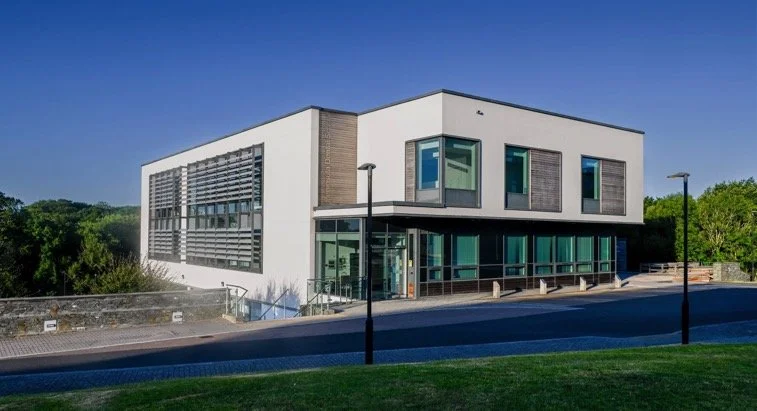
Peninsula Dental School is part of the University of Plymouth, and it is unlike most dental schools in the United Kingdom before you even reach the admissions page. No single grand Victorian dental hospital sits at its centre. Instead, the school runs a network of NHS Dental Education Facilities spread across Devon and Cornwall — in Devonport, Derriford and Plymouth city centre, in Exeter and in Truro — treating over 10,000 NHS patients every year.
The Bachelor of Dental Surgery (BDS) is a five-year programme, with Universities and Colleges Admissions Service (UCAS) course code A206 and institution code P60. And you genuinely move around:
- Years 1–2 — based in Plymouth. Normal structure, function and behaviour; dental health and the prevention of dental disease; the Simulated Dental Learning Environment (SDLE) from your very first week. Patient contact begins in Year 1, initially working as a dental nurse alongside senior students
- Year 3 — Plymouth-based, consolidating medically related knowledge, with visits to the Exeter clinic, hospital outpatient clinics and accident and emergency departments
- Year 4 — you relocate to Truro for the whole academic year, with clinical activity rising to three days a week and specialist placements in restorative dentistry, oral surgery, maxillofacial surgery and orthodontics
- Year 5 — four days a week in primary dental care, case presentations, and preparation for Dental Foundation Training (DF1) and registration with the General Dental Council (GDC)
Teaching is built on enquiry-based learning (EBL) — small groups working through real patient scenarios rather than sitting through lecture after lecture — supported by blended e-learning, tutorials, plenary "theatre events", forum theatre and role play. The curriculum runs on four integrated themes: applied dental and scientific knowledge, inter-professional engagement, clinical dental practice, and personal and professional development.
The programme is approved by the General Dental Council for registration as a dentist on completion.
What makes Peninsula Dental School stand out?
Five things genuinely separate Plymouth from the rest of the UK's dental schools. 🌟
🤲 Social engagement is not an add-on — it is a graded part of all five years. Community engagement runs through the entire course, and the school's Dental Outreach Team works with local organisations on oral health and lifestyle. This is the school's identity, and it is the single most reliable source of "why Plymouth?" material.
🏆 A national award for exactly that. In 2023, Peninsula Dental School and Peninsula Dental Social Enterprise won the Times Higher Education Award for Outstanding Contribution to the Local Community, recognising work by more than 100 staff and 400 students across Devon and Cornwall.
🏥 Peninsula Dental Social Enterprise (PDSE). A Community Interest Company — a not-for-profit social business — that runs the dental education facilities where you will treat patients. Improving oral health in the South West is written into its constitution, not its marketing.
🌍 You train where the need is greatest. The South West has among the worst NHS dental access in England. Somerset, for example, has recorded adult access as low as 23%, against 56% in South Yorkshire, and "dental deserts" — areas where no NHS practice is taking new patients — are a live regional problem. Plymouth students spend five years inside that reality rather than reading about it. 🦷
🎓 Early, and relentlessly practical. Simulated Dental Learning Environment in week one, patients in Year 1, three clinical days a week by Year 4, four by Year 5. If you learn by doing, this course is built for you.
📊 Rankings and student experience ratings
Dentistry subject rankings
- 6th in the United Kingdom for dentistry — Guardian University Guide 2026
- 13th in the United Kingdom — Complete University Guide, Dentistry subject table 2027
Those two look contradictory, and it is worth understanding why: league tables weight different things. The Complete University Guide's underlying scores for Plymouth dentistry are 96 for graduate prospects, 87 for student satisfaction, 75 for research quality and 74 for entry standards. 📈
That 96 for graduate prospects is the number that matters, and it is one of the strongest in the entire dentistry table. Plymouth's own Graduate Outcomes data goes further: 100% of dental surgery graduates were in highly skilled work, 100% said their work was meaningful, and 100% said they were using what they learned on the course.
87 for student satisfaction is the other standout — comfortably above several far more famous dental schools.
The University of Plymouth overall
- 67th of 130 in the Complete University Guide 2027 overall league table
- Teaching Excellence Framework (TEF) Gold — the highest rating, awarded across all three categories in 2023
- Research Excellence Framework (REF) 2021 — more than three-quarters of the University's research rated world-leading or internationally excellent
- Top 100 in the world and top 15 in the UK — Times Higher Education Impact Rankings 2025, which measure universities against the United Nations Sustainable Development Goals
- 3rd in the UK for Sustainable Development Goal 3 (Good Health and Well-being), 2025
- Community University of the Year — Daily Mail University Guide 2027
- Three Queen's Anniversary Prizes
- Over 19,000 students
Student experience and satisfaction
- 6th in the UK for assessment and feedback in dentistry — National Student Survey (NSS) 2026
- 87 for student satisfaction in the Complete University Guide 2027 dentistry table
- 94% of University of Plymouth graduates are working or studying 15 months after graduating
- The dental school holds an Athena Swan Silver Award for equality, diversity and inclusion, with a stated zero-tolerance policy on all forms of discrimination, abuse and harm
Being 6th nationally for assessment and feedback is a genuinely unusual thing to be good at, and it tells you something real about the course. Feedback is the currency of clinical training. On a five-year degree where you are learning intricate manual skills, being told clearly and quickly what you did wrong is worth more than a nice library. 💬
🎯 How Peninsula Dental School decides who to call for an interview
This is where Plymouth diverges sharply from almost every other dental school in the country — and where most applicants waste their preparation.
The rule that changes everything
An Admissions Advisory Panel of academics, clinicians, and administrators makes all decisions. The University states:
"Applicants are considered for interview based on relevant academic qualifications alone. We do not currently consider personal statements or work experience when selecting for interview."
And the entry requirements page adds the missing piece:
"UCAT test results will be used alongside A Levels and GCSEs to select for interview."
So shortlisting is a three-ingredient calculation: A-level grades or predictions, GCSE profile, and UCAT score. Nothing else. No reference weighting, no shadowing hours, no glowing paragraph about the time you watched a molar extraction.
🔑 What this actually means for you
Read that carefully, because it cuts both ways.
The good news: if you have strong grades and a strong UCAT but a thin work experience record — because you live somewhere with no accessible dental practice, or because you could not get placements — Plymouth is one of the fairest dental schools in the country for you. Roughly 48% of applicants were interviewed in the 2024 cycle. That is an extraordinary proportion.
The catch: everything your personal statement would normally have done — proving your motivation, your insight, your values, your understanding of the profession — now has to happen live, in five MMI stations, in 55 minutes. There is no written safety net. Nobody has read a word about you before you appear on screen.
⚠️ And here is the trap almost everyone falls into: "no work experience required" is not the same as "no knowledge of dentistry required." The MMI absolutely tests motivation, commitment and reflection. Plymouth doesn't just want your placement list — it wants what you understood. Show up with nothing to reflect on and the interview will expose it in about ninety seconds.
⛔ Two further rules worth knowing: Plymouth states that extenuating circumstances are not considered at any stage of admissions, and late applications are not accepted after the UCAS deadline.
🧪 How the University Clinical Aptitude Test (UCAT) is used at Plymouth
The rules
- Everyone must sit the UCAT in the year of application. Results are valid for 12 months only — reapply, and you retake it
- The UCAT is used alongside A-levels and GCSEs to select for interview
- Plymouth is one of the few dental schools that publishes its historic cut-off scores — which is genuinely helpful, and also genuinely easy to misread
The published cut-off scores
These are the thresholds Plymouth has published for previous cycles:
- 2025 entry — Home 2690, International 2640
- 2024 entry — Home 2610, International 2630
- 2023 entry — Home 2650, International 2570
Plymouth also states that the cut-off is "influenced by overall candidate performance in the UCAT and the number and quality of applications received" — in other words, it moves every year with the strength of the field. No cut-off has yet been published for 2026 or 2027 entry.
🚨 Read this before you compare your score to those numbers
Every figure above is on the old UCAT scale, and cannot be compared to your score.
Abstract Reasoning was removed from the UCAT from 2025 onwards. The test now has three cognitive subtests — Verbal Reasoning, Decision Making and Quantitative Reasoning — instead of four. The maximum total cognitive score is now 2700, not 3600.
Plymouth's own page flags the change: "Please note for 2026 entry the UCAT is changing. In 2025, Abstract Reasoning will be withdrawn from the test."
So think about what that means. A cut-off of 2690 out of 3600 is roughly 75% — demanding, but achievable. 2690 out of 2700 would be very close to a perfect score. Same number, completely different planet. 🪐
If you see "Plymouth wants 2690" repeated on a forum or a tutoring site without that caveat, that page is misleading you. Ignore it.
So what should you actually aim for?
Until Plymouth publishes a threshold on the new scale, use the national picture as your yardstick. For the 2025 UCAT cycle, across 41,354 tests, the means were:
- Verbal Reasoning: 602
- Decision Making: 628
- Quantitative Reasoning: 661
- Total cognitive mean: 1891 (out of 2700)
- In the same cycle, the top 10% of candidates scored 2220 or above
Plymouth's historic cut-offs sat comfortably above the national average in their own cycles. Assume the same pattern holds and aim well above the mean rather than at it. 🎯
📌 A note on the Situational Judgement Test (SJT): unlike several other dental schools, Plymouth does not publish a minimum SJT band requirement. Do not read that as permission to ignore it — but the cognitive score is what is doing the visible work here.
The GAMSAT alternative route
Applicants without suitable A-levels, or who already hold a degree, may apply using the Graduate Medical School Admissions Test (GAMSAT) instead. Results are valid for two years and must be sat by September in the year of application. For 2025 entry the thresholds were Section 1: 46, Section 2: 45, Section 3: 56, Overall: 53. 📗
📚 Academic entry requirements for 2027 entry
- A-levels: A*AA – AAB, including grade A in Biology and grade A in a second science from Chemistry, Physics, Maths or Psychology. The third subject can be anything except General Studies
- Widening access / contextual offer: AAB including the same science requirements
- International Baccalaureate (IB): 36–38 points, with Higher Level 6 in Biology and Higher Level 6 in another science. Widening access: 35 points on the same subject conditions
- Scottish Advanced Highers: AAA, including grade A in Biology and grade A in another science
- Irish Leaving Certificate: H1, H1, H2, H2, H2, H2
- Cambridge Pre-U Diploma: D3, D3, D3
- GCSEs: seven passes at grade C/4 or above, including English Language, Mathematics and two science subjects
- English language (if English is not your first language): IELTS 7.5 overall with a minimum of 7.0 in Speaking and Listening, taken within 12 months. If English is your first language, GCSE English Language at grade A/8 at Common European Framework of Reference (CEFR) level C1 or above
📌 Note the second-science list. Psychology and Maths count as sciences at Plymouth — which is more generous than several dental schools, and worth checking against your other four choices before you lock in your A-level combination.
The rules that catch people out
📌 Chemistry is not compulsory. Biology at grade A is. Your second science can be Chemistry, Physics, Maths or Psychology. This is unusual — most dental schools demand Chemistry — and it opens Plymouth up to applicants who would be ineligible elsewhere. ✅
📌 Your qualifications must be recent. They must have been completed within five years of the start of the application cycle.
📌 Resits are allowed, with conditions. You need a minimum of ABB at first sitting (ABC for widening participation applicants), A-levels must be completed within three years of study, and the required profile must be achieved at the first re-sit attempt.
📌 Deferred entry for under-18s. You must be 18 by the time the course starts, because clinical placements require it. Applicants who would still be 17 at induction are offered deferred entry.
📌 No transfers. Plymouth does not accept transfers from other dental programmes, and cannot consider applicants who have academically failed a previous dental degree or been subject to Fitness to Practise (FtP) proceedings.
📌 BTEC is not listed among accepted qualifications for the standard A206 route, and Functional Skills are not accepted in place of GCSEs.
Widening access and contextual offers 🌱
Plymouth reduces its offer to AAB for applicants who meet at least three widening access indicators, which include:
- POLAR4 low participation neighbourhood
- Indices of Multiple Deprivation
- State school attendance
- Attending a low-performing school or college
- Receipt of a UCAT bursary
- Education Maintenance Allowance or 16–19 bursary entitlement
- Free school meals eligibility
- Care leaver, kinship care or young carer status
- Estranged from parents
- Refugee or asylum seeker status
- Engagement with the Peninsula Pathways programme
The Integrated Foundation Year route
Plymouth also offers BDS Dental Surgery with Integrated Foundation Year, UCAS code A205 — a six-year route described as "an alternative dentistry route for students impacted by adversity."
Typical entry is BBB including Biology and another science, with BTEC, T Level and Access qualifications considered, and applicants must meet at least three contextual indicators, including living in the South West. It also uses MMIs, and shortlisting again looks at academic qualifications and contextual criteria rather than personal statements or work experience. This route does not accept international applicants. 🌟
🔬 Work experience: what Plymouth actually wants
Plymouth is explicit — "We do not require demonstrable work experience as part of the admissions process." No shadowing quota. No signed logbook. No week in a practice you had to have a family friend arrange.
This is a deliberate widening participation decision, and it is one of the most quietly progressive policies in UK dental admissions. Access to work experience correlates heavily with who your parents know. Plymouth has taken that out of the equation.
But — and this matters enormously — motivation and commitmentand reflection and self-insightare two of the eight attributes assessed at the MMI. So the honest translation is:
Plymouth will not count your hours. Plymouth will absolutely test whether you understand the job.
Which means your preparation should shift from collecting experience to interrogating it. Useful and free sources of genuine insight include:
- 🦷 Conversations with dental professionals — even one honest twenty-minute conversation beats a silent week of observation
- 📚 The General Dental Council's Standards for the Dental Team — the nine principles are the professional backbone of everything you will be asked
- 🏥 Any caring, customer-facing or volunteering role — a supermarket till, a care home, a sports coaching badge. Plymouth's MMI is about attitudes, not access
- 📰 NHS dentistry in the news, particularly access, prevention and the workforce
- 🎓 Peninsula Pathways, if you are eligible — free University of Plymouth outreach workshops covering enquiry-based learning, ethics, UCAT preparation, reflective practice and mock MMIs with seven stations. Doing a dental school's own MMI practice before interviewing there is close to free marks, and engagement is itself a widening access indicator
🗣️ How Peninsula Dental School interviews: format, structure and timings
The format
The Dental Schools Council lists Plymouth's 2027 entry selection method as "Online Multiple mini-interviews." The University's own admissions process page gives the structure:
"You will be assessed across five stations by four different interviewers, which takes approximately 55 minutes."
So: five stations. Four interviewers. Roughly 55 minutes in total. 🕐
That arithmetic is worth pausing on. Five stations across 55 minutes averages out to around 10–11 minutes per station, including changeovers — which is a long MMI station by national standards. Many schools run five to eight minutes.
A long station is not an easier station. It means you cannot survive on a rehearsed opening paragraph. The interviewer has time to probe, follow up, change the scenario for you, and ask "why?" three times. Depth is the whole game here. 🧠
The fact that four interviewers cover five stations also tells you something: at least one assessor sees you twice, or one station is unstaffed in the traditional sense. Either way, treat every station as a fresh start — a wobble at station two is genuinely recoverable.
Who is assessing you
Plymouth deliberately mixes its panel:
"Our interview assessors are from different backgrounds, and we aim to include a range of clinicians, academics, medical school students, healthcare professionals and members of the public."
👥 That last group is the one to plan for. Members of the public sit on Plymouth's interview panels. Jargon, name-dropped acronyms and rehearsed technical vocabulary do not impress a lay assessor — clarity, warmth and plain English do. If you cannot explain your point to an intelligent person who has never worked in healthcare, you have not explained it.
The eight assessed attributes
Plymouth names them, and they are aligned with the NHS core values. This is your mark scheme, so learn it:
- 💬 Communication skills
- ⚖️ Decision making
- 🤒 Impact of illness
- 🪞 Reflection and self-insight
- 🎯 Motivation and commitment
- 🤝 Integrity and inclusivity
- 💪 Resilience and adaptability
- 👥 Teamwork
And the crucial framing, in the University's own words:
"It is not a test of medical or scientific knowledge, but aims to explore your attitudes, outlook and way of thinking."
Read that twice before you spend an evening memorising the stages of tooth development. Nobody is going to ask you. 🚫📖
"Impact of illness" is the attribute most applicants have never prepared for, and it is very much a dental attribute at Plymouth. It means understanding what poor oral health actually does to a person — pain that stops them from sleeping, the teenager who covers their mouth when they laugh, the job interview they did not go to, the parent who cannot chew, the fear that keeps someone out of a dental chair for fifteen years. If your answers only ever discuss teeth, you will score badly on this one.
Delivery: online
Interviews are held online. The Dental Schools Council lists "Online Multiple mini-interviews" for 2027 entry, and Plymouth confirmed video delivery via Zoom for its recent cycles. 💻
No train to Devon. No hotel. That is a real saving — and also a real risk, because an online MMI has its own failure modes that an in-person one doesn't. Practise on camera, not just out loud.
📅 When are Plymouth dentistry interviews held?
Plymouth's stated window is short and clear: interviews typically take place between December and February, and candidates choose their preferred dates. 📆
The timeline for 2027 entry looks like this:
- 15 October 2026, 18:00 — UCAS deadline for dentistry (a maximum of four of your five choices may be dentistry). Late applications are not accepted
- October–November 2026 — the Admissions Advisory Panel shortlists on academic qualifications and UCAT
- December 2026 – February 2027 — MMIs held online; you pick from the available dates
- Spring 2027 — offers issued through UCAS, subject to health and police checks
📌 Being able to choose your slot is a genuine advantage. If you can, avoid the days immediately before a mock exam block, and avoid the very first available date unless you are genuinely ready — a December interview means preparing over the autumn term, while a February one gives you Christmas to work with.
🧠 What topics are covered in the Plymouth dentistry interview?
Mapping everything Plymouth publishes onto real station content, prepare for:
- Explaining something clearly to a layperson or an anxious patient
- Ethical scenarios and prioritisation — decision making under incomplete information
- The lived experience of dental disease — pain, embarrassment, cost, fear, access
- Reflection on your own experiences — what you learned, not what you did
- Motivation for dentistry and why not medicine
- Honesty, error and professional integrity
- Inclusivity — treating patients whose lives look nothing like yours
- Resilience — setbacks, criticism, and the physical demands of clinical work
- Teamwork — the whole dental team, not just dentists
- NHS core values and the General Dental Council's standards
- Why Plymouth specifically — the community model, the peninsula, the moving around
- Role play or simulated conversation — realistic in a station of this length
⚠️ What is not covered: scientific and clinical knowledge. Plymouth says so directly.
🔢 How many are interviewed, and how many get offers?
Plymouth publishes real numbers, which is rarer than it should be. For the 2024 cycle:
- 888 applications
- 425 applicants interviewed
- 121 offers made
- 58 places available, including 2 for international students
📉 What the numbers really say
Run the arithmetic, because it changes your entire strategy.
- Roughly 48% of applicants were interviewed — nearly one in two
- Roughly 28% of interviewees received an offer — a little over one in four
- About 2.1 offers were made for every place, as Plymouth accounts for applicants who decline or firm elsewhere
- Overall, roughly one applicant in seven received an offer
Compare that with a school like Sheffield, where about one applicant in four is interviewed, but a much larger share of interviewees are made offers. The shape is completely inverted.
🔑 At Plymouth, the interview is the competition. Getting invited is comparatively achievable. Converting is not. Roughly three out of every four people who log into that Zoom call will not get an offer.
Which leads to the only sensible conclusion: if Plymouth is on your UCAS form, your MMI preparation is not optional polish. It is the main event. 💪
✅ What is the interview scoring method?
Plymouth is unusually transparent here. There are two scores running in parallel, and they do very different jobs.
1️⃣ The numerical score
"Interviews are scored using both a numerical scale and a red flag section."
The numerical score reflects "how well attributes are demonstrated through a candidate's response to each question." So you are marked against the eight named attributes, question by question, station by station. Every station is scored independently.
2️⃣ The red flag 🚩
This is the part to take seriously:
"The red flag section can only be marked Yes or No and reflects whether the applicant said something or behaved in a way that is unsuitable for the programme."
A red flag is binary. It is not a low score you can average away with four strong stations. It is an assessor recording that something you said or did was unsuitable for a professional healthcare programme.
Both scores are referred to when interview outcomes are decided.
⚠️ What triggers red flags in practice is rarely dramatic. It is dismissiveness about a patient group. It is a joke that lands badly. It is defending dishonesty when a scenario invites honesty. It is contempt for a colleague, impatience with a nervous person, or a flat refusal to consider another point of view. You do not need to be perfect. You need to be kind, honest and open for 55 minutes.
How offers are decided
Plymouth states that it can provide "the overall score achieved at interview and the threshold score to secure an offer for the various applicant groups" — which confirms that a threshold score is set, and that it differs between applicant groups such as home, international and widening participation.
Detailed station-by-station feedback is not provided. If you are unsuccessful, you can find out your overall score and the threshold you needed — which is genuinely useful data if you plan to reapply. 📊
📮 When are offers released?
Plymouth does not publish a single fixed offer date. Offers are made through UCAS, and with interviews running from December to February, decisions follow across the winter and spring of 2027.
Because Plymouth issues roughly two offers for every place, and because the threshold is set per applicant group, decisions do not all arrive on one day. If friends interviewing at the same school hear before you, that is normal — it is not a rejection. 🤞
All offers are subject to health screening and police (Disclosure and Barring Service) checks before you can start clinical placements.
❓ 84 example Plymouth dentistry interview questions, by assessed attribute
These are written as MMI station prompts, grouped by the eight attributes Plymouth names, plus a Plymouth-specific section.
⏱️ Practise them to a clock — but a long clock. With five stations across roughly 55 minutes, you have far more time per station than a typical MMI, and interviewers will follow up. Rehearse three to five minutes of substance with follow-ups, not a thirty-second soundbite. Then get someone to ask you "why?" three times in a row. That is what a Plymouth station actually feels like.
💬 Communication skills
- Explain to me, as though I have never studied science, what plaque is and why it matters.
- I am a nervous adult who has not seen a dentist in twelve years. Persuade me to book an appointment.
- Teach me something you know well in three minutes. It does not have to be dental.
- A parent does not want their child to have fluoride varnish. Talk to them about it.
- Explain to a patient why you are recommending a filling when they are in no pain at all.
- How would you explain a treatment plan to someone whose English is limited?
- Tell me about a time you had to give someone information they did not want to hear.
- What makes someone a good listener? Give me a specific example of when you listened well.
- Describe a time your communication failed. What did you change afterwards?
- How does the way you explain something change between a six-year-old, a teenager and an eighty-year-old?
⚖️ Decision making
- You have one emergency appointment left today and three patients who all want it. How do you decide?
- A patient wants a treatment you believe is unnecessary. Walk me through your thinking.
- Should sugary drinks be taxed more heavily? Argue both sides, then tell me where you land.
- A friend asks you to lie to a teacher on their behalf. What do you do, and why?
- How would you decide between two options when you do not have all the information you need?
- Should NHS dental treatment be free for everyone at the point of use? Make the case both ways.
- Tell me about a difficult decision you have made. What would you do differently now?
- You notice a colleague has made a small error that nobody else has spotted. What are your options?
🤒 Impact of illness
- What effect does poor oral health have on someone's life beyond their mouth?
- How might a toothache change a person's week — work, sleep, mood, family?
- A teenager is embarrassed to smile because of the appearance of their teeth. What is going on for them?
- Why do you think some people avoid the dentist for years, even in pain?
- What is the link between oral health and general health?
- How does poverty affect someone's dental health, and what can a dentist realistically do about it?
- What might a diagnosis of oral cancer mean for a patient and the people around them?
- How might a long-term illness or disability change how someone looks after their teeth?
- Someone tells you their dental anxiety started with a bad experience as a child. How do you respond?
🪞 Reflection and self-insight
- Tell me about something you did badly. What did you learn?
- What is your biggest weakness, and what are you actually doing about it?
- Describe feedback that was hard to hear. What did you do with it?
- What have you learned about yourself in the last twelve months?
- Tell me about an experience that changed your view of healthcare.
- What would someone who knows you well say you find difficult?
- Describe a time you realised you were wrong. How did you handle it?
- What did you take from a caring, customer-facing or volunteering role that will help you as a dentist?
🎯 Motivation and commitment
- Why dentistry? And why not medicine?
- What do you think a dentist actually does all day?
- What is the least appealing part of dentistry, and how do you know you can live with it?
- This is five years of study followed by Dental Foundation Training. How do you feel about that commitment?
- What have you done to test whether this career is genuinely right for you?
- What have you read, watched or listened to recently about dentistry that changed your thinking?
- Who is in the dental team, and what does each member contribute?
- What do you understand about the pressures facing NHS dentistry right now?
- If you do not get a place this year, what will you do?
- Would you still want to do this job in thirty years' time? Convince me.
🤝 Integrity and inclusivity
- A fellow student posts a photograph of a patient's mouth on social media. What do you do?
- What does professionalism mean for a dental student, before they have qualified?
- You make a clinical mistake that the patient never notices. What do you do?
- How would you treat a patient whose beliefs about health are very different from your own?
- What does inclusivity mean in a dental practice, in practical terms?
- A patient makes a discriminatory remark about a member of your team. How do you respond?
- Should a patient who repeatedly misses appointments lose their NHS place?
- Tell me about a time you did the right thing when it would have been easier not to.
- How would you make a dental practice more accessible to someone with a learning disability?
- What would you do if you suspected a colleague was not being honest about their work?
💪 Resilience and adaptability
- Tell me about a significant setback. What did you do next?
- Dentistry involves repeating intricate manual tasks under time pressure for hours. Why do you think you can do that?
- How do you cope when something you are practising simply will not come right?
- Year 4 of this course is spent in Truro, away from Plymouth. How do you feel about that?
- What do you do to look after your own wellbeing, and would it survive a five-year clinical course?
- Stress and burnout are high in dentistry. Why do you think that is?
- Describe a time you had to change your plans at short notice.
- How do you organise yourself when several deadlines land in the same week?
- What is the most out of your depth you have ever felt, and what did you do?
👥 Teamwork
- Tell me about a team you were part of that was not working. What did you do?
- What is the difference between a dentist, a dental therapist, a dental hygiene professional and a dental nurse?
- When have you had to follow a decision you disagreed with?
- What does good leadership look like to you? Have you ever led anything?
- How do you handle a team member who is not pulling their weight when you are not in charge?
- Why does inter-professional working matter in dentistry?
- Describe a time you had to rely completely on someone else.
- What have you learned about teamwork from something outside school — a job, a sport, music, volunteering?
🏫 Questions specific to Peninsula Dental School and the University of Plymouth
This is where generic answers die. Plymouth's identity is community, the peninsula, and enquiry-based learning — build your answers out of those three things. 🌊
- Why Peninsula Dental School rather than the other dental schools on your UCAS form?
- Our course involves community engagement in every one of the five years. Why do you think we do that, and what would you gain from it?
- What do you know about Peninsula Dental Social Enterprise, and why does a dental school run a social enterprise?
- The South West has some of the worst NHS dental access in England. What do you think a dental school can do about that?
- You would spend Year 4 living in Truro. Why do you think we structure the course that way?
- We teach through enquiry-based learning in small groups rather than mainly through lectures. How do you learn best, and how would you cope with that?
- Our students treat patients from Year 1. How do you feel about that, and what would worry you about it?
- We do not read personal statements or require work experience when shortlisting. What do you think of that policy?
- What is a "dental desert", and have you seen anything like it where you live?
- Our dental education facilities treat over 10,000 NHS patients a year. What does that tell you about the kind of dentist we are trying to produce?
- What would you contribute to Peninsula Dental School beyond your clinical work?
- Could you live in the South West for five years? What appeals to you, and what would you miss?
💬 What students say about the Plymouth dentistry interview
⚠️ The themes below are drawn from recurring feedback shared by applicants and current students across several cycles, paraphrased rather than quoted from named individuals. Treat them as a steer, not as gospel.
"The stations felt long." The most consistent theme. Applicants used to five-minute MMI circuits describe being surprised by how much time there was to fill — and how quickly a prepared answer ran out. Several said the follow-up questions were where the real assessment happened.
"They genuinely did not ask about my work experience." Repeatedly flagged, and frequently a relief. Candidates report being asked what they understood about dentistry rather than what they had done—and those who prepared a list of placements found it didn't come up in the form they expected.
"One of my interviewers clearly was not a dentist." Consistent with Plymouth's stated policy of including members of the public. Applicants describe being pulled up when they used jargon, and say the friendliest stations were often the lay ones.
"Online was easier than I expected — until the technology wobbled." Most describe a smooth Zoom process. The recurring regret is not testing the setup in advance: a laptop camera pointing at a ceiling, a housemate on a video call eating the bandwidth, a phone buzzing on a desk.
"Nobody asked me a single science question." Exactly as the University says. Applicants who spent their preparation revising biology reported that it went entirely unused.
"The community stuff came up more than once." Several candidates said Plymouth's social engagement model appeared in more than one station, in different disguises, and that having a real view on it — rather than praise for the seaside — was what carried them through.
"I wish I had practised on camera." The single most repeated piece of hindsight. Applicants describe realising too late that eye contact down a webcam, and speaking without visible body language to lean on, is a skill in itself.
🌟 Top tips for the Plymouth dentistry interview
1. Understand that the interview is the competition. 🎯 Roughly 48% of applicants get interviewed and roughly 28% of those get an offer. Preparation you might spread across a personal statement should go entirely into MMI practice here.
2. Learn the eight attributes by heart. Communication skills, decision-making, impact of illness, reflection and self-insight, motivation and commitment, integrity and inclusivity, resilience and adaptability, teamwork. ** That is the published mark scheme. Map every practice answer to one of them.
3. Prepare "impact of illness" properly. 🤒 It is the attribute almost nobody rehearses, and it is entirely learnable. Practise talking about what bad teeth do to a person's sleep, job, confidence and relationships — not just to their enamel.
4. Do not revise science. 🚫 Plymouth states plainly that the MMI is not a test of scientific or clinical knowledge. Spend that evening on a mock station.
5. Build answers that survive three follow-ups. With around ten minutes per station, "why?" is coming. For every claim you plan to make, know the reason behind it, and the reason behind that.
6. Practise on camera, not just out loud. 💻 Test your laptop, your lighting, your background and your internet on the actual platform. Look at the lens, not at your own face. Have a phone number to hand in case the connection dies.
7. Speak like a human, not a brochure. Members of the public sit on Plymouth's panels. If your answer needs three acronyms, it is the wrong answer.
8. Have five stories, not fifty facts. ⭐ A job, a team, a failure, a caring role, a moment you led something. Five well-reflected experiences will answer sixty different questions once you learn to angle them.
9. Respect the red flag. 🚩 It is binary, and it cannot be averaged away. Be kind about patients, honest in ethical scenarios, and generous about colleagues — for the entire 55 minutes.
10. Build a real "why Plymouth" answer. Community engagement in all five years. Peninsula Dental Social Enterprise. Enquiry-based learning in small groups. Year 4 in Truro. Patients from Year 1. Over 10,000 NHS patients a year. Specific nouns beat enthusiasm every single time.
11. Have an honest view on NHS dental access in the South West. 🦷 It is the region's defining healthcare problem and the reason this dental school exists in the way it does. You do not need a solution. You need a considered opinion.
12. Read the General Dental Council's Standards for the Dental Team. Nine principles, freely available, and they underpin every integrity and professionalism station you will face.
13. Choose your interview date deliberately. 📆 You get to pick. Don't take the first slot out of politeness if you are not ready, and don't take one the day after a mock exam.
14. Do Peninsula Pathways if you are eligible. Free, run by the University itself, includes mock MMIs with seven stations — and engagement counts as a widening access indicator in its own right.
15. Remember there are 58 places and 121 offers. You are not competing for a miracle. You are competing to be clearly, consistently good across five stations. 💪
⚡ Key facts at a glance
🏛️ Dental school: Peninsula Dental School, University of Plymouth — with NHS dental education clinics in Devonport, Derriford, Plymouth city centre, Exeter and Truro, treating over 10,000 NHS patients a year
🎓 Degree: Bachelor of Dental Surgery (BDS), 5 years, UCAS code A206, institution code P60 · also A205, BDS with Integrated Foundation Year, 6 years, for applicants impacted by adversity
📍 Where you study: Years 1–3 Plymouth (with Exeter clinic visits in Year 3) · Year 4 based in Truro · Year 5 primary dental care four days a week
🥇 Rankings: 6th in the UK for dentistry (Guardian University Guide 2026) · 13th (Complete University Guide 2027, with 96 for graduate prospects and 87 for student satisfaction) · University 67th of 130 overall (Complete University Guide 2027)
⭐ Recognition: TEF Gold (2023, all three categories) · Times Higher Education Award 2023 for Outstanding Contribution to the Local Community · Top 100 world / top 15 UK in THE Impact Rankings 2025 · Community University of the Year (Daily Mail University Guide 2027) · 100% of dental graduates in highly skilled work
📅 Application deadline: 15 October 2026, 18:00 — maximum four dentistry choices. Late applications not accepted
📝 Entry requirements: A-levels A*AA – AAB with grade A Biology and grade A in a second science (Chemistry, Physics, Maths or Psychology) · contextual AAB · IB 36–38 with Higher Level 6 in Biology and another science (widening access 35) · Scottish Advanced Highers AAA · Irish Leaving Certificate H1 H1 H2 H2 H2 H2 · Cambridge Pre-U D3 D3 D3 · 7 GCSEs at grade C/4 or above including English Language, Maths and two sciences
🧬 Chemistry is not compulsory — Biology at grade A is, plus a second science
🔁 Resits: minimum ABB at first sitting (ABC for widening participation); required profile must be met at first re-sit attempt · Qualifications must be within 5 years · Deferred entry offered to applicants under 18 at induction · Transfers not accepted · Extenuating circumstances not considered at any stage
🧪 Admissions test: UCAT, sat in the year of application, valid 12 months · GAMSAT accepted as an alternative route (2025 entry: Section 1 46, Section 2 45, Section 3 56, Overall 53)
⚠️ UCAT use: "used alongside A Levels and GCSEs to select for interview." Published cut-offs — 2025 entry 2690 home / 2640 international · 2024 entry 2610 / 2630 · 2023 entry 2650 / 2570. All on the old 3600 scale and not comparable to your score. No 2026 or 2027 cut-off published. No SJT band requirement published
📉 2025 UCAT national means (new 2700 scale): VR 602, DM 628, QR 661, total 1891; top 10% scored 2220+
📄 Personal statement: not used in shortlisting · Work experience: not required — "We do not require demonstrable work experience as part of the admissions process"
🗣️ Interview format: Online Multiple Mini Interviews (MMI) — five stations, four different interviewers, approximately 55 minutes (around 10–11 minutes per station)
👥 Assessors: clinicians, academics, students, healthcare professionals and members of the public
✅ Assessed: communication skills · decision making · impact of illness · reflection and self-insight · motivation and commitment · integrity and inclusivity · resilience and adaptability · teamwork — aligned to NHS core values. "Not a test of medical or scientific knowledge"
🚩 Scoring: a numerical scale across the attributes plus a binary red flag marked Yes or No for unsuitable statements or behaviour. Both inform the outcome. A threshold score applies, and differs by applicant group
👥 Numbers (2024 cycle): 888 applications · 425 interviewed (≈48%) · 121 offers (≈28% of interviewees) · 58 places including 2 international — roughly 2.1 offers per place
📆 Interviews: December 2026 – February 2027, candidates choose their preferred date · Offers: via UCAS across winter and spring 2027
🩺 Also required: health screening and Disclosure and Barring Service (DBS) police checks
💬 Feedback: overall interview score and the offer threshold score are available; station-by-station feedback is not
🔗 Useful links
- University of Plymouth — BDS Dental Surgery
- University of Plymouth — BDS Dental Surgery entry requirements
- University of Plymouth — BDS curriculum overview
- University of Plymouth — Medicine and Dentistry selection and admissions process
- University of Plymouth — BDS Dental Surgery with Integrated Foundation Year
- Peninsula Dental School
- University of Plymouth — Peninsula Pathways workshops
- University of Plymouth — Facts and figures
- Peninsula Dental Social Enterprise
- Dental Schools Council — Entry requirements for 2027 entry (PDF)
- Dental Schools Council
- UCAT Consortium — official test information
- UCAT Consortium — Test statistics
- UCAT Consortium — Test format and scoring
- General Dental Council — Standards for the Dental Team
- NHS Constitution for England
- UCAS — Applying to university
- Complete University Guide — Dentistry league table
- Healthwatch — response to the latest NHS dental statistics