Can You Use ChatGPT for Your Medicine Personal Statement? UCAS Rules Explained
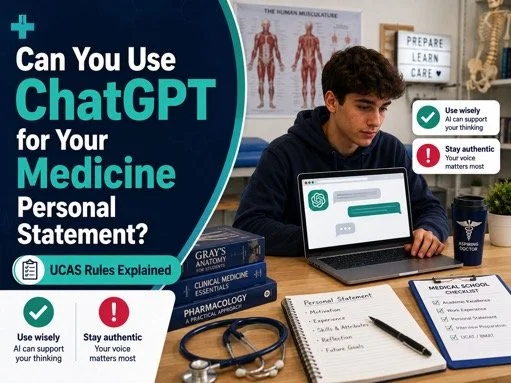
If you're in sixth form and applying to medical school, you've almost certainly wondered it — probably at 11 pm, staring at a blinking cursor: could ChatGPT just write this for me?
You're not alone. Thousands of medicine applicants type some version of that question into Google every year. And the honest answer is more interesting than a flat "no". Used badly, AI can wreck your application before an admissions tutor has read a single line. Used well, it can genuinely sharpen your writing — and UCAS itself says so.
This guide breaks down exactly what UCAS allows, what counts as cheating, why medicine is a special case, and how to use AI tools without putting your dream of a medical career at risk.
💙 The short answer
No, ChatGPT should not write your medicine personal statement — but yes, it can help you write it.
UCAS is clear that copying and pasting AI-generated text and submitting it as your own words can be treated as cheating. Anything that isn't genuinely yours risks being flagged by UCAS's similarity and fraud checks, which can mean universities withdraw offers or reject your application outright.
At the same time, UCAS acknowledges that AI tools can be useful to applicants if used in the right way — for sparking ideas, checking structure and improving readability. This article is about where the line is drawn.
🔵 What UCAS actually says about AI and ChatGPT
UCAS has published official guidance on using AI with personal statements, and it boils down to three principles:
- Your statement must be in your own words. Text generated by an AI tool and presented as your own writing could be considered cheating and may be flagged as fraud.
- Everything must be true. Anything you write may need to be discussed or evidenced later — at interview, for instance. Invented experiences are a serious problem (more on that below).
- AI can support, not substitute. UCAS explicitly recognises that tools like ChatGPT can help applicants brainstorm, organise their thoughts and check readability, provided the final words are the applicant's own.
There's also a quieter warning buried in the UCAS guidance that's worth taking seriously: if you feel you need AI to write your personal statement for you, ask yourself whether the course is right for you. For medicine — a career built on honesty, self-awareness and communication — that question cuts especially deep.
⚠️ Does UCAS detect AI-written statements?
UCAS runs every personal statement through similarity detection, and universities are increasingly alert to the tell-tale signs of machine-generated writing: polished but hollow prose, vague reflections, and phrasing that could belong to any of ten thousand applicants. Statements flagged for similarity or suspected fraud can be reported to the universities you've applied to — and it's then up to them how to respond. Rejection and withdrawn offers are both on the table.
Even without software, admissions tutors read hundreds of statements every cycle. They know what an eighteen-year-old's authentic voice sounds like. They also know what ChatGPT sounds like.
🩺 Why medicine is a special case
Every applicant should be careful with AI. Medicine applicants need to be doubly careful, for three reasons.
Your statement follows you to interview
Most medical schools interview, and many use your personal statement as a starting point for questions. Some, such as Edinburgh, tell applicants directly that the statement will be essential preparation for assessment days. If ChatGPT wrote a moving paragraph about your hospice volunteering and an interviewer asks, "Tell me more about that patient you mentioned" — and your face goes blank — the interview is effectively over.
Reflection is the whole point
Medical schools repeatedly say the same thing: they don't want a list of what you did, they want evidence of what you learned. The Medical Schools Council emphasises that applicants should show genuine understanding of the realities of medical training, and the General Medical Council promotes structured reflection as a core professional skill. Reflection is, by definition, personal. An AI tool has never stood in a care home corridor feeling out of its depth. You have. Only you can write about it.
Medicine is a profession built on probity
Honesty and integrity aren't just nice-to-haves in medicine — they're professional requirements from day one of medical school. Submitting someone (or something) else's words as your own is a poor way to open a career in which trust is everything.
📋 A quick reminder: the new UCAS personal statement format
Since the 2026 entry cycle, the single free-form personal statement has been replaced by three structured questions:
- Why do you want to study this course or subject?
- How have your qualifications and studies helped you to prepare for this course or subject?
- What else have you done to prepare outside of formal education, and why are these experiences useful?
You still have 4,000 characters in total, with a minimum of 350 characters per answer, and you can split the rest however suits you. UCAS notes that courses like medicine lean heavily on question three, because work experience and volunteering matter so much — which is exactly where authentic, first-hand reflection is hardest to fake and easiest to spot when it's fake.
✅ Acceptable ways to use ChatGPT for your medicine personal statement
Here's where the nuance comes in. Used as a thinking partner rather than a ghostwriter, AI can add real value. All of the following sit comfortably within UCAS guidance.
🧠 Brainstorming themes and structure
Stuck on where to start? Ask ChatGPT questions like:
- "What themes do medical schools typically look for in answers about work experience?"
- "Ask me ten questions that would help me reflect on my GP shadowing placement."
That second prompt is particularly powerful. Getting AI to interview you draws out memories and insights you'd forgotten you had — and every word of the eventual answer is still yours.
🔍 Checking clarity and readability
Paste in a paragraph you've written and ask: "Is anything here unclear or clunky?" You'll get useful feedback on sentence length, muddled logic and jargon — the same kind of feedback a good teacher gives, just available at midnight.
♻️ Spotting repetition
With only 4,000 characters across three answers, repetition is expensive. Admissions staff read your three answers as one whole, so asking AI "Do any ideas repeat across these three answers?" is a legitimate and genuinely useful check.
❓ Stress-testing your reflection
This is the most underrated use of all. Ask: "Play the role of a sceptical admissions tutor. What follow-up questions would you ask about this paragraph?" If the AI exposes a shallow reflection — "I learned that teamwork is important" — you've just found a weakness before an interviewer did. Then go away and deepen it yourself.
✏️ Proofreading
Spelling, grammar, punctuation. Absolutely fine. Just check the corrections don't quietly rewrite your voice into something that no longer sounds like you.
❌ Problematic uses that could sink your application
Now the other side of the line — the uses that UCAS, universities and medical schools consider unacceptable.
🚫 Generating your actual submission
Prompting "write me a medicine personal statement" and submitting the output — even with light edits — is exactly what UCAS warns could be considered cheating. It's also self-defeating: AI-written statements are consistently generic, and generic is fatal in a field where thousands of strong applicants chase every place.
🚫 Inventing experiences
Never let AI (or your own nerves) fabricate a placement, a patient encounter or a volunteering role. UCAS states plainly that anything in your statement may need to be evidenced. In medicine, a fabricated experience isn't just risky — it's a probity issue that could follow you into fitness-to-practise territory later. It is genuinely not worth it.
🚫 Producing generic reflections
"This experience taught me the importance of empathy and communication, skills essential for a career in medicine." Sound familiar? That's because AI produces sentences like this by the tonne. Medical schools value quality of reflection over quantity of experience — a specific moment, honestly examined, beats a paragraph of polished platitudes every time.
🚫 Pasting AI-generated paragraphs into your draft
The halfway house is still the wrong side of the line. Mixing your paragraphs with ChatGPT's creates a Frankenstein statement with two voices — obvious to experienced readers — and the pasted sections still fall foul of the "your own words" rule. If AI wrote the sentence, don't submit the sentence.
📝 A sensible workflow for medicine applicants
If you want to use AI responsibly, this order of operations keeps you safe:
- Do the living first. Work experience, volunteering, wider reading. Keep a reflective diary as you go — UCAS's own medicine guide recommends exactly this.
- Write a messy first draft yourself. In your own voice, imperfections and all. This is the raw material nothing can replace.
- Use AI to question, not to write. Ask it to probe your reflections, flag repetition and highlight unclear passages.
- Redraft yourself. Every improvement should pass through your own keyboard, in your own words.
- Get human feedback. Teachers, careers advisers, family. UCAS encourages this — and humans who know you will spot when something doesn't sound like you.
- Final proofread — AI is fine here — then read the whole thing aloud. If it doesn't sound like you speaking, keep editing.
💬 Frequently asked questions
Is using ChatGPT for a personal statement cheating?
Using it to brainstorm, check clarity or proofread is not cheating, and UCAS says as much. Submitting AI-generated text as your own words crosses into cheating and can be flagged as fraud.
Will universities know if I used AI?
Quite possibly. UCAS runs similarity checks on every statement, some universities use AI-detection tools, and admissions tutors are practised at spotting generic, machine-flavoured writing. Interviews then test whether you can actually talk about what you wrote.
Can I use ChatGPT to fix my grammar?
Yes — proofreading is one of the uses UCAS considers acceptable. Just make sure the corrections don't rewrite your meaning or flatten your voice.
What happens if my statement gets flagged?
Flagged statements can be reported to your chosen universities, which may investigate, reject the application or withdraw offers. For medicine, where competition is fierce and integrity is scrutinised, the stakes are as high as they get.
Does the new three-question format change anything?
The format changed; the rules didn't. All three answers must still be truthful, and in your own words — and for medicine, question three (experience outside education) is precisely where authentic personal reflection matters most.
🔵 The final word
ChatGPT is a tool, and like any tool in medicine, what matters is how you use it. A scalpel in trained hands saves lives; the same blade used carelessly does harm.
Let AI ask you hard questions, tidy your grammar and point out where you've repeated yourself. But the memories, the reflections, the reasons you want to spend your working life caring for other people — those have to come from you. Not because a rule says so (although it does), but because that's the only version of your statement that can survive an interview, and the only version worth writing.
Your story got you this far. Trust it to take you the rest of the way. 💙
🔗 Useful links
- UCAS: A guide to using AI and ChatGPT with your personal statement
- UCAS: How to write your personal statement (2026 entry onwards)
- UCAS: Medicine personal statement guide
- Medical Schools Council: Applying to medical school
- General Medical Council: Reflective practice guidance
- Edinburgh Medical School: Your personal statement