Medicine Interview Questions Based on Your Personal Statement: How to Prepare and Impress
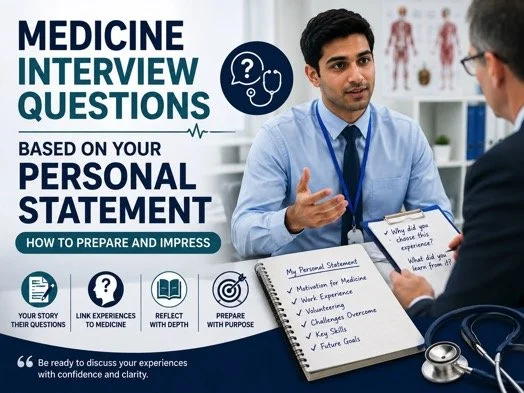
If you're applying to medical school, here's something worth knowing early: your personal statement doesn't stop working once you hit "submit" on UCAS. Even at medical schools that don't score it during initial selection, admissions tutors often read it before your interview — and UCAS itself warns applicants that anything in your statement is likely to come up in conversation.
In other words, your personal statement is a promise. Your interview is where you prove you can keep it. 🩺
This guide walks you through exactly how UK medical schools use your personal statement at interview, the most common personal statement interview questions (with examples), and a step-by-step method for preparing answers that sound confident, reflective and genuinely you.
Why Medical Schools Ask About Your Personal Statement at Interview
Think about it from the interviewer's point of view. They have ten to twenty minutes to work out whether you understand what a career in medicine actually involves. Your personal statement is a ready-made map of your experiences — so it makes sense to use it.
There are three main reasons interviewers return to your statement:
1. To check it's really yours
Admissions tutors know that some statements are heavily edited by teachers, tutors or family members — and, increasingly, they're alert to AI-generated writing. If you wrote about reading The Emperor of All Maladies but can't recall a single idea from it, that's a red flag. Questions based on your statement are the quickest authenticity test there is.
2. To test reflection, not just experience
The Medical Schools Council is clear that it's not what you did that matters, but what you learned from it. Anyone can spend a week shadowing a GP. Far fewer applicants can explain how that week changed their understanding of communication, uncertainty or teamwork. Interview questions dig for that reflection.
3. To see how you think under gentle pressure
When an interviewer challenges something you wrote — "You mentioned empathy. Can a doctor be too empathetic?" — they're not trying to catch you out. They want to see whether you can think aloud, consider another viewpoint and stay composed. These are core clinical skills.
Do All Medical Schools Use the Personal Statement at Interview?
Not all, but many do — and you should prepare as though yours will.
Broadly, UK medical schools fall into three camps:
- Scored at selection or interview — a minority of schools formally assess the statement, sometimes as part of the interview itself.
- Used as a discussion prompt — a large group of schools don't score the statement but draw interview questions directly from it, particularly in panel interviews and some MMI stations.
- Minimal use — a few schools state that the personal statement plays little or no part in selection.
Here's the crucial bit: admissions policies change year on year, so always check the current admissions page of each medical school you're applying to. The Medical Schools Council publishes an annually updated summary of how every UK medical school uses each part of the application — it should be your first port of call.
💡 Golden rule: never write anything in your personal statement that you couldn't happily discuss for five minutes. If you mention a book, read the whole book. If you mention a placement, be ready to describe a specific moment from it.
Common Personal Statement Interview Questions (With Examples)
Below are the categories of questions that come up again and again, based on the themes most applicants write about. Read your own statement alongside this list and highlight every sentence that could trigger one of these.
Questions About Work Experience and Volunteering 🤝
These are almost guaranteed if you mentioned any placement, volunteering role or part-time job.
- "You mentioned volunteering in a care home. What did this teach you?"
- "Describe a specific patient or resident interaction that stayed with you. Why?"
- "What surprised you most about your work experience?"
- "Did you see anything during your placement that you thought could have been done better?"
- "You wrote about shadowing a GP. What challenges do GPs face that you hadn't appreciated before?"
- "What did your part-time job at a supermarket teach you that's relevant to medicine?"
How to answer: use a specific moment, not a general summary. Compare these two openings:
❌ "Volunteering in a care home taught me communication skills and empathy."
✅ "There was one resident with advanced dementia who became distressed every afternoon. I noticed she settled when I talked about gardening, which her daughter mentioned she'd loved. That taught me that communication in medicine often means finding the person behind the condition."
The second answer is memorable because it's real, reflective and shows initiative — exactly what interviewers are listening for.
Questions About Motivation for Medicine ❤️
Your opening paragraph will almost certainly be probed.
- "You wrote that a family member's illness inspired you. How do you know medicine is right for you, rather than nursing or physiotherapy?"
- "Your statement says you want to 'help people'. Lots of careers help people — why this one?"
- "Has anything you've learned since writing your statement changed your view of medicine?"
- "You described medicine as a blend of science and humanity. What did you mean by that?"
How to answer: avoid simply repeating your statement word for word. Interviewers have read it. Add depth: a new example, a further reflection, or an honest acknowledgement of the challenges of the career alongside its rewards.
Questions About Wider Reading and Medical Issues 📚
If you referenced a book, podcast, article or topical issue, expect it to come up.
- "You mention a particular book. What did you disagree with?"
- "What was the author's central argument, and how convincing did you find it?"
- "You wrote about health inequalities. What do you think causes them?"
- "How could the NHS reduce health inequalities in practice?"
- "You mentioned an interest in medical ethics. Talk me through an ethical dilemma that interests you."
- "Your statement refers to antibiotic resistance. Whose responsibility is it to tackle this?"
How to answer: the "what did you disagree with?" question is a favourite because it separates genuine readers from name-droppers. Before your interview, jot down for every source you mentioned:
- One idea you found persuasive
- One idea you'd challenge or question
- One way it changed how you think about medicine
For big-picture topics like health inequalities, structure helps. You might mention social determinants of health — income, housing, education, environment — alongside access to services and lifestyle factors, then acknowledge that these causes overlap and are difficult to untangle. You don't need a perfect answer; you need a thoughtful one.
Questions About Skills and Personal Qualities 🌟
Every claim you made about yourself is fair game.
- "You describe yourself as resilient. Give me an example of a time you failed."
- "You mentioned leading your school's debating team. What makes a good leader?"
- "You say teamwork is essential in medicine. Tell me about a time a team you were in didn't work well."
- "You wrote that you're empathetic. Can empathy ever be a disadvantage for a doctor?"
How to answer: interviewers love the follow-up twist ("Can empathy be a disadvantage?"). Don't panic — this is an invitation to show balanced thinking. Yes, over-identifying with patients can lead to burnout or clouded judgement, which is why doctors need professional empathy: caring deeply while maintaining the objectivity to make sound decisions.
Questions About Hobbies and Extracurriculars 🎻
Yes, even the final paragraph about your Grade 7 violin or Sunday league football can generate questions.
- "How will you keep up your hobbies at medical school, given the workload?"
- "What has playing in an orchestra taught you about working with others?"
- "You mentioned Duke of Edinburgh. What was the hardest moment of your expedition?"
How to answer: link your answer to wellbeing and balance. Medical schools genuinely care about this — burnout is a real issue in the profession, and they want students who know how to look after themselves.
How to Prepare: A Five-Step Method 📝
Step 1: Interrogate your own statement
Print your statement and go through it line by line with a highlighter. For every experience, claim or reference, write the question an interviewer might ask in the margin. Be brutal — if you'd struggle to expand on a sentence, prepare it or be honest about its limits.
Step 2: Build a "story bank"
For each experience in your statement, prepare one specific story with a beginning, middle and reflective end. A simple structure that works well:
- What happened — set the scene in one or two sentences
- What you did or noticed — your role, your observation
- What you learned — the reflection, linked to a quality doctors need
- What it means for your future — how it will shape you as a medical student or doctor
Step 3: Revisit your wider reading
Skim-read every book or article you mentioned. Refresh your memory of the key arguments, and decide in advance what you agreed with, what you'd challenge, and what questions it left you with.
Step 4: Update yourself on the topics you raised
If you wrote about health inequalities, NHS pressures, AI in medicine or any topical issue, check what's happened since you wrote your statement. Being able to say "since I wrote my statement, I've also read about..." is hugely impressive — it shows sustained, genuine interest.
Step 5: Practise out loud
Answers that sound polished in your head often fall apart when spoken. Ask a teacher, friend or family member to fire personal statement questions at you — or record yourself on your phone and listen back. Aim for answers of roughly one to two minutes: long enough to show depth, short enough to stay focused.
Common Mistakes to Avoid ⚠️
- Reciting your statement verbatim. The interviewer has read it. Add something new every time.
- Exaggerating in the statement itself. If you spent one afternoon at a hospice, don't imply it was a months-long placement. Interviews expose embellishment quickly.
- Name-dropping books you haven't finished. "What did you disagree with?" will find you out.
- Generic reflections. "It taught me communication skills" tells the interviewer nothing. A specific moment tells them everything.
- Panicking at challenge questions. Being pushed on your views is normal and usually a good sign — it means the interviewer is engaged. Take a breath, think aloud, and it's absolutely fine to say "that's a fair challenge — I'd add that..."
A Note on MMIs vs Panel Interviews
In a traditional panel interview, questions about your personal statement can appear anywhere and interviewers often have your statement in front of them.
In a Multiple Mini Interview (MMI), many stations are standardised for fairness, so not every school will reference your statement directly. However, some schools include a dedicated station drawing on your application, and the themes of personal statement questions — motivation, work experience reflection, ethics, teamwork — appear at MMI stations everywhere. Preparing your statement thoroughly is never wasted effort.
Final Thoughts 🎯
Your personal statement got you through the door. At interview, it becomes your greatest asset or your biggest liability — and the difference is entirely down to preparation.
Know every line of it. Have a story for every claim. Read what you said you read. And remember that interviewers aren't trying to trip you up: they're giving you the chance to prove that the thoughtful, motivated applicant on the page is the real person sitting in front of them.
Good luck — you've got this. 💙
Useful Links
- Medical Schools Council — entry requirements and how medical schools use applications: https://www.medschools.ac.uk
- UCAS — medicine personal statement guide: https://www.ucas.com/applying/applying-to-university/writing-your-personal-statement/personal-statement-guides/medicine-personal-statement-guide
- UCAS — applying to medicine: https://www.ucas.com/explore/subjects/medicine
- University of Oxford Medical Sciences Division — Anatomy of a Personal Statement: https://www.medsci.ox.ac.uk/study/medicine/pre-clinical/applying/anatomy-of-ps
- General Medical Council — Good Medical Practice: https://www.gmc-uk.org/professional-standards/professional-standards-for-doctors/good-medical-practice
- NHS — the NHS Constitution for England: https://www.gov.uk/government/publications/the-nhs-constitution-for-england
- NHS Health Careers — becoming a doctor: https://www.healthcareers.nhs.uk/explore-roles/doctors