How to Write About GP Work Experience in a Medicine Personal Statement
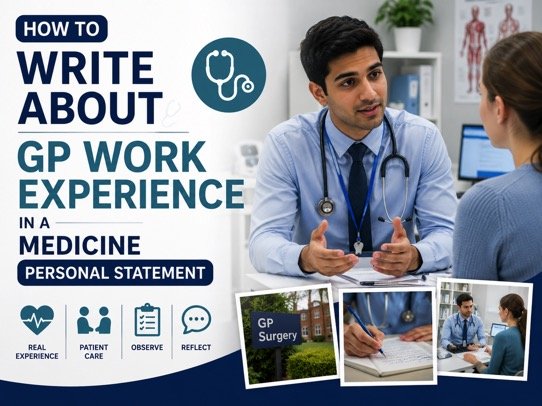
If you've spent time in a GP surgery — even just a few days — you're sitting on some of the strongest material you could possibly have for your medicine personal statement. General practice is where most NHS patient contact actually happens, and admissions tutors know it. The problem? Most applicants waste it.
They write things like: "I shadowed a GP for a week and saw many interesting cases, which confirmed my passion for medicine."
That sentence tells a medical school nothing. This guide will show you how to do better — how to turn your GP work experience into reflective, specific writing that stands out in the new three-question UCAS personal statement format.
🩺 Whether you spent two weeks shadowing your local GP or completed a virtual placement like Observe GP, everything here applies to you.
Why GP Work Experience Matters to Medical Schools
Around 90% of NHS patient contact takes place in general practice. It's the front door of the health service. When you shadow a GP, you see medicine as it's actually practised for most doctors, most of the time: ten-minute appointments, undifferentiated symptoms, safety-netting, uncertainty, and long-term relationships with patients.
Medical schools value GP experience because it shows you've seen:
- Realistic medicine — not just the dramatic hospital cases from TV
- Communication in action — history-taking, breaking difficult news, managing expectations
- The multidisciplinary team — practice nurses, pharmacists, receptionists, healthcare assistants
- Continuity of care — doctors who know their patients over years, not hours
- The pressures on the NHS — appointment demand, resource limits, and how doctors cope
Here's the crucial point, straight from the Medical Schools Council: it is what you learned from your experience that matters, not how prestigious the placement was. A reflective paragraph about watching a GP explain a diabetes diagnosis will beat a name-drop about shadowing a surgeon every single time.
Where GP Work Experience Fits in the New UCAS Personal Statement
Since the 2026 entry cycle, the UCAS personal statement is no longer one continuous essay. You now answer three structured questions, sharing a total of 4,000 characters (with a minimum of 350 characters per answer):
- Why do you want to study this course or subject?
- How have your qualifications and studies helped you to prepare for this course or subject?
- What else have you done to prepare outside of education, and why are these experiences useful?
Question 3 is your main stage
Your GP work experience belongs primarily in Question 3. This is where admissions tutors expect to find work experience, volunteering and wider preparation — and, critically, why those experiences are useful. The question literally asks you to reflect. Take the hint.
But Question 1 can borrow from it too
A specific moment from your GP placement can also anchor your motivation in Question 1. "Watching a GP gently unpick why an elderly patient kept missing her medication showed me that medicine is as much detective work as science" is a far more convincing opening than "I have always wanted to be a doctor."
⚠️ One rule: never repeat yourself. Medical schools read all three answers as a single statement. If you use a moment from your placement in Question 1, use different moments and lessons in Question 3.
The Golden Rule: Reflection Beats Description
This is the single most important idea in this entire article.
Admissions tutors are not assessing what you saw. They are assessing what you understood. Two students can sit in the same consulting room for the same week and write completely different statements — one descriptive and forgettable, one reflective and memorable.
A simple structure that works
For every experience you mention, aim for three moves:
1. What happened (briefly) 🔵 One or two lines of specific detail. Not "I saw many patients" but "I observed a consultation where a patient presented with fatigue that turned out to be linked to bereavement."
2. What you learned 🔵 The insight. What did it teach you about medicine, doctors, patients or yourself? This is where most of your characters should go.
3. Why it matters for you as a future doctor 🔵 Connect the insight to the qualities medicine demands — communication, empathy, teamwork, resilience, scientific curiosity — or to something you then did as a result (further reading, volunteering, a taster course).
Some schools call versions of this "What? So what? Now what?" — the label doesn't matter. The habit does.
Before and after: see the difference
❌ Weak (descriptive): "During my GP work experience I shadowed doctors and nurses and saw a wide variety of conditions including asthma, diabetes and depression. It was fascinating and confirmed my desire to study medicine."
✅ Strong (reflective): "In one morning surgery, I watched the GP adapt her communication three times: simplifying language for a child with asthma, checking understanding with a patient whose first language wasn't English, and sitting in silence while a man described his low mood. I realised that a consultation is not a script but a negotiation — and that listening is a clinical skill in its own right. It prompted me to read about the Calgary–Cambridge consultation model and to pay closer attention to how I communicate in my own volunteering at a care home."
The second version is longer, yes — but every line earns its place. It shows observation, insight, initiative and follow-through.
What to Actually Write About: Themes From GP Placements
Stuck on what your placement actually taught you? Here are themes that GP work experience illustrates brilliantly. Pick two or three — don't try to cram in all of them.
Communication and the ten-minute consultation
How did the GP build rapport in seconds? How did they handle a patient who arrived with a list of five problems? What did you notice about open versus closed questions, body language, or the way bad news was delivered?
Dealing with uncertainty
Hospital medicine often starts with a diagnosis; general practice starts with a symptom. GPs constantly manage uncertainty — deciding who needs urgent referral, who needs watchful waiting, and how to "safety-net" ("come back if it gets worse"). If you noticed this, write about it. It shows genuine insight into how medicine really works.
Holistic and continuity of care
Did you see a GP treat the person, not just the illness — asking about home life, work stress, or family? Did you notice how knowing a patient for years changed the consultation? This is the heart of general practice.
Teamwork beyond doctors
Practice nurses running chronic disease clinics. Pharmacists reviewing medications. Receptionists triaging calls. Reflecting on the wider team shows maturity — medicine is not a solo sport.
The realities and pressures of the NHS
Appointment pressures, an ageing population, mental health demand, health inequalities in the local community. Showing you've seen the hard parts — and still want in — demonstrates realistic commitment, which is exactly what medical schools are checking for.
Confidentiality: The Mistake That Can Sink Your Statement
🚨 This one is non-negotiable.
Never include details that could identify a patient. No names, no unusual conditions combined with locations, no "a 74-year-old woman from my village with a rare heart condition." Doctors are bound by confidentiality under the GMC's Good Medical Practice, and admissions tutors expect applicants to respect the same principle. Breaching it in your statement suggests poor judgement before you've even started.
Keep descriptions general: "a patient with a long-term condition," "an elderly patient," "a consultation about mental health." You lose nothing by anonymising — the reflection is what counts, and that's yours.
What If You Couldn't Get a GP Placement?
Take a deep breath — you are not doomed. 💙
Medical schools understand that placements are hard to secure. Access depends on where you live, who you know, and pure luck — and admissions teams have publicly acknowledged this for years. The Medical Schools Council is clear that no applicant should be disadvantaged by lack of access to formal shadowing, and that any experience of caring responsibility or working with people can demonstrate the same qualities.
Strong alternatives that count
- Observe GP — a free interactive video platform from the Royal College of General Practitioners, designed specifically for aspiring medics aged 16+. It simulates a GP placement and gives you genuine material to reflect on.
- Volunteering — care homes, hospices, charity shops, befriending schemes, St John Ambulance. Regular commitment over months often impresses more than a one-week placement.
- Paid work — a part-time job in a pharmacy, as a healthcare assistant, or even in retail or hospitality can evidence communication, responsibility and dealing with the public under pressure.
- Caring responsibilities — looking after a family member is legitimate, valuable experience. Reflect on it with the same structure.
The reflective skills in this article apply identically. A student who writes thoughtfully about Observe GP and a care home will outscore a student who lists a fortnight of shadowing with zero reflection.
Common Mistakes to Avoid
Listing instead of reflecting
"I saw consultations, home visits, minor surgery and vaccination clinics" is a timetable, not a personal statement. Cut the list; keep one moment and go deep.
Vague superlatives
"Fascinating," "amazing," "invaluable," "confirmed my passion." These words do nothing. If you delete the sentence and your statement loses no meaning, delete the sentence.
Pretending you did more than observe
You did not "assist in diagnosing" anyone. You observed. Honesty matters — and interviewers will probe your work experience, so never write anything you can't discuss in detail face to face.
Criticising doctors or the NHS carelessly
You can acknowledge pressure and imperfection thoughtfully, but sneering at overworked professionals is a terrible look.
Forgetting the interview
Everything in your statement is fair game at interview. Keep notes from your placement (a reflective diary is ideal) so that months later you can expand on every claim with confidence.
A Quick Checklist Before You Submit ✅
- Does every GP experience mentioned include a specific moment, a lesson, and a link to medicine?
- Have you shown insight into general practice specifically — uncertainty, continuity, the ten-minute consultation, the wider team?
- Is every patient detail fully anonymised?
- Have you avoided repeating the same example across Questions 1 and 3?
- Have you cut every "fascinating" and "passion"?
- Could you talk about every sentence for two minutes at interview?
- Is it entirely your own work? (UCAS screens statements with similarity-detection software, and universities take AI-written statements seriously — in the worst way.)
If you can tick all of those, your GP work experience is doing exactly what it should: proving you understand what being a doctor actually involves, and that you've thought hard about whether it's for you.
Good luck — and if you're applying for medicine this cycle, remember the earlier deadline: applications for most medicine courses must reach UCAS by mid-October, months before the main January deadline. Don't leave your statement until half term. 🍀
Useful Links and Authoritative Resources
- Medical Schools Council — Work experience guidance: https://www.medschools.ac.uk/studying-medicine/making-an-application/work-experience
- Medical Schools Council — Entry requirements and applying to medicine: https://www.medschools.ac.uk/studying-medicine/making-an-application
- UCAS — Personal statements (three-question format): https://www.ucas.com/applying/applying-university/writing-your-personal-statement
- UCAS — Medicine subject guide: https://www.ucas.com/explore/subjects/medicine
- Observe GP (Royal College of General Practitioners): https://www.rcgp.org.uk/observegp
- NHS Health Careers — Applying to medical school: https://www.healthcareers.nhs.uk/explore-roles/doctors/applying-medical-school
- General Medical Council — Good Medical Practice: https://www.gmc-uk.org/professional-standards/good-medical-practice
- BMA — Becoming a doctor: https://www.bma.org.uk/advice-and-support/studying-medicine/becoming-a-doctor
Always check the individual medical school's own website for their specific selection criteria, as each school weighs personal statements differently.