How to Write About Care Home Volunteering: A Guide for Sixth Form Students
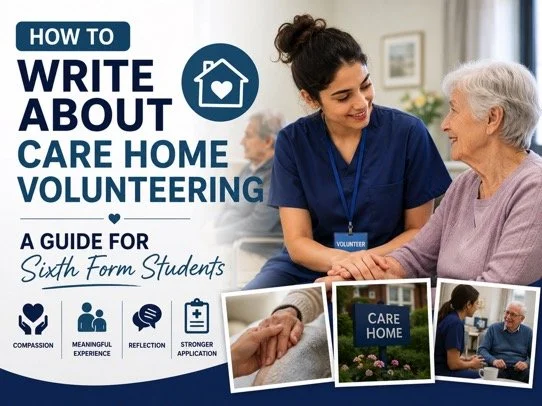
So you've spent your Saturday mornings pouring tea, playing dominoes and chatting about the 1960s with people who were actually there. Brilliant. Care home volunteering is one of the most valuable experiences you can bring to a medical school application — but only if you write about it well.
Here's the uncomfortable truth: admissions tutors read thousands of personal statements every year, and most of them mention some form of caring experience. Simply having volunteered won't make you stand out. What matters is what you learned, how you reflected on it, and how honestly you can connect it to a career in medicine or healthcare.
This guide walks you through exactly how to write about care home volunteering — for your UCAS application, medical school interviews, or a reflective piece for your school. Let's get started. 🩺
Why Care Home Volunteering Matters to Medical Schools
The Medical Schools Council is refreshingly clear about this: medical schools don't expect you to have shadowed a brain surgeon or flown abroad on an expensive placement. What they want is evidence that you understand what a career in caring for people actually involves — the rewarding parts and the difficult ones.
Care home volunteering ticks that box beautifully because it shows:
- Sustained commitment — turning up week after week, even when it's cold, you're tired, or your friends are doing something more exciting
- Direct contact with vulnerable people — including those living with dementia, frailty or long-term conditions
- Realistic insight into care — you've seen that healthcare isn't all dramatic diagnoses; much of it is patience, dignity and communication
- Teamwork with professionals — you've watched carers, nurses and activity coordinators work under pressure
In short, it demonstrates the values set out in the NHS Constitution: compassion, respect, dignity and commitment to quality of care. That's exactly the language admissions tutors are listening for — as long as you show it rather than just say it.
Before You Write: Gather Your Raw Material 📝
Keep a Reflection Journal
If you're still volunteering, start writing things down now. After each visit, spend five minutes noting:
- One moment that stuck with you
- One thing that surprised or challenged you
- One thing you'd do differently next time
You'll thank yourself later. Memory fades fast, and the small, specific details — the resident who only spoke when the wartime songs came on, the carer who calmed an anxious gentleman with nothing but tone of voice — are pure gold when you come to write.
Ask Yourself the Right Questions
Before drafting anything, jot honest answers to these:
- Why did I choose a care home rather than another setting?
- What did I expect, and how did reality differ?
- What was genuinely hard? (Boredom, awkwardness and helplessness all count.)
- What did I learn about communication, especially with residents living with dementia?
- What did I observe about the staff and the pressures they face?
- How has this changed my view of medicine, nursing or care as a career?
If you can't answer question three, dig deeper. Admissions tutors are rightly suspicious of experiences that were apparently 100% heartwarming.
The Golden Rule: Reflect, Don't Describe
This is the single biggest difference between a forgettable statement and a memorable one.
Describing (weak) ❌
"I volunteered at a care home every Saturday for a year, where I helped serve meals, ran activities and talked to residents. This taught me communication skills and empathy."
This tells the reader what you did but nothing about who you are. Anyone could have written it.
Reflecting (strong) ✅
"One resident, a former teacher, repeated the same question every few minutes. At first I felt awkward answering it again and again. Watching a carer respond each time with the same warmth taught me that in dementia care, patience isn't passive — it's an active skill, and one I had to consciously practise."
Notice the difference? The strong version is specific, honest about difficulty, and shows learning in action. It could only have been written by someone who was actually there.
Try the "What? So What? Now What?" Model
A simple reflective framework used across healthcare education:
What?
Briefly describe the situation. One or two sentences maximum — resist the urge to narrate your entire year.
So What?
This is the heart of your writing. What did it mean? What did you feel, learn or realise? How did it challenge your assumptions?
Now What?
How has it shaped your motivation, your skills, or your understanding of a healthcare career? What will you carry forward?
Aim for roughly 20% What, 60% So What, 20% Now What. Most first drafts get this ratio completely backwards.
Writing for Your UCAS Application 🎓
Fit Your Reflection to the Structure
The UCAS application now asks structured questions about your motivation for the course, how your studies have prepared you, and what you've done outside education. Care home volunteering sits naturally in that final section — but the reflective skills in this guide apply wherever you place it. Whatever the format, the principle is identical: evidence plus reflection beats a list of duties every time.
Be Specific, Stay Confidential
Use concrete moments, but never identify a resident. No names, no identifying details, no "the lady in Room 4". Confidentiality is a core professional value — demonstrating it in your writing is itself a quiet signal that you understand healthcare culture.
Avoid These Common Clichés
- "I have always wanted to be a doctor since I was young…"
- "This experience confirmed my passion for medicine…"
- "It taught me valuable communication skills…" (without saying which skills or how)
- Claiming your visits "made a huge difference" to residents' lives — stay humble; you were one small part of their week
Don't Overclaim
You served tea and provided company. You did not "provide care to dementia patients" in a clinical sense. Admissions tutors and interviewers know exactly what a sixth form volunteer does — honesty about the limits of your role shows maturity, and exaggeration will unravel quickly at interview.
Talking About It at Interview 🗣️
Anything you write can — and probably will — come up at interview, so only include experiences you can discuss in depth. Prepare for questions like:
- "Tell me about a difficult moment during your volunteering."
- "What did you observe about how staff communicated with residents?"
- "What did your volunteering teach you about the limitations of medicine?"
That last question is a gift. Care homes show you that health isn't only about curing — it's about comfort, dignity and quality of life. A candidate who understands that end-of-life and long-term care are central to modern medicine, not a footnote, immediately sounds more thoughtful than one who only talks about saving lives.
A Quick Word on Emotional Honesty
It's absolutely fine — powerful, even — to admit that some moments were sad or uncomfortable. Perhaps a resident you'd grown fond of passed away, or you felt helpless watching someone in distress. Reflecting on how you processed that, and what it taught you about the emotional demands of caring professions, demonstrates exactly the self-awareness medical schools look for. Just keep the focus on learning rather than dwelling on the sadness itself.
A Simple Checklist Before You Submit ✅
- 💙 Have I used at least one specific (anonymised) moment rather than general claims?
- 💙 Is at least half of my writing reflection rather than description?
- 💙 Have I been honest about something I found difficult?
- 💙 Have I linked what I learned to the realities of a healthcare career?
- 💙 Have I protected confidentiality completely?
- 💙 Could I talk about every sentence for two minutes at interview?
- 💙 Have I avoided exaggerating my role?
If you can tick all seven, you've turned your Saturday mornings into something genuinely persuasive.
Final Thoughts
Care home volunteering won't get you into medical school by itself — but written about well, it proves the things that grades never can: commitment, compassion, humility and insight into what caring for people really involves. Reflect deeply, write honestly, and let the small moments do the talking.
Good luck — and if you're still volunteering, keep that journal going. Your future self, staring at a blank application form, will be very grateful indeed. 💙
Useful Links 🔗
- Medical Schools Council — guidance on work experience: https://www.medschools.ac.uk/studying-medicine/making-an-application/work-experience
- Medical Schools Council — applying to medical school: https://www.medschools.ac.uk/studying-medicine/making-an-application
- UCAS — personal statement and application advice: https://www.ucas.com/applying/applying-to-university/writing-your-personal-statement
- NHS Health Careers — becoming a doctor: https://www.healthcareers.nhs.uk/explore-roles/doctors
- NHS — the NHS Constitution and its values: https://www.gov.uk/government/publications/the-nhs-constitution-for-england
- Royal Voluntary Service — volunteering opportunities: https://www.royalvoluntaryservice.org.uk
- Care Quality Commission — understanding care home standards: https://www.cqc.org.uk