
How to Write About Hospital Work Experience in a Medicine Personal Statement
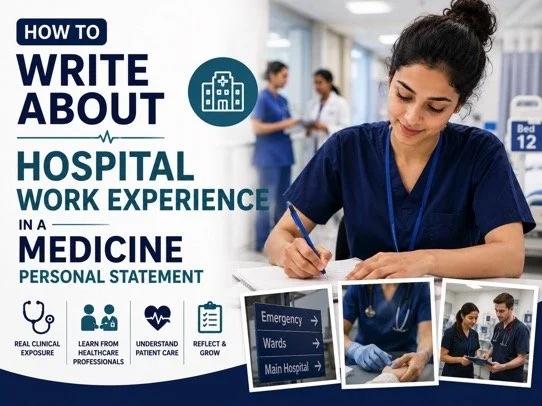
So you've done it. You spent a week trailing around a hospital ward, watched a consultant explain a difficult diagnosis, maybe sat in on a multidisciplinary team meeting where half the acronyms went over your head. Now you're staring at a blank UCAS form wondering how on earth to squeeze all of that into a few hundred characters.
Here's the thing most sixth formers get wrong: admissions tutors don't actually care what you saw. They care what you learned. A student who spent one afternoon in a GP surgery and reflected on it brilliantly will beat a student who spent three weeks in a teaching hospital and simply listed everything they witnessed.
This guide walks you through exactly how to write about hospital work experience in your medicine personal statement — what to include, what to cut, and how to reflect in a way that makes admissions tutors sit up.
💙 First things first: the UCAS personal statement has changed
Before we get into the writing itself, a quick but important update. The old free-form personal statement essay is gone. UCAS now asks all applicants three structured questions, sharing a total of 4,000 characters:
- Why do you want to study this course or subject?
- How have your qualifications and studies helped you to prepare for this course or subject?
- What else have you done to prepare outside of formal education, and why are these experiences useful?
Your hospital work experience belongs mostly in Question 3 — and for medicine, this is arguably the most important answer of the three. UCAS itself notes that vocational courses like medicine lean heavily on this section. You can spread your 4,000 characters unevenly, so it's perfectly sensible to give Question 3 the lion's share.
That said, a well-chosen moment from your placement can also open Question 1 beautifully. If a single patient interaction genuinely sparked or confirmed your motivation to study medicine, that's exactly the sort of authentic detail that answers "why medicine?" better than any grand statement about "wanting to help people" ever could.
🩺 What admissions tutors are actually looking for
The Medical Schools Council — the body representing all UK medical schools — is refreshingly clear about this. Medical schools don't set a minimum number of hours, and they don't rank hospital shadowing above other experience. What they assess is how you reflect on your experiences and what they taught you about working in medicine.
In fact, several medical schools openly say that a caring role — volunteering in a care home, supporting disabled people, working with vulnerable groups — can be more valuable than shadowing a doctor. Why? Because shadowing is passive. Caring is active. But if hospital experience is what you have, the same principle applies: show what you took from it.
Broadly, tutors are looking for evidence of three things:
- Realistic insight — do you understand what being a doctor actually involves, including the unglamorous parts?
- Reflection — can you connect what you observed to the skills and values a doctor needs?
- Self-awareness — did the experience change, challenge or confirm anything about you?
Notice what's missing from that list? Impressiveness. Nobody expects you to have watched open-heart surgery. A conversation with a healthcare assistant about staffing pressures can be far richer material than an operation you observed silently from the corner.
✍️ The golden rule: describe less, reflect more
If you take one thing from this article, make it this. The classic weak personal statement paragraph reads like a diary:
"During my week at Royal Blackburn Hospital I shadowed doctors on the respiratory ward, observed ward rounds, watched a bronchoscopy and attended an MDT meeting. This gave me a fascinating insight into life as a doctor."
Every sentence describes; nothing reflects. "Fascinating insight" is doing all the work, and it tells the reader precisely nothing. Compare:
"On a respiratory ward round, I watched a consultant explain to an elderly patient that her COPD had worsened. What struck me wasn't the medicine but the pacing — she paused, checked understanding, and translated 'exacerbation' into plain English. It showed me that communication isn't a soft extra in medicine; it's a clinical skill, and one I've since worked on through my volunteering at a local care home."
Same placement. Same length, roughly. Completely different impact. The second version zooms in on one moment, draws out a genuine lesson, and links it forward to continued action. That final step — showing you acted on the insight — is what separates good statements from great ones.
The "one moment, one lesson" technique
You cannot cover a whole week of work experience in a personal statement, and you shouldn't try. Instead:
- Pick one or two specific moments that genuinely made you think
- Draw one clear lesson from each — about medicine, about doctors, or about yourself
- Link the lesson forward — to a skill you've developed, a value you hold, or your motivation to study medicine
If you're struggling to identify your moments, dig out any notes you made during your placement (and if your placement is still to come — take notes each evening; your future self will thank you).
Try a simple reflection framework
If reflection doesn't come naturally, borrow a structure. The simplest is "What? So what? Now what?"
- What? Briefly, what happened? (One or two sentences, maximum)
- So what? Why did it matter? What did it reveal about medicine or about you?
- Now what? What have you done, or will you do, because of it?
You don't need to name the framework in your statement — just let it shape your paragraph. Medical schools such as Edinburgh explicitly say they want "clear evidence of reflection" showing the personal lessons you took from your experiences. This structure delivers exactly that.
📋 What to include from a hospital placement
Not sure which parts of your placement are worth writing about? These themes consistently work well, because they map onto the qualities medical schools are selecting for:
Communication and empathy
Moments where you saw doctors adapt how they spoke — to a frightened patient, an anxious relative, a colleague under pressure. Breaking bad news, gaining consent, explaining jargon. These scenes let you discuss empathy without ever using the tired phrase "I am a very empathetic person."
Teamwork and the wider NHS
Medicine is not a solo sport. If you watched nurses, physiotherapists, pharmacists and doctors coordinate care — perhaps in an MDT meeting — reflect on what that taught you about the doctor's role within a team, not above it. Admissions tutors love applicants who understand that the NHS runs on collaboration.
The realities and pressures of the job
Long hours. Difficult decisions. Emotional weight. Resource constraints. The Medical Schools Council wants applicants who understand the realities of medical training and practice — and crucially, whose ambition survived contact with them. A sentence explaining why the hard parts strengthened rather than weakened your resolve is worth its weight in gold.
Professionalism and ethics
Did you see confidentiality in action? Dignity preserved in an undignified situation? A doctor admitting uncertainty? These small moments show you've absorbed the values in the GMC's Good Medical Practice — the standards you'll one day be held to.
🚫 Common mistakes to avoid
A few traps catch students year after year:
Listing placements like a CV. "I completed placements in cardiology, A&E and general practice" wastes characters and tells tutors nothing. Depth beats breadth, every single time.
Name-dropping procedures. Watching a laparoscopic cholecystectomy doesn't make you a stronger applicant than someone who watched a blood pressure check — unless your reflection on it is stronger.
Pretending you did more than you did. Never claim hands-on clinical involvement you didn't have, and be scrupulously honest about dates and durations. Anything in your statement is fair game at interview, and interviewers will probe it.
Breaching confidentiality. Never include names, identifiable details or specific dates alongside patient stories. Write "an elderly patient with heart failure," not anything that could identify a real person. Getting this right is itself a quiet demonstration of professionalism.
Overclaiming transformation. "This experience taught me everything about being a doctor" rings hollow. Modest, specific claims are more credible: "It showed me one way experienced doctors handle uncertainty."
Clichés. If a sentence could appear in ten thousand other statements — "I have always wanted to help people," "medicine is the perfect blend of science and compassion" — cut it. Your specific moments are what make your statement yours.
🔗 Connecting hospital experience to your other experiences
The strongest Question 3 answers don't treat hospital work experience as an isolated trophy. They weave it into a bigger picture. Perhaps your ward placement showed you the importance of patient communication, which you then developed through months of care home volunteering. Perhaps observing an overstretched A&E department led you to read about NHS workforce planning.
This matters because medical schools value sustained commitment over one-off experiences. A week in a hospital plus six months of weekly volunteering tells a far better story than the hospital week alone — and linking them shows joined-up thinking.
What if your hospital experience was limited or virtual?
Don't panic. Medical schools know clinical placements are hard to secure, and they say so publicly. Free online options like the Brighton and Sussex Medical School virtual work experience and Observe GP (from the Royal College of General Practitioners) are widely accepted, and the same rules apply: it's your reflection that counts, not the postcode of the placement. If most of your insight comes from a care home, a pharmacy, a first aid society or conversations with your own GP, that is genuinely fine — reflect well and you lose nothing.
💙 A quick checklist before you submit
Run your work experience paragraphs through these questions:
- Could another applicant have written this sentence? If yes, make it more specific.
- Does every described moment come with a lesson attached?
- Have I shown insight into the realities of medicine, not just the highlights?
- Is every claim honest and interview-proof?
- Are all patients completely anonymous?
- Have I linked my experiences to skills I've gone on to develop?
- Have I said why these experiences make me suited to medicine — not just interested in it?
If you can tick all seven, your hospital work experience section is doing its job.
Final thoughts
Writing about hospital work experience well isn't about having had the most impressive placement — it's about noticing what others walk past. The student who watched a healthcare assistant comfort a confused patient, thought hard about it, and wrote three honest sentences of reflection will always outshine the student who merely catalogued a week of ward rounds.
Pick your moments. Reflect properly. Be honest. And remember: admissions tutors read thousands of these. The ones they remember aren't the flashiest — they're the most genuinely thoughtful. Good luck! 🩺
Useful links and further reading
- Medical Schools Council — guidance on gaining relevant experience for medicine: https://www.medschools.ac.uk/studying-medicine/making-an-application/work-experience
- UCAS — medicine personal statement guide: https://www.ucas.com/applying/applying-to-university/writing-your-personal-statement/personal-statement-guides/medicine-personal-statement-guide
- UCAS — the personal statement and the three questions: https://www.ucas.com/applying/applying-to-university/writing-your-personal-statement
- General Medical Council — Good Medical Practice: https://www.gmc-uk.org/professional-standards/good-medical-practice
- NHS Health Careers — becoming a doctor: https://www.healthcareers.nhs.uk/explore-roles/doctors
- Brighton and Sussex Medical School — free virtual work experience: https://bsmsoutreach.thinkific.com/courses/VWE
- Royal College of General Practitioners — Observe GP: https://www.rcgp.org.uk/discover-general-practice/observe-gp