How to Write About Virtual Medical Work Experience: A Sixth Former's Guide
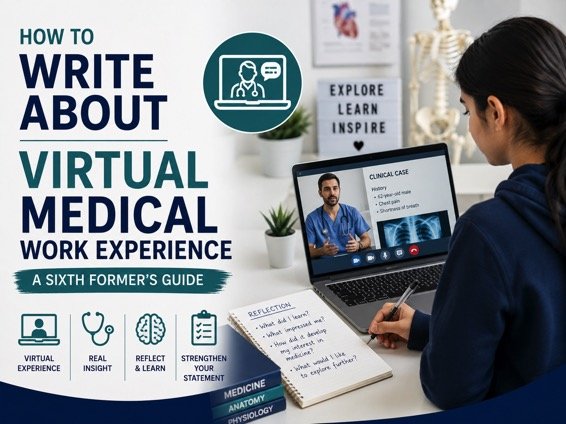
So you've finished Observe GP or worked your way through the Brighton and Sussex Medical School virtual course. You've got pages of notes, a certificate, and a nagging question: how on earth do I actually write about this?
You're not alone. Thousands of sixth form students complete virtual medical work experience every year, but very few know how to turn it into something that genuinely strengthens a medical school application. The good news? Admissions tutors don't care whether your experience happened on a hospital ward or on your laptop at the kitchen table. What they care about is what you learned — and how well you can reflect on it.
This guide walks you through exactly how to write about virtual work experience in your personal statement, your interviews, and your reflective diary.
Does Virtual Work Experience Actually Count? 🩺
Yes — and this isn't just wishful thinking. The Medical Schools Council, which represents every UK medical school, explicitly lists virtual schemes such as Observe GP (run by the Royal College of General Practitioners) and the BSMS Virtual Work Experience as valid ways to gain insight into medicine.
Medical schools moved away from expecting weeks of hospital shadowing years ago. They know that not every student has a parent who works in healthcare or lives near a teaching hospital. What they now look for is relevant experience — anything that helps you understand what a caring profession involves and develops qualities like empathy, communication and teamwork.
The catch? Because virtual experience is accessible to everyone, simply doing it isn't impressive. Writing about it well is where you stand out.
The Golden Rule: Reflection Beats Description ✍️
Here's the single most important idea in this whole article:
Admissions tutors don't want to know what you watched. They want to know what it taught you.
Compare these two sentences:
❌ "I completed Observe GP, where I watched consultations covering topics such as mental health and chronic disease."
✅ "Watching a GP adapt her language for an anxious patient during Observe GP showed me that communication in medicine isn't about explaining well — it's about listening first."
The first sentence is a receipt. The second is a reflection. One proves you clicked through some videos; the other proves you think like a future doctor.
Use a Reflective Framework (Without Making It Obvious)
A simple structure to shape every example you write:
- What happened? — One brief, specific moment. Not the whole course.
- What did it make you think or feel? — Surprise, discomfort, admiration?
- What did you learn about medicine? — Link it to a real quality: teamwork, resilience, ethics, communication.
- What did you do next? — Did it prompt you to read something, volunteer, or change how you behave in your part-time job?
That final step is the one most students miss, and it's the one that impresses most. It shows initiative and genuine curiosity rather than box-ticking.
Writing About Virtual Work Experience in Your Personal Statement 📄
Be Specific, Not Sweeping
The personal statement for medicine now asks you directly how you've prepared for the course, so vague claims won't survive contact with an admissions tutor. Avoid catch-all lines like "virtual work experience deepened my passion for medicine." Instead, zoom in on one or two concrete moments:
- A consultation that surprised you
- An ethical dilemma a doctor described
- A moment of teamwork between professionals you hadn't expected
- Something that challenged a rosy assumption you held about being a doctor
Example in Action
"During the BSMS virtual work experience, a psychiatrist described balancing a patient's autonomy against their safety. It unsettled my assumption that doctors simply 'fix' problems — sometimes the hardest skill is knowing when not to act. This led me to read about the Mental Capacity Act and shaped how I support residents during my care home volunteering."
Notice how that example names the scheme once, then moves swiftly to insight and action. That's the ratio to aim for: roughly 20% description, 80% reflection.
Pair Virtual Experience With Real-World Action 🤝
Virtual experience is strongest when it's the starting point of a story, not the whole story. The Medical Schools Council is clear that caring roles — volunteering in a care home, helping at a food bank, a Saturday job in a shop — count as relevant experience because they develop the same core skills.
So connect the dots. If Observe GP taught you about communicating with elderly patients, show how you applied that insight while volunteering. This combination — online insight plus hands-on people skills — is far more convincing than either alone.
Words and Phrases to Avoid 🚫
- "Passion for medicine" (everyone says it; nobody believes it)
- "Fascinating insight" (show the insight instead)
- "Confirmed my desire to study medicine" (reflection isn't a rubber stamp)
- Long lists of every module you completed (one strong moment beats six weak ones)
Talking About Virtual Work Experience at Interview 🎤
If you mention a virtual scheme anywhere in your application, expect questions on it. "What did you learn from Observe GP?" is a genuinely common interview question — and a gift, if you've prepared.
Keep a Reflective Diary While You Study
The RCGP provides a free reflective diary alongside Observe GP, and it's worth using from day one. After each module, jot down:
- One moment that stuck with you (and why)
- One quality you saw demonstrated — empathy, leadership, honesty
- One question the module raised that you'd like to explore
Come interview season, this diary becomes your revision bank. Instead of desperately trying to remember videos you watched eight months ago, you'll have a page of ready-made, personal examples.
Answering Honestly About Limitations
A sharp interviewer might ask: "Isn't virtual experience a bit limited compared to being on a ward?" Don't panic, and don't get defensive. A mature answer acknowledges the limitation and shows what you did about it:
"Virtual experience can't replicate the atmosphere of a ward or the unpredictability of real patients — which is exactly why I paired it with volunteering. But it gave me structured access to specialties I could never have shadowed at sixteen, and time to reflect properly on each one."
That answer demonstrates self-awareness, honesty and initiative — three qualities medical schools prize far more than an impressive-sounding placement.
Common Mistakes Sixth Formers Make ⚠️
Mistake 1: Treating the Certificate as the Achievement
The certificate proves attendance. Your writing has to prove learning. If a paragraph could have been written by someone who skipped every video, rewrite it.
Mistake 2: Exaggerating
Never claim virtual experience was in person, and never inflate what you saw. Interviewers probe details, and honesty is a core value of the profession you're applying to join. There is nothing embarrassing about virtual experience — medical schools endorse it.
Mistake 3: Cramming Everything In
You may have completed Observe GP, the BSMS course, a Springpod programme and a webinar series. Brilliant — but your personal statement isn't a CV. Choose the one or two experiences that genuinely changed how you think, and give them room to breathe.
Mistake 4: Forgetting the "So What?"
Every sentence about work experience should survive the "so what?" test. If a tutor could read it and reasonably ask "so what?", you haven't finished the thought.
Quick Checklist Before You Submit ✅
- Have I described specific moments rather than whole courses?
- Does every example end with what I learned or did next?
- Have I linked virtual insight to real-world experience where possible?
- Is my description-to-reflection ratio roughly 20/80?
- Could I talk about each example for two minutes at interview?
- Is everything I've written completely honest?
If you can tick all six, your virtual work experience is doing exactly what it should: proving you understand medicine, and that you're already thinking like someone who belongs in it.
Final Thoughts 💭
Virtual medical work experience levelled the playing field for aspiring doctors — no connections or postcode lottery required. But the levelling cuts both ways: when everyone has access to the same schemes, the students who stand out are the ones who reflect deeply, write specifically and act on what they learn.
Watch carefully. Note honestly. Reflect properly. Then write about it like the future doctor you're planning to become.
Useful Links 🔗
- Medical Schools Council — Work Experience Guidance: https://www.medschools.ac.uk/for-students/applying-to-medical-school/work-experience/
- Medical Schools Council — Guidance on Relevant Work Experience: https://www.medschools.ac.uk/latest/publications/guidance-on-relevant-work-experience/
- Observe GP — Royal College of General Practitioners: https://www.rcgp.org.uk/your-career/work-experience
- Brighton and Sussex Medical School — Virtual Work Experience: https://www.bsms.ac.uk/about/info-for-schools-teachers-parents/outreach-activity-and-resources-for-all.aspx
- NHS Health Careers — Applying to Medical School: https://www.healthcareers.nhs.uk/
- UCAS — Applying for Medicine: https://www.ucas.com/